TEHRAN: Pakistan’s Chief of Army Staff, Field Marshal Syed Asim Munir, has emphasised the need for dialogue, de-escalation, and peaceful resolution of outstanding issues through sustained diplomatic engagement, as he concluded a three-day official visit to Iran, where he held high-level meetings with the country’s political and military leadership.
Pakistan’s military media wing, ISPR, said on Saturday that Field Marshal Syed Asim Munir has concluded his three-day official visit to the Islamic Republic of Iran.
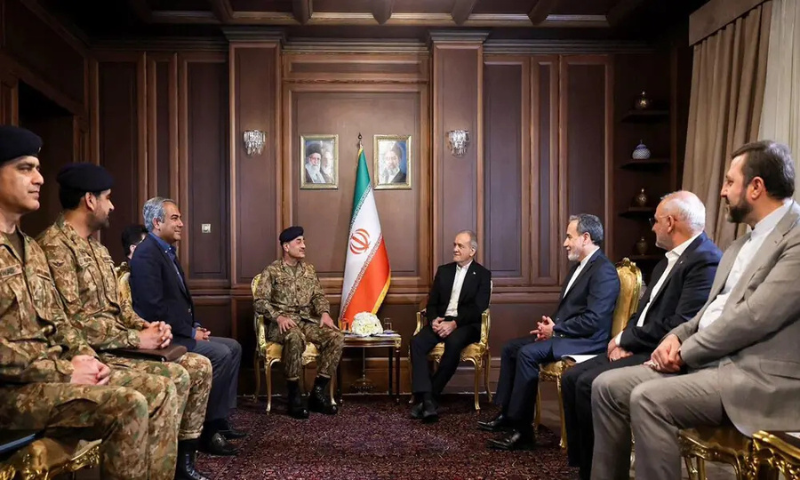
During the visit, the Field Marshal called on Iran’s President, Dr Masoud Pezeshkian, and held separate meetings with Speaker of the National Assembly Mohammad Bagher Ghalibaf, Foreign Minister Abbas Araghchi, and Commander of Khatam ul Anbiya Headquarters Major General Ali Abdollahi, ISPR said.
1/3
President @depezeshkian in a meeting with Pakistan’s Army Chief: Pakistan’s responsible role in moving toward a ceasefire is notable. Iran seeks peace, stability, and brotherly ties in the region. Unity of the Islamic Ummah will block the Israeli regime’s objectives. https://t.co/jO5fjXSudS pic.twitter.com/syJqQDcuoO— Government of the Islamic Republic of Iran (@Iran_GOV) April 16, 2026
ISPR added that the discussions were “focused upon bringing sustainable peace to the region, with particular emphasis on the evolving regional security environment, ongoing diplomatic engagements, and collaborative measures aimed at promoting enduring peace and stability in the region.”
The Field Marshal expressed deep appreciation for the warm hospitality extended by the Iranian leadership and the people of Iran, conveying sincere regards and best wishes from the President, the Prime Minister, and the people of Pakistan to the Iranian leadership, while reaffirming Islamabad’s desire to further strengthen the historic and brotherly ties between the two countries.
The visit reflects Pakistan’s unwavering resolve to facilitate a negotiated settlement to the Middle East conflict and to promote peace, stability, and prosperity in the region.
He also visited the Khatam al-Anbiya Central Headquarters, where he was received by its commander, Major General Ali Abdollahi.
The visit comes at a critical juncture, with a Pakistan-brokered ceasefire between Iran and the United States due to expire on April 22.
Officials familiar with the diplomacy said the talks in Tehran focused on sustaining the truce, reducing differences, and preparing the ground for a second round of negotiations between the United States and Iran.
Field Marshal Asim Munir, Pakistan’s Army Chief, who arrived in #Iran yesterday, met and held talks with President @drpezeshkian. pic.twitter.com/CkIrmdqNFK
— Government of the Islamic Republic of Iran (@Iran_GOV) April 16, 2026
Diplomatic sources said Pakistan has remained in continuous contact with both sides since the initial round of talks in Islamabad last weekend. Munir’s visit is seen as part of a broader effort to build confidence and prevent a return to hostilities.
3/3
President Pezeshkian: The U.S. will not prevail in this conflict. Regional and global actors will bear serious costs, while the Israeli regime alone seeks to advance its own ambitions. pic.twitter.com/y0Mug1RkRv— Government of the Islamic Republic of Iran (@Iran_GOV) April 16, 2026
Pakistan’s diplomatic outreach has also included coordination with key international partners. Deputy Prime Minister and Foreign Minister Ishaq Dar has held consultations with counterparts in the United Kingdom, China, Turkiye, Saudi Arabia, and Egypt to consolidate support for the process.
Developments in Lebanon, including a recent ceasefire, are also feeding into the broader regional calculus, with Tehran assessing both the evolving situation and the credibility of US commitments before proceeding further.
Against this backdrop, US President Donald Trump said on Thursday that Washington and Tehran were “very close” to a deal and suggested he could travel to Islamabad if an agreement is finalised there.
“If the deal is signed in Islamabad, I might go. Pakistan has been great,” Trump told reporters at the White House before departing for Nevada and Arizona.
He claimed that Iran had “agreed to almost everything” in negotiations aimed at ending the conflict, including steps related to its nuclear programme, though he did not provide details.
Trump also signalled that talks could resume soon and warned that failure to reach an agreement could lead to renewed fighting. “If there’s no deal, fighting resumes,” he said.
A two-week ceasefire, brokered with Pakistan’s help, remains in effect for now, with efforts underway to extend it or convert it into a more durable arrangement.
As diplomatic activity intensifies, Islamabad is increasingly emerging as a central venue for negotiations, with officials on all sides looking to Pakistan’s mediation to help steer the process towards a potential agreement.