Key Points
- Agreements cover desalination, agricultural technology and tea sector collaboration
- Karachi desalination project aims to boost potable water supply
- Agri-tech cooperation to support productivity and technology transfer
- Tea sector pact targets trade expansion and industry development
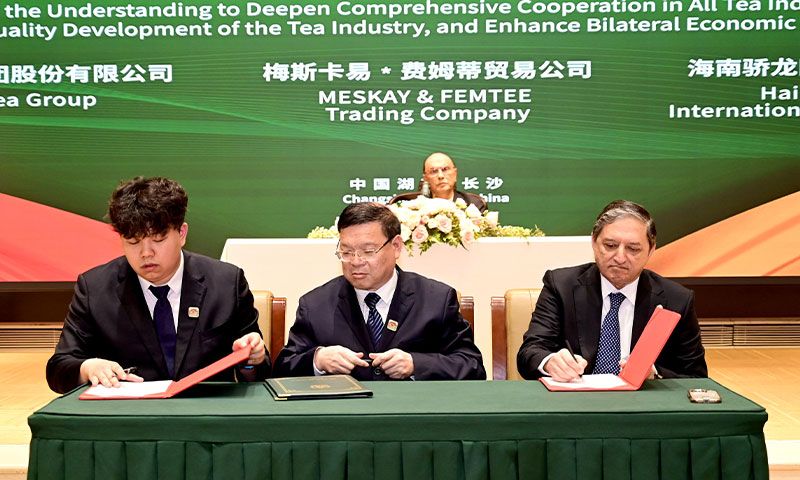
ISLAMABAD: Pakistan and China have signed three Memorandums of Understanding (MoUs) covering desalination, agricultural technology, and tea cooperation at a ceremony in Changsha, Hunan Province and witnessed by visiting President Asif Ali Zardari.
The agreements reflect a joint effort to advance practical collaboration in key sectors with direct economic impact, as both countries expand engagement beyond traditional infrastructure cooperation.
The first MoU was signed between the Sindh Local Government Department and Lucion Environmental Technology Group for a seawater desalination project in Karachi.
The initiative is aiming to convert seawater into potable water to help address the city’s growing water needs.
The second MoU, concluded between the Sindh Local Government Department and Long Ping Hi-Tech Information Company, focuses on cooperation in agricultural technology.
The partnership is expected to facilitate modern farming practices, enhance productivity and support technology transfer.
The third MoU relates to the tea sector and was signed between MESKAY & FEMTEE Trading Company, Hunan Tea Group and Jiaolong International Technology.
It aims to promote cooperation across the tea value chain, strengthen trade links and support industry development in both countries.
Officials present at the ceremony included Sindh Senior Minister Sharjeel Inam Memon, Special Assistant for Investment and Public-Private Partnership Qasim Naveed Qamar, Chief Secretary Ali Hasan Barohi and Pakistan’s Ambassador to China Khalil Hashmi.
Pakistan and China share a longstanding strategic partnership anchored in economic cooperation under the China-Pakistan Economic Corridor.
In recent years, bilateral engagement has expanded into agriculture, water management and industry, with increasing emphasis on technology-driven and private-sector-led initiatives.
President Zardari’s ongoing visit to China is aimed at further strengthening bilateral ties, attracting investment and accelerating sector-specific cooperation.
The latest agreements highlight a shift toward targeted, project-based collaboration designed to deliver tangible outcomes in urban services, food security and export-oriented industries.