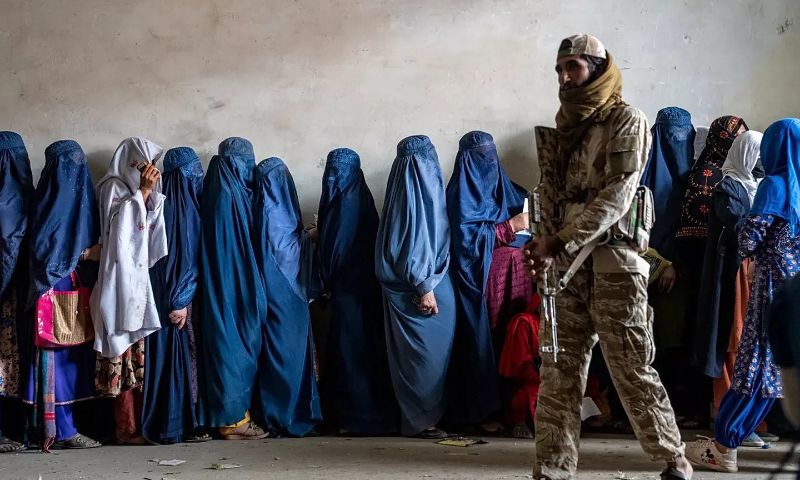
KABUL, Afghanistan: Taliban regime morality police detained at least 20 Afghan women and girls in Kabul’s Taimani area on Saturday, with several of those detained saying they were taken into custody despite wearing hijab, Amu TV reported.
The women told the Afghan broadcaster that some detainees were beaten during the arrests. A witness said a pregnant woman was among those detained and alleged that she was beaten and dragged away despite her husband’s pleas that she not be harmed, Amu TV reported.
Footage obtained, according to Amu TV, showed Taliban regime morality police, accompanied by female personnel, forcing women and girls into a vehicle.
ویدیو؛ بازداشت یک زن افغان بهدلیل حجاب مورد نظر ط/ن
گزارشها میگویند روند بازداشت زنان افغان به اتهام رعایت نکردن حجاب مورد نظر اداره امر به معروف ط/ن در خیابانها همچنان ادامه دارد. pic.twitter.com/UwmwJKk9UN
— Saranwal Ali ⚖︎ (@PROSECUTOR_ALI) September 14, 2026
One woman interviewed by Amu TV said she resisted when the Taliban regime members tried to take her into custody. She alleged that she was slapped and struck in the face after refusing to wear a face mask.
She said she resisted for several minutes before a male member of the Taliban regime personnel intervened and took her away.
Another witness told Amu TV that about 20 women had been detained and that a woman who was two or three months pregnant was among them. The witness alleged that the Taliban regime personnel hit and dragged the woman away despite her husband’s pleas.
The women were reportedly later released after their families and local community representatives provided guarantees for them, according to sources cited by Amu TV.
Taliban regime did not respond to Amu TV’s questions about the detentions, the reasons for the arrests or allegations that some women were beaten.
A video circulating on social media on Monday showed a woman resisting as two other women attempted to force her into a white van. Kabul residents told Afghanistan International that the footage showed Taliban regime forces detaining a woman.
On Saturday evening, 12 September, at least eight women were detained in Kabul’s Taimani area. A Kabul resident told Afghanistan International that they had witnessed the detentions.
Two days later, on Monday, 14 September, a video circulated on social media showing a woman… pic.twitter.com/ddhXYb8NFv— Afghanistan International English (@AFIntl_En) September 14, 2026
The Taliban regime’s morality police have previously used white vans in operations to detain women, according to reports.
Former Afghan parliamentarian Fawzia Koofi criticised the treatment of women and restrictions on their rights at an online event on Sunday. She said Afghan women had been left isolated under Taliban rule and criticised restrictions on girls’ education.
The reported Kabul detentions come after a similar crackdown in western Herat province in June.
The United Nations Assistance Mission in Afghanistan (UNAMA) said at least 30 women were arrested in Herat between June 6 and 7 by members of the Taliban regime for allegedly violating dress-code instructions.
The women were released on June 8, but UNAMA expressed concern over arbitrary arrests and their impact on women and their families.
UNAMA also said the Taliban regime forces used excessive force against residents who protested the arrests in Herat on June 9. The UN confirmed that at least one person, a boy, was killed by gunfire and said it was verifying reports of a second death.
Human Rights Watch said Taliban regime forces beat protesters and fired towards crowds during the Herat demonstration, killing a child and injuring others. It said the protest followed the arrests of women accused of violating the authorities’ dress code.
The detentions come amid continuing international concern over restrictions imposed by the Taliban regime on Afghan women and girls since the group returned to power in 2021.
In a statement issued last week, UN Secretary-General Antonio Guterres said he remained deeply concerned by the Taliban’s discriminatory policies affecting women and girls, including restrictions on their participation in public life, education and many areas of work.