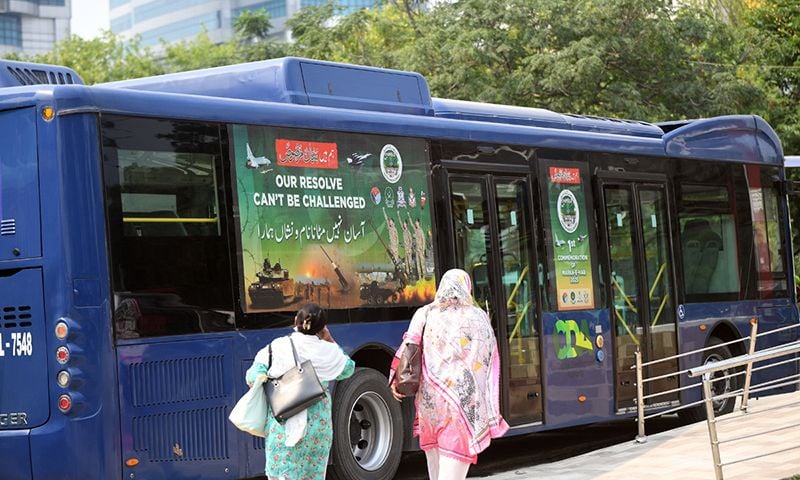
ISLAMABAD: Electric buses plying the roads of Pakistan’s capital Islamabad make virtually no noise and no rattle, but the message inscribed on them is very loud: “We are Bunyan-um-Marsoos (Iron Wall)” and “Our resolve can’t be challenged.”
Dressed in bright blue, green, and sky blue, these buses have been transformed into moving symbols of courage and national pride. Covered with colourful panaflex posters commemorating the first anniversary of Marka-e-Haq and Operation Bunyan-um-Marsoos, they are catching the attention of commuters, sparking conversations across the city, and reigniting a deep sense of patriotism among residents of Islamabad.
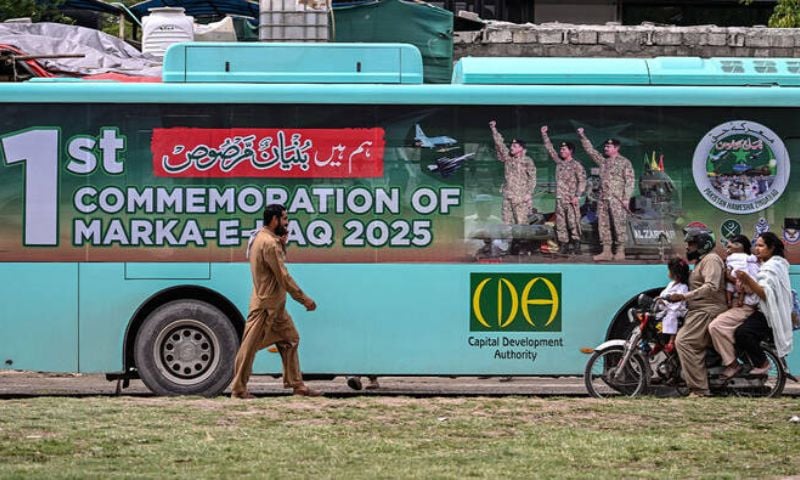
As early May 2026 unfolds, Pakistan’s capital finds itself at the intersection of technological progress and patriotic remembrance. The city’s public transport system, now operating 160 electric buses on 21 routes, serving over 90,000 daily passengers, has become an unlikely gallery of heroism.
Among the busiest stops, including the key PIMS hospital junction, several buses feature bold inscriptions and dramatic imagery celebrating what many call Pakistan’s decisive military and diplomatic triumph.
How Islamabad’s quiet buses became loud symbols of bravery
The posters on display throughout Islamabad mark the first anniversary of Marka-e-Haq (The Battle of Truth) and Operation Bunyan-um-Marsoos, a defining moment in modern Pakistani history.
The operation established Pakistan’s military power on the global stage, not merely through ground and air superiority, but through strategic coordination that shattered conventional expectations.
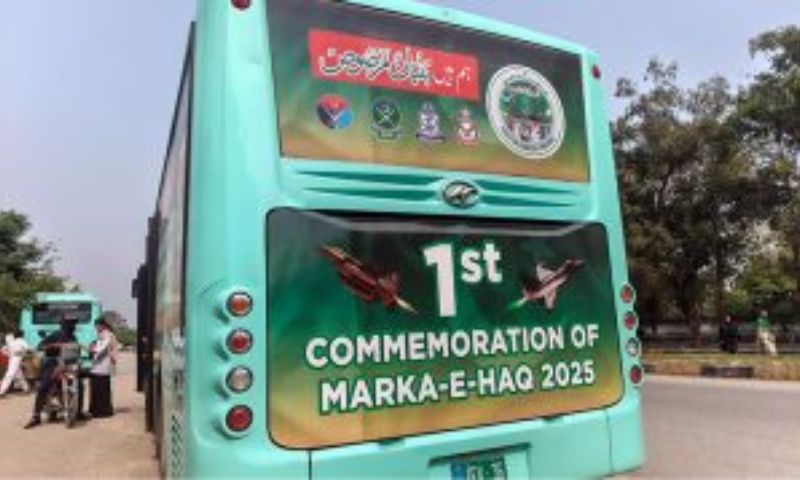
The most striking element of the campaign, prominently highlighted on the blue and green line EV bus posters across Islamabad, remains the performance of the Pakistan Air Force (PAF). In a series of swift and decisive engagements, PAF fighter jets downed nine Indian aircraft, including multiple Dassault Rafale jets, widely considered one of the world’s most advanced and expensive multirole fighters.
For many passengers traveling through Pakistan’s capital, seeing those numbers and images on their daily commute is both startling and stirring.
Passenger voices: Pride on the move
At the PIMS bus stop in Islamabad, a crowd of commuters gathered around an electric bus wrapped in green-and-white artwork, snapping photos before boarding.
“I saw the number, nine Indian jets, including Rafales, and I had to double-check,” said Ahmed Raza, a 34-year-old software engineer waiting to board a bus. “but seeing it on a public bus in Pakistan’s capital on my way to work makes it feel real. It reminds me that our forces didn’t just fight, they dominated.”
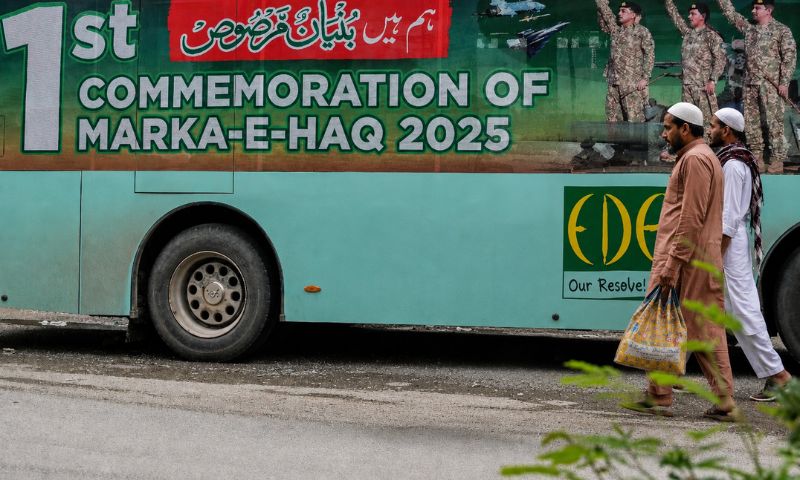
Inside another bus traversing Islamabad, the atmosphere was reflective yet proud. A poster near the driver’s seat showed silhouettes of PAF jets with the caption: “Bunyan-um-Marsoos: Where Truth Met Triumph.”
“I bring my son to school on this bus every morning,” said Farzana Kausar, a 41-year-old government employee. “He asks me what the pictures mean. I tell him these are the heroes who made Pakistan untouchable. It’s not just a poster, it’s a lesson.”
For some passengers moving through Pakistan’s capital, the electric buses themselves add symbolic weight to the message.
“We are moving toward the future, clean energy, modern transport, but we haven’t forgotten our roots or our sacrifices,” said Bilal Ahmed, a university student. “The bus is electric, but the energy inside is pure patriotism.”
More than a billboard in Islamabad
The decision to display these commemorative posters on public transport across Islamabad by authorities is to mark the first anniversary of Marka-e-Haq alive in everyday spaces. Unlike traditional military parades or official ceremonies, the bus campaign brings the narrative directly to the people of Pakistan, from students to shopkeepers, from professionals to pensioners.
One poster, photographed on a bus traveling along Park Road, reads: “One Year of Marka-e-Haq, Pakistan’s power established across the world. PAF: Nine down. Rafale down. Pride up.”
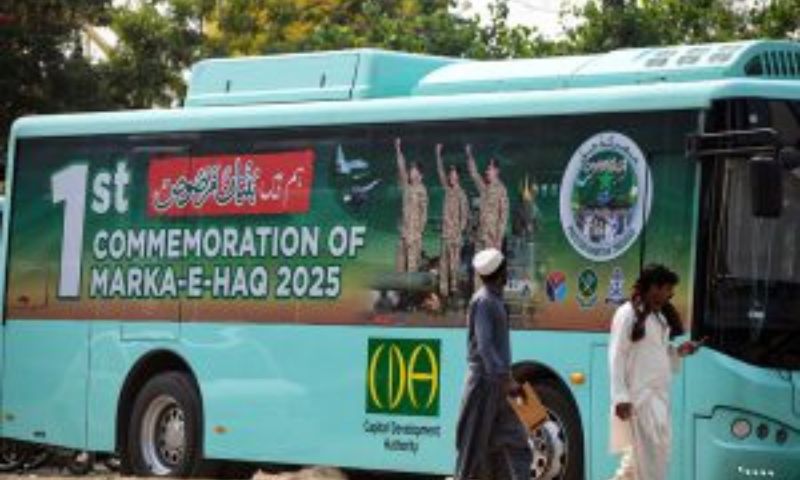
Another, spotted on a bus in the I-8 sector, features a map of the region with stars marking operational successes, alongside the words: “Bunyan-um-Marsoos: The operation that echoed beyond borders.”
As the buses glide silently through the streets of Pakistan’s capital, their electric motors humming beneath bold declarations of aerial and military supremacy, one thing is clear: in Islamabad, even public transport has a story to tell. And this month, that story is of Marka-e-Haq, of Bunyan-um-Marsoos, and of skies made safe by the men in uniforms.