Key Points
- US Navy used F/A-18 jets to stop tankers, with more than 50 vessels redirected.
- US and Iran exchanged fire near the Strait of Hormuz despite a fragile ceasefire.
- US has proposed a 14-point peace plan including limits on Iran’s nuclear programme.
- Iran is reviewing the proposal but has not yet given a formal response.
TAMPA: The US Central Command (CENTCOM) confirmed on Friday that American forces have disabled two more vessels, the M/T Sea Star III and M/T Sevda, in the Gulf of Oman over the blockade on Iran.
“US Central Command (CENTCOM) enforced blockade measures against two Iranian-flagged unladen oil tankers attempting to pull into an Iranian port on the Gulf of Oman,” CENTCOM in a statement said.
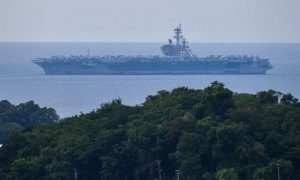
It said that a US Navy F/A-18 Super Hornet operating from the USS George H.W. Bush (CVN 77) disabled both tankers by firing precision munitions into their smokestacks, preventing the vessels from entering Iran.
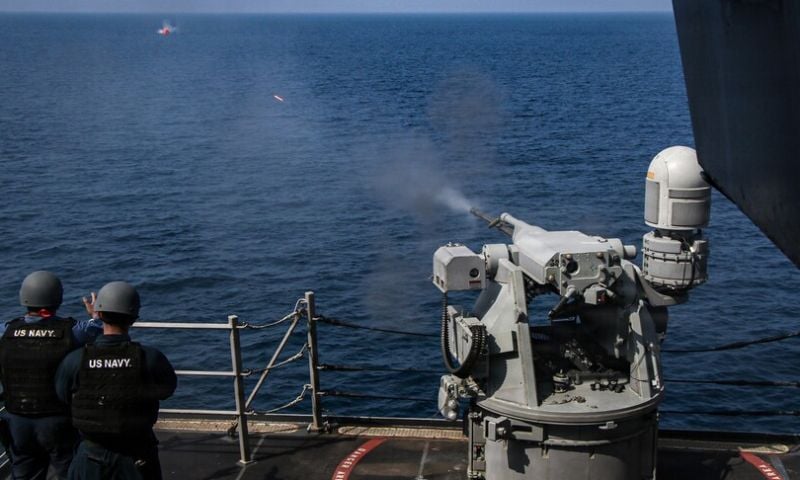
Separately, US forces also disabled the Iranian-flagged M/T Hasna on 6 May as it attempted to sail towards an Iranian port in the Gulf of Oman. “An F/A-18 Super Hornet from the USS Abraham Lincoln (CVN 72) disabled the empty oil tanker’s rudder using 20mm cannon fire,” the statement said.
“All three vessels are no longer transiting to Iran,” it confirmed.
— U.S. Central Command (@CENTCOM) May 8, 2026
“US forces in the Middle East remain committed to full enforcement of the blockade of vessels entering or leaving Iran,” said Adm. Brad Cooper, CENTCOM commander. “Our highly trained men and women in uniform are doing incredible work.”
Multiple commercial vessels have been disabled and more than 50 have been redirected by CENTCOM forces to ensure compliance.
There are currently more than 70 tankers that U.S. forces are preventing from entering or leaving Iranian ports. These commercial ships have the capacity to transport over 166 million barrels of Iranian oil worth an estimated $13 billion-plus. pic.twitter.com/VBKfDwMwqJ
— U.S. Central Command (@CENTCOM) May 8, 2026
US, Iran exchange fire in Hormuz
Earlier on Thursday, the United States and Iran exchanged fire in and around the Strait of Hormuz on Thursday, marking the most serious confrontation since a ceasefire between the two countries came into effect last month.
Despite the escalation, both Washington and Tehran indicated they were seeking to avoid a broader military conflict.
Before the recent hostilities, the strait handled nearly one-fifth of global oil and gas supplies, making it one of the world’s most strategically important energy corridors.
Iranian officials accused the US of violating the ceasefire by targeting vessels in the strategically vital waterway and launching strikes on Iranian territory, while the US military said it acted in response to Iranian attacks involving missiles, drones, and armed boats aimed at American naval assets.
US President Donald Trump attempted to downplay the incident, insisting that the ceasefire remained intact despite the exchange of fire.
President Trump posts on TruthSocial: Three World Class American Destroyers just transited, very successfully, out of the Strait of Hormuz, under fire. There was no damage done to the three Destroyers, but great damage done to the Iranian attackers.
They were completely… pic.twitter.com/HzxCey8tHh
— Donald J Trump Posts TruthSocial (@TruthTrumpPost) May 7, 2026
US expects Iran’s response to peace proposal by Friday: Rubio
US Secretary of State Marco Rubio has said Washington expects to receive a response from Iran on Friday regarding a US proposal aimed at ending the conflict.
“We’re expecting a response from them today at some point… I hope it’s a serious offer, I really do,” Rubio told reporters in Rome.
“We’ll see what the response entails. The hope is it’s something that can put us into a serious process in negotiation.”
“We’ve seen a report overnight that Iran has established, or trying to establish, some agency that’s going to control traffic in the straits. That would be [a] problem. That would actually be unacceptable,” said Rubio.
Iran reviewing US peace proposal
Earlier, Iran said it is currently reviewing a United States peace proposal aimed at ending the war, even as both sides exchanged fire in the Strait of Hormuz on Thursday.
According to US media reports, Washington recently sent Iran a 14-point proposal outlining conditions for a potential agreement. The plan reportedly requires Iran to pledge that it will not develop nuclear weapons and to suspend all uranium enrichment for at least 12 years. It would also need to transfer an estimated 440 kilograms (970 pounds) of uranium enriched to 60 percent.
In exchange, the United States would gradually ease sanctions, release billions of dollars in frozen Iranian assets, and lift its naval blockade of Iranian ports.
The proposal also suggests that both sides—currently in a naval standoff in the Strait of Hormuz—would reopen the strategic waterway within 30 days of signing any agreement.
Iran has not yet issued a formal response to the latest US proposal, although senior Iranian officials have already pushed back against it.