
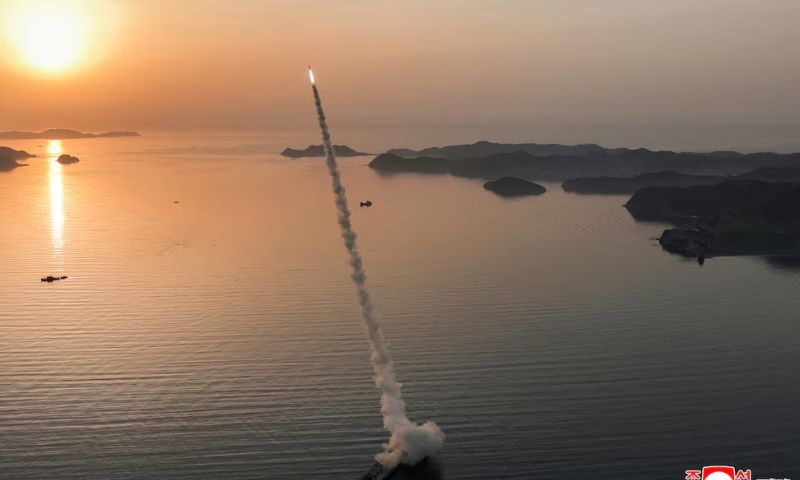
SEOUL: North Korean leader Kim Jong Un personally supervised a new round of ballistic missile tests on Sunday, focusing on evaluating advanced warheads equipped with cluster munitions and fragmentation mines, according to state media reports released on Monday.
The launches mark North Korea’s fourth ballistic missile test this month and its seventh so far this year, underlining Pyongyang’s continued push to expand its missile and nuclear capabilities despite longstanding United Nations Security Council restrictions.
The exercise involved five firings of upgraded short-range Hwasong-11 Ra surface-to-surface tactical ballistic missiles, designed to assess both the destructive power and operational performance of newly developed warheads.
According to Reuters quoting the Korean Central News Agency (KCNA), the missiles were launched towards a designated island target approximately 136 kilometres away. The strikes reportedly hit an area spanning roughly 12.5 to 13 hectares with high concentration, demonstrating what the regime described as an ability to carry out “dense and precise suppression strikes” over a defined battlefield zone.
South Korea’s military confirmed that the missiles were fired early Sunday morning from near the eastern coastal city of Sinpo, travelling towards the sea. In response, the presidential office in Seoul condemned the launches, urging Pyongyang to halt what it termed provocative actions that heighten tensions on the Korean Peninsula.
Officials in Seoul also noted an “unusually large presence” of frontline military commanders observing the test, suggesting the exercise was linked to North Korea’s broader strategy of strengthening deterrence through the forward deployment of tactical missile systems.
Analysts believe this could significantly increase the threat to major South Korean urban centres, including Seoul, as well as key United States military installations in the region.
The Korean Peninsula remains technically in a state of war, as the 1950–53 Korean War ended with an armistice rather than a formal peace treaty. Against this backdrop, such missile tests continue to carry serious geopolitical implications.
KCNA reported that Kim expressed satisfaction with the outcome of the tests, describing them as validation of years of research by specialised weapons development teams. He reportedly called on defence scientists to accelerate efforts to further enhance the country’s military readiness and technological capabilities.
Photographs released alongside the report showed Kim observing the launches with his daughter, widely believed to be Ju Ae, accompanied by senior military officials. Her repeated appearances at high-profile military events have intensified speculation about a potential future leadership role.
Earlier this month, North Korea also conducted tests involving a new cluster-type warhead and an electromagnetic weapon, moves that experts interpret as part of a broader attempt to demonstrate preparedness for modern, high-intensity warfare.
International reaction has been critical. The United Kingdom’s Foreign Office condemned the latest launches and urged Pyongyang to return to meaningful diplomatic engagement. Meanwhile, regional experts warn that these developments indicate a clear intent by North Korea to enhance strike precision, expand operational reach, and increase overall lethality.
Some analysts suggest that ongoing global conflicts, including recent tensions involving Iran, may be reinforcing North Korea’s determination to strengthen its own nuclear and missile programmes. In late March, Kim reiterated that the country’s nuclear status is “irreversible” and emphasised the importance of expanding what he described as a “self-defensive nuclear deterrent”.