MUZAFFARABAD: The Azad Jammu and Kashmir (AJK) government on Tuesday ruled out any blanket amnesty for leaders of the banned Joint Awami Action Committee (JAAC), saying they would have to face legal action for their involvement in the recent violence and deaths.
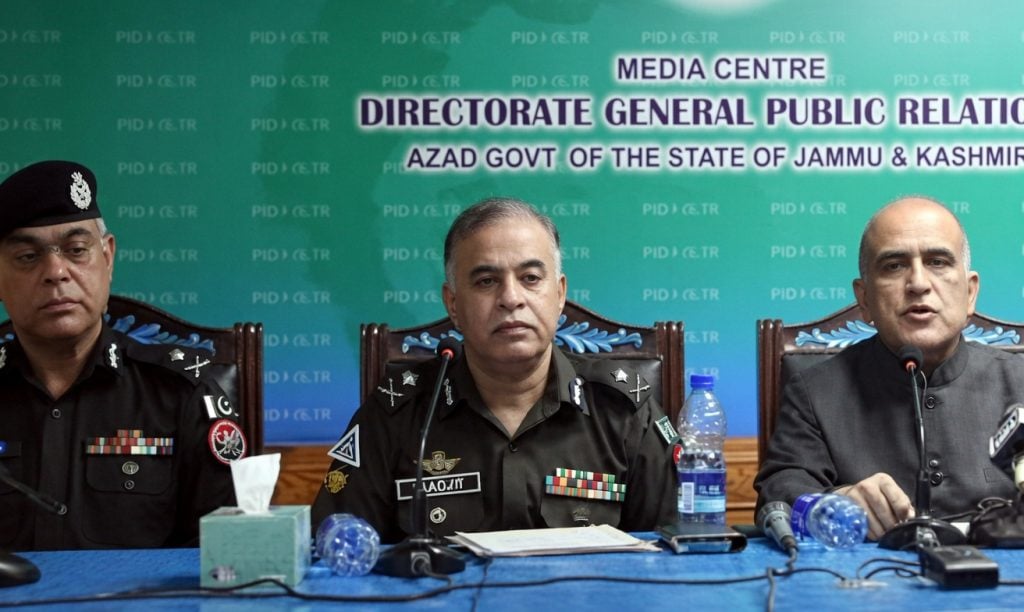
Addressing a joint press conference alongside Inspector General of Police (IGP) Liaqat Ali Malik, Chief Secretary Khushal Khan said the Joint Awami Action Committee leadership had become divided after their involvement in disruptive activities and violence.
“There will be no blanket amnesty,” the Chief Secretary said, adding that the leadership of the proscribed group would have to face the consequences of the deaths and violence linked to its disruptive activities.
Chief Secretary Khushal Khan said the government had offered the banned JAAC several constitutional options to pursue its demand regarding the 12 Legislative Assembly seats reserved for refugees from Indian Illegally Occupied Kashmir, including an all-parties conference, an assembly session and recourse to the courts.
He said that while the government had kept all channels of dialogue open, the banned group had expanded its demands from two points to 38, and then added further demands.
Parliamentary Affairs Minister Tariq Fazal Chaudhry has maintained that 35 out of 38 demands of the banned JAAC, agreed between it and the government last October, had been fulfilled.
During the press conference, Chief Secretary Khushal Khan said road blockades and violent activities were unacceptable, adding that highways had been blocked by felling trees and that trucks carrying goods had been stopped and burned in some areas.
He also said that an attempt had been made in Rawalakot to hijack trucks carrying relief supplies, which were later recovered by law enforcement agencies.
Khan said maintaining subsidised flour and electricity rates had imposed a heavy financial burden on the government. According to him, reducing electricity tariffs to Rs2.75 per unit could result in annual losses of Rs8 billion to Rs10 billion, while subsidies on flour and electricity had required allocations of Rs20 billion to Rs25 billion from the resources of the federal and AJK governments.
The chief secretary said that the banned JAAC leadership was attempting to use women and children as “human shields”.
He said that the government would continue to take constitutional and legal measures to maintain peace and stability.
Speaking on the occasion, Inspector General of Police Liaqat Ali Malik said that activists of the proscribed JAAC had opened fire on police during a routine checkpoint inspection on June 5, resulting in the death of one activist and injuries to JAAC leader Umar Nazir and two police personnel.
He said that a post-mortem examination of the deceased driver had indicated that he was shot in the back of the neck, suggesting that the fatal bullet had come from inside the vehicle.
The police chief further said that banned JAAC activists attacked the Rawalakot Combined Military Hospital (CMH), killing three policemen deployed there for security duties and assaulting patients and medical staff.
He said LEAs would continue action against those involved in “anti-state” activities and would uphold the writ of the state at all costs.
Describing the ongoing protest movement, he contended: “This is not a long march but an organised mobilisation.”
The police chief also said that women and children were being used as human shields, adding that there were reports of weapons being concealed under burqas.
Moreover, the IGP said that those who surrendered unconditionally would be treated fairly under the law.