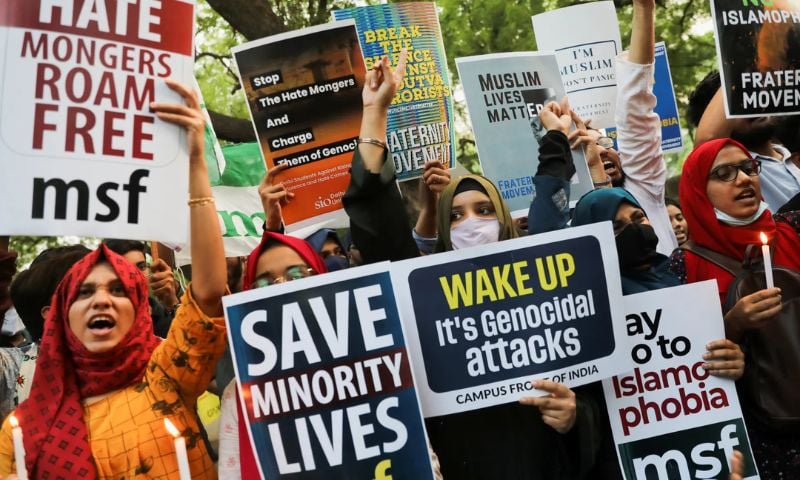
MUMBAI: Members of religious minority communities staged a protest in western India’s Maharashtra state, voicing concern over rising incidents of violence, hate speech and discrimination.
The demonstration took place in Beed city on Friday, coinciding with Maharashtra Foundation Day.
It was organised by the Minority Protection Sangharsh Committee outside the district collector’s office, local media reported.
Participants from various religious minority communities gathered in large numbers to highlight growing insecurity and marginalisation.
Protesters cited incidents of mob lynching, hate speech and inflammatory remarks by political leaders targeting minority groups, according to reports by PTI news agency.
Organisers of the protest called for the introduction of a Minority Protection Law to safeguard vulnerable communities.
They said such legislation should mirror provisions of the Scheduled Castes and Scheduled Tribes (Prevention of Atrocities) Act.
The committee said concerns were extended to all minority communities in India, including Muslims, Buddhists, Sikhs, Christians, Jains, Parsis and Jews.
Participants said the reported incidents had created widespread anxiety among minorities across the state and the country.
Rising hate speech in India
Concerns over hate speech have been highlighted in recent research.
A report released in January 2026 by India Hate Lab (IHL), a Washington-based research initiative, documented 1,318 verified hate speech incidents in 2025, marking a 13 percent increase from 2024 and a 97 percent rise compared to 2023.
According to the report, religious minorities were the primary targets.
Muslims were targeted in 1,289 incidents, accounting for 98 per cent of cases, while Christians were targeted in 162 incidents.
The report also noted that 88 percent of hate speech incidents occurred in states governed by the ruling Bharatiya Janata Party (BJP) or its allies.
It added that incidents often coincided with election periods and major political developments.
India Hate Lab said its findings were based on the United Nations definition of hate speech.
Violence, lynchings, forced evictions and destruction of religious sites
Researchers linked hate speech to real-world violence, including lynchings, forced evictions and destruction of religious sites.
The report documented 308 instances classified as “dangerous speech”, involving explicit or implicit incitement to violence.
It also recorded campaigns promoting economic and social boycotts of minority communities, along with conspiracy narratives.
More than 160 organisations were identified as being linked to hate speech events, many aligned with Hindu nationalist networks, the report said.
International concern over risk of mass violence
International organisations have also raised alarm over the situation. The US Holocaust Memorial Museum’s Early Warning Project ranked India fourth globally for the risk of mass violence in late 2025, estimating a 7.5 per cent probability of large-scale violence before the end of 2026.
Genocide Watch has placed India at Stage 8 (Persecution) on its risk scale, warning of the potential for escalation if conditions worsen.
Human rights groups, including Human Rights Watch, have raised concerns about alleged impunity and lack of enforcement against hate speech, while UN experts have criticised practices such as punitive demolitions affecting minority communities.