


BEIRUT: Lebanon’s military announced on Sunday that it has restored access to several key transport routes in the country’s south, reopening a major road and partially repairing a bridge that had been damaged in recent Israeli air strikes, as a 10-day ceasefire between Israel and Hezbollah remains in effect.
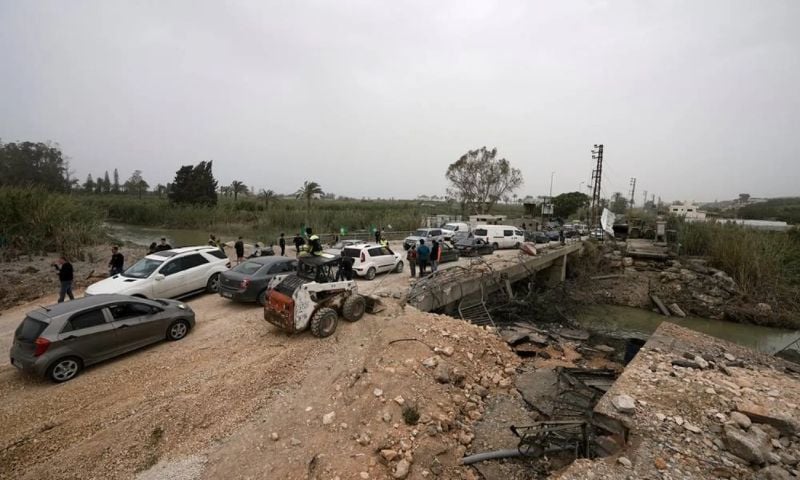
In an official statement, the Lebanese army confirmed it had “fully reopened” the road linking the southern city of Nabatieh with the Khardali region. It also reported that the Burj Rahal–Tyre bridge had been “partially reopened,” enabling some movement across the affected area.
The army added that rehabilitation efforts are ongoing on the Tayr Falsay–Tyre bridge, which also sustained damage during what it described as Israeli aggression. Engineering teams, along with local authorities, are continuing work to restore vital infrastructure disrupted during weeks of hostilities.
According to the military, Israeli strikes targeting bridges over the Litani River — which runs roughly 30 kilometres north of the Israeli border — had effectively severed southern Lebanon from the rest of the country. The destruction of these crossings significantly restricted civilian movement and complicated humanitarian access to the region.
The reopening of routes comes in the wake of a ceasefire that took effect on Friday, following the first direct negotiations between Israel and Lebanon in decades. The truce has brought a temporary halt to weeks of intense clashes between Israeli forces and Hezbollah fighters, a conflict that has resulted in nearly 2,300 fatalities and displaced more than one million people.
Since the ceasefire began, Lebanese authorities have prioritised clearing debris and repairing damaged infrastructure to facilitate the return of displaced residents. Among the key developments was the reopening of the strategic Qasmiyeh bridge on Friday morning, which allowed large numbers of civilians to travel back to southern areas to assess damage to their homes and properties.
Despite these improvements, uncertainty surrounding the durability of the ceasefire continues to weigh heavily on residents. Many remain cautious about returning permanently, fearing a potential resumption of hostilities.
On Saturday, an AFP correspondent in the southern city of Sidon reported heavy traffic heading north towards Beirut, as some displaced individuals chose to return to temporary accommodation in the capital after making brief visits to their hometowns in the south.
Hezbollah official Mahmud Qamati underscored these concerns, warning that the situation remains volatile. “Israeli treachery is expected at any time, and this is a temporary truce,” he said, urging displaced residents to remain cautious. “Take a breath, relax a little, but do not abandon the places you have taken refuge in until we are completely reassured about your return,” he added.
Meanwhile, reports indicate that Israeli forces have continued to conduct limited strikes and demolition operations in parts of southern Lebanon, even after the ceasefire came into force. The Israeli military also announced on Saturday the establishment of a “yellow line” — a demarcation similar to one used in Gaza — intended to separate Israeli-controlled areas from zones held by Hezbollah.
As reconstruction efforts progress, the situation on the ground remains delicate, with the reopening of roads and bridges offering only partial relief to communities still grappling with the aftermath of conflict and the uncertainty of what lies ahead.