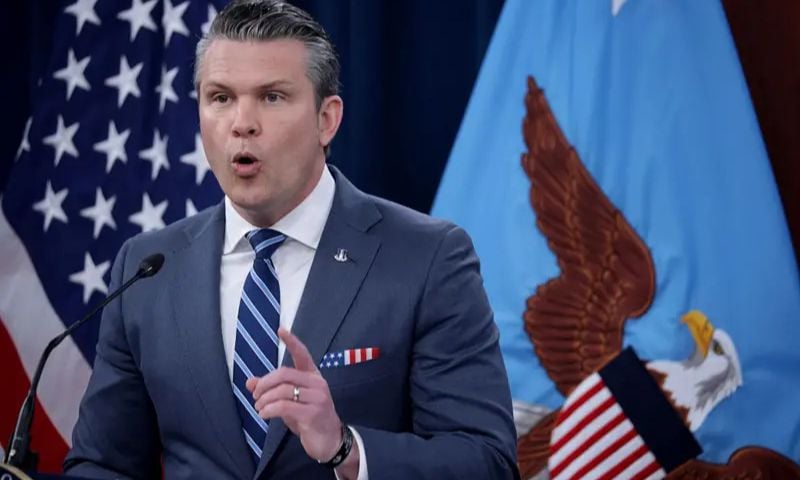



WASHINGTON: Iran’s motivation to maintain a ceasefire with the United States remains “very high” despite damage to its military command structure, US Defence Secretary Pete Hegseth said on Thursday.
Speaking at a Pentagon briefing, Hegseth said Iran’s command capabilities had been degraded following weeks of conflict, but stressed that its willingness to continue the ceasefire remained strong.
Hegseth said the US would continue its naval blockade of Iranian ports “for as long as it takes,” warning of renewed strikes if Tehran “chooses poorly”.
“If Iran chooses poorly, then they will have a blockade and bombs dropping on infrastructure, power and energy,” he said.
General Dan Caine, chairman of the Joint Chiefs of Staff, said the blockade began on April 13 and applies to all vessels entering or leaving Iranian ports, regardless of nationality.
“Enforcement will occur inside Iran’s territorial seas and in international waters,” Caine said.
He said that ships attempting to breach the blockade would face force. He noted that 13 vessels had already turned back, calling it a “wise choice”.
US forces have not yet boarded any ships, but had identified seven vessels of concern at the outset of the blockade, he added.
US forces ready to resume operations
Caine said US forces are ready to resume combat operations “at literally a moment’s notice” under orders from President Donald Trump.
Hegseth said Washington preferred a diplomatic resolution led by Vice President JD Vance, but warned that military options remained on the table.
“This is the polite way this can go,” he said, referring to the blockade. “It can also be done the hard way.”
He also dismissed Iran’s claims of controlling the Strait of Hormuz, accusing Tehran of engaging in “piracy” by threatening commercial shipping.
Admiral Brad Cooper, head of US Central Command, said American forces were using the ceasefire period to rearm and adjust operational tactics.
“We’re rearming, retooling, and adjusting our tactics, techniques and procedures,” Cooper said.
He said Israel has “achieved military objectives over and over again” alongside the United States.
Hegseth also said that Houthi forces in Yemen appeared to be staying out of the conflict so far, calling it a “good decision”.
Pakistan’s diplomatic push for peace
Despite continued military pressure, US officials signalled progress towards a diplomatic agreement with Iran.
On Wednesday, the White House said a second round of talks was “very likely” to take place in Islamabad, highlighting Pakistan’s growing role as a mediator.
Press Secretary Karoline Leavitt said discussions remained ongoing and productive.
“The Pakistanis have been incredible mediators throughout this process,” she said, adding that Washington aimed to streamline communication through Islamabad.
Officials said backchannel contacts were continuing via Pakistani intermediaries.
Pakistan’s mediation efforts
Pakistan has intensified diplomatic engagement to facilitate dialogue between Washington and Tehran.
Prime Minister Shehbaz Sharif met Saudi Crown Prince Mohammed bin Salman in Jeddah, where both leaders reviewed regional developments and efforts to support negotiations.
According to Pakistan’s Prime Minister’s Office, the meeting covered economic cooperation, defence ties and regional security.
Prime Minister Sharif reaffirmed Pakistan’s “unwavering solidarity” with Saudi Arabia and reiterated Islamabad’s commitment to advancing dialogue for “lasting peace and stability”.
Saudi leadership appreciated Pakistan’s role in facilitating the ceasefire and initial talks.
Meanwhile, a delegation led by Pakistan’s Chief of Defence Forces and Chief of Army Staff Field Marshal Asim Munir visited Tehran, carrying a message from Washington and discussing prospects for further talks.
Pakistan-brokered ceasefire holds
The diplomatic push follows a two-week ceasefire after more than a month of conflict involving the United States, Israel and Iran.
US Vice President Vance has described the talks as part of a potential “grand bargain” aimed at ending hostilities and addressing Iran’s nuclear programme.
Washington has proposed a long-term suspension of uranium enrichment, while Tehran insists on its right to civilian nuclear activity.