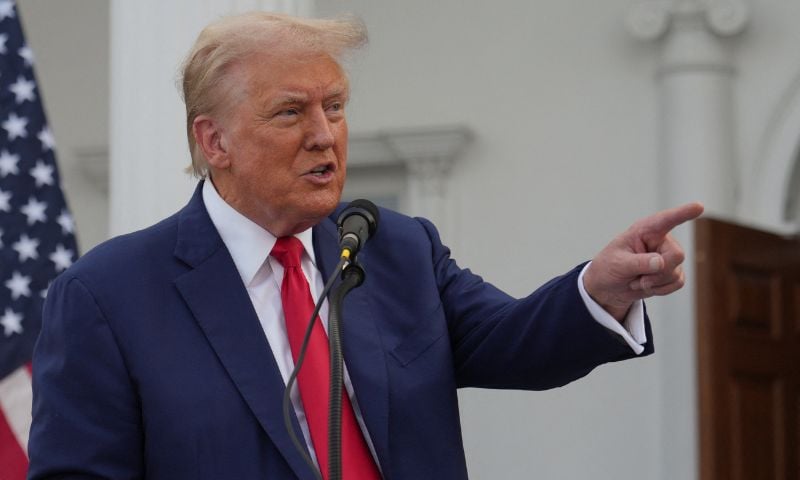



WASHINGTON: US President Donald Trump claimed on Monday that Iranian representatives had reached out to Washington seeking a deal following the conclusion of Pakistan-mediated talks in Islamabad over the weekend.
“I can tell you that we’ve been called by the other side. They’d like to make a deal. Very badly, very badly,” Trump told reporters outside the Oval Office, without specifying which Iranian officials made contact.
🚨 BREAKING: President Trump announces the US will STORM into Iran to take the nuclear dust whether they like it or not
He’s not playing games!
“Iran will NOT have a nuclear weapon, and we’re going to get the dust back. We’ll get it back. We’ll get it back from them, or we’ll… pic.twitter.com/kBErqNUPKD
— Eric Daugherty (@EricLDaugh) April 13, 2026
US officials, cited by CBS News, said engagement between Washington and Tehran had continued since the weekend talks in Islamabad.
One official, cited by CBS News, said there is “forward motion on trying to get to an agreement.”
Pakistan-mediated talks between the United States and Iran concluded in Islamabad on Sunday after more than 21 hours of negotiations, marking the highest-level direct engagement between the two sides in decades.
The talks, facilitated by Pakistan following a two-week ceasefire, ended without a final agreement but with both sides indicating that diplomacy would continue.
US Vice President JD Vance, who led the American delegation, said the discussions were substantive but failed to bridge differences over some issues, particularly over Iran’s nuclear programme.
“We’ve made very clear what our red lines are… and they have chosen not to accept our terms,” Vance said, adding that Washington had presented a “final and best offer”.
Trump underscores nuclear red lines
Trump reiterated that the central issue in the standoff remained Iran’s nuclear ambitions, stressing that Tehran would not be allowed to acquire nuclear weapons.
“Iran will never have a nuclear weapon,” he said, adding that while progress had been made on several issues, a comprehensive agreement had not yet been reached.
“We agreed to a lot of things,” he said, suggesting that differences over nuclear capabilities remained the key obstacle.
Trump defends blockade strategy
The US president also defended his administration’s decision to impose a naval blockade on Iranian ports, saying the move was aimed at preventing Tehran from “blackmail” and “extort[ing] the world”.
He claimed the United States was not dependent on the Strait of Hormuz for energy supplies, stating that the country had “more oil and gas than Russia”.
Trump claimed several countries had expressed willingness to support the blockade but added that US action did not depend on external backing.
“We don’t need other countries,” he said.
Pakistan’s mediation
Pakistan has played a central role in facilitating dialogue between Washington and Tehran, hosting the Islamabad talks after brokering a two-week ceasefire between the two sides earlier this month.
Pakistan’s Prime Minister Shehbaz Sharif said on Monday that Islamabad remained fully engaged in efforts to resolve outstanding issues.
“Full efforts are underway to resolve them,” he said, noting that the ceasefire remained in place.
Iranian Parliament Speaker Mohammad Bagher Ghalibaf said Tehran had entered the negotiations in good faith but remained cautious due to past experiences.
He said Iranian officials had presented forward-looking proposals during the talks, while acknowledging that the process had yet to build sufficient trust for a breakthrough.
Ghalibaf also expressed appreciation for Pakistan’s role in facilitating the engagement.