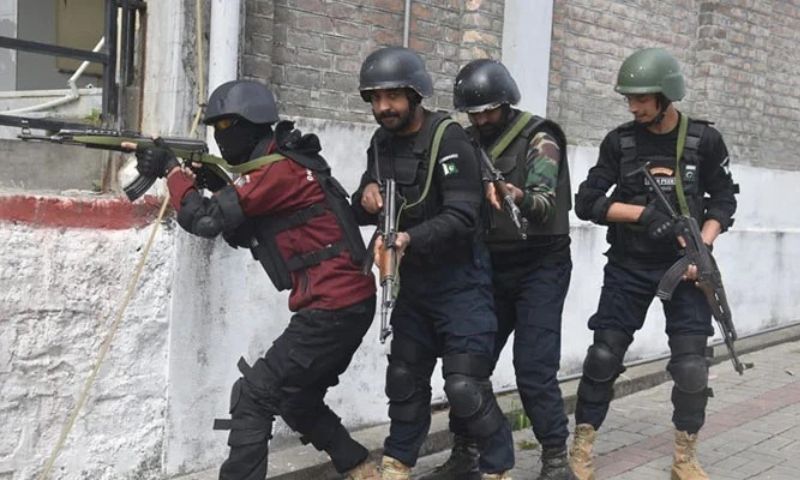
PESHAWAR: The Counter Terrorism Department (CTD) of Khyber Pakhtunkhwa — the province’s frontline bulwark against militancy — is confronting a resurgent wave of violence while grappling with chronic shortages of trained manpower, protective gear and modern technology, leaving its officers increasingly exposed at the front lines.
Manpower and gear gaps
A report recently presented before the Khyber Pakhtunkhwa Assembly’s Standing Committee on Sustainable Development Goals by Additional Inspector General of Police (AIG) Jawad Qamar paints a bleak picture of the province’s policing capacity, revealing severe shortages in manpower, equipment, and protective resources across key counter-terror and law-enforcement units.
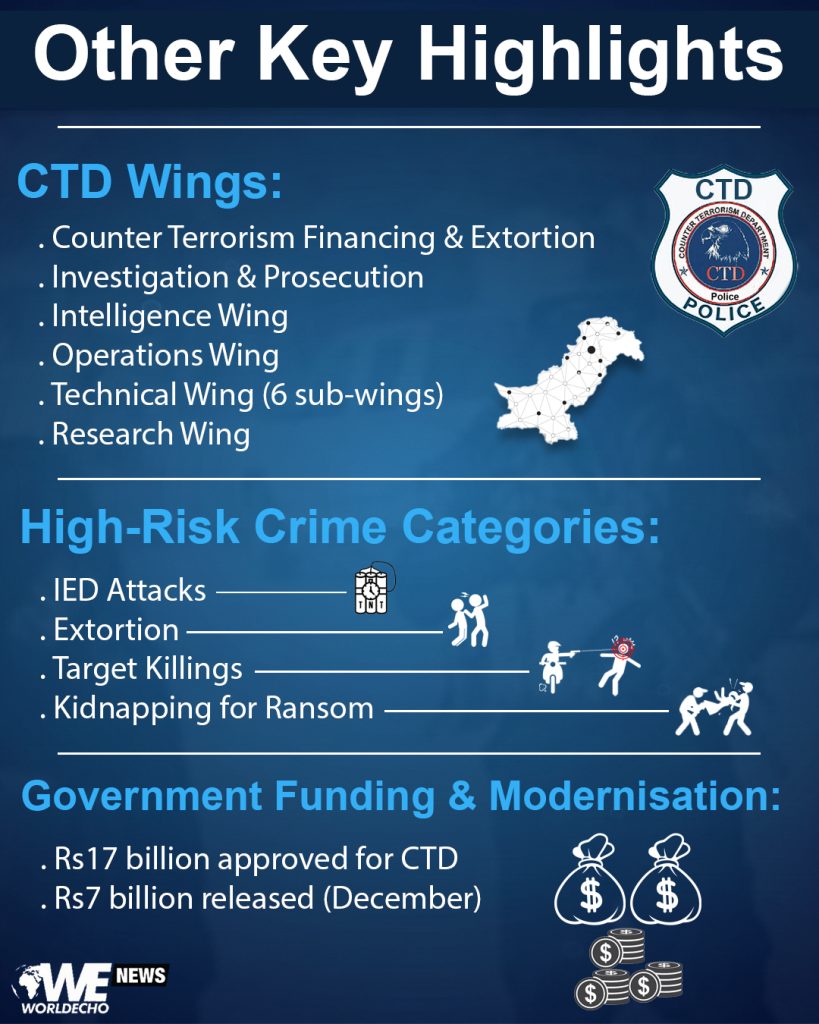
The report states that the Khyber Pakhtunkhwa CTD comprises six wings:
- Counter Terrorism Financing and Extortion
- Investigation and Prosecution
- Intelligence Wing
- Operations Wing
- Technical Wing (which has six sub-wings)
- Research Wing
To further complicate matters, the CTD operates across four high-risk categories of crimes, each demanding precision and speed:
- Improvised Explosive Device (IED) attacks
- Extortion
- Target killings
- Kidnapping for ransom
Rising threat landscape
The rise in terrorism is no flash in the pan. Since the withdrawal of the US forces from Afghanistan in August 2021, the province has witnessed a steady climb in violent incidents.
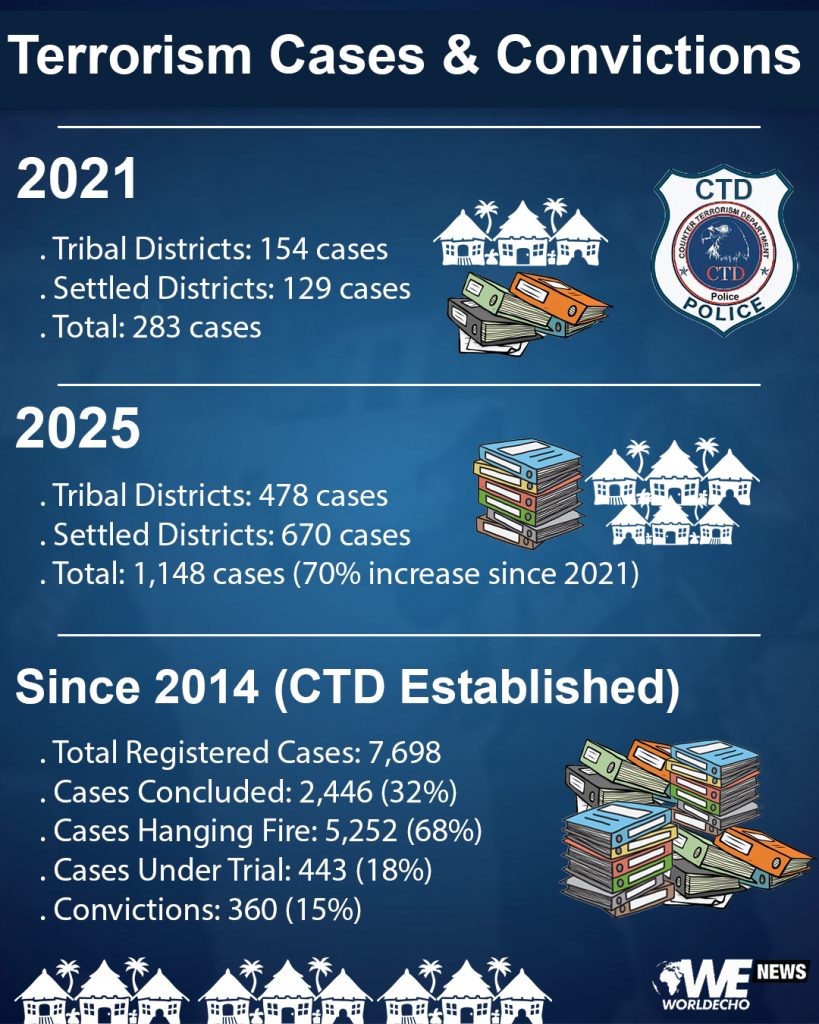
In that year, 154 terrorism cases were reported in the tribal districts and 129 in the settled districts of the province.
By 2025, terrorism cases increased by more than 70 per cent, with 478 cases reported in the tribal districts and 670 in the settled districts.
Permanent staff serve as the backbone of any department. In CTD Punjab, officers assigned for years to investigation, operations, and especially counter-terrorism assessments play a crucial role in resolving cases.” – AIG Jawad Qamar told the parliamentary committee.
Official records further show that since the establishment of the CTD in 2014, a total of 7,698 terrorism cases have been registered in Khyber Pakhtunkhwa.
Of these, only 32 per cent — 2,446 cases — have been concluded, leaving a whopping 68 per cent — 5,252 cases — hanging fire.
Currently, only 18 per cent (443 cases) are under trial in courts, and overall, convictions have been secured in just 15 per cent of cases — 360 in total.
KP CTD lags behind
When the Khyber Pakhtunkhwa CTD is measured against its counterparts in Punjab and Balochistan, the deficiencies are glaring.
Despite being the province most affected by terrorism, Khyber Pakhtunkhwa suffers from a severe lack of weapons, technology, and manpower.
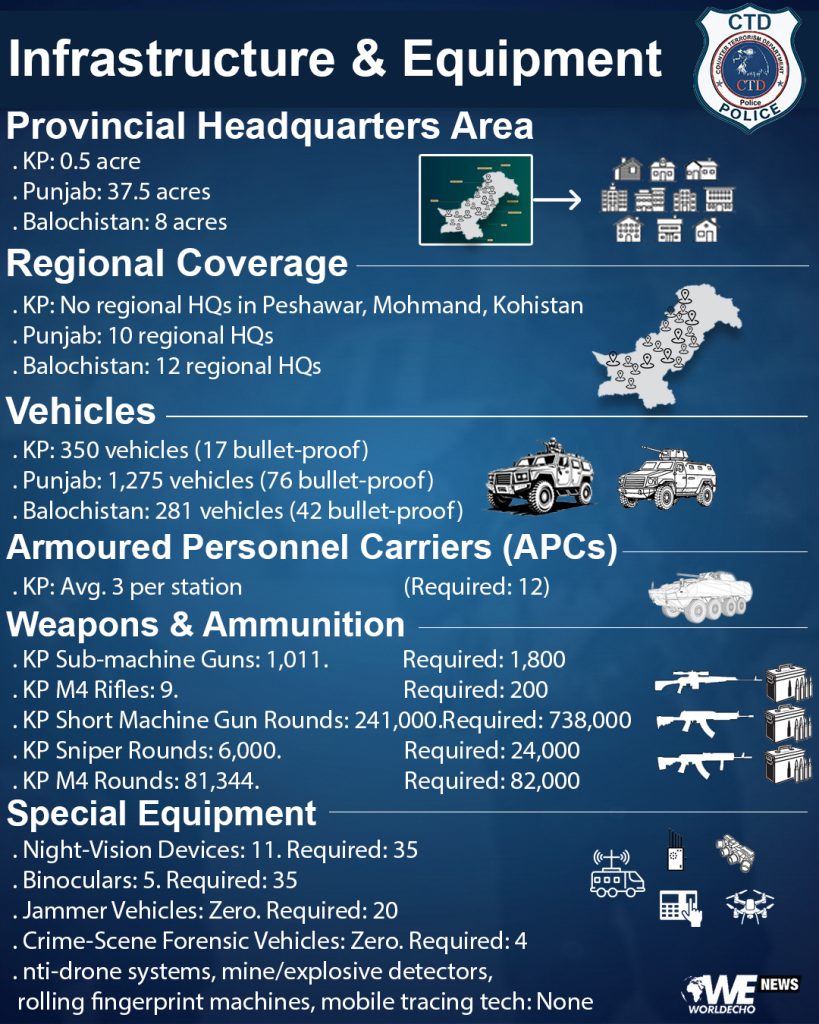
According to official documents available with WE News English, the Punjab CTD’s provincial headquarters is a comprehensive complex spread over 37.5 acres, 300 kanals, whereas Balochistan’s CTD headquarters covers eight acres. In stark contrast, the KP CTD provincial headquarters occupies only half an acre.
While Punjab has established 10 regional CTD headquarters, and Balochistan and Khyber Pakhtunkhwa have 12 each, the number of functional district offices tells another tale.
Punjab has 26 CTD district offices and Balochistan has 28, and Khyber Pakhtunkhwa? None. The province is flying blind at the district level.
Punjab CTD has a total strength of 6,053 personnel, of whom 2,153 are permanent employees. Balochistan CTD has 5,540 personnel in total, including 1,827 permanent staff.
In Khyber Pakhtunkhwa, the approved strength of the CTD is 3,844, but only 3,113 personnel are currently serving. Of these, just 25 — belonging to the prosecution and research wings — are permanent employees.
Punjab CTD has 250 technical staff members, while Balochistan CTD has 478 permanent technical personnel.
In stark contrast, Khyber Pakhtunkhwa CTD has no permanent technical staff; all technical personnel are drawn from the regular police — a classic case of biting off more than one can chew.
“Permanent staff serve as the backbone of any department. In CTD Punjab, officers assigned for years to investigation, operations, and especially counter-terrorism assessments play a crucial role in resolving cases,” AIG Jawad Qamar told the parliamentary committee.
Punjab CTD operates 1,275 vehicles — including 76 bullet-proof vehicles. Balochistan has 281 vehicles — 42 of which are bullet-proof. Khyber Pakhtunkhwa CTD, by contrast, has 350 vehicles but only 17 bulletproof ones.
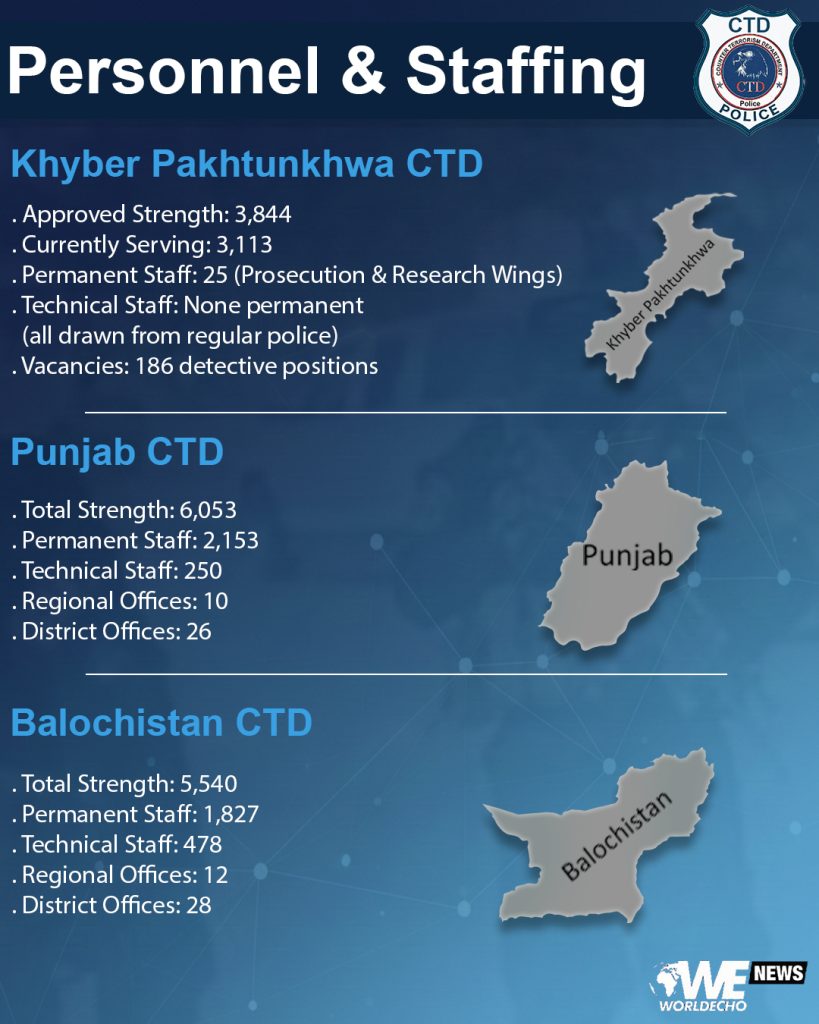
To make matters worse, 186 detective positions in Khyber Pakhtunkhwa CTD have remained vacant — a ticking bomb in operational readiness.
Regional coverage gaps further exacerbate the problem. Khyber Pakhtunkhwa has no regional CTD headquarters in Peshawar, Mohmand, or Kohistan.
The provincial capital’s CTD police station is crammed into a dilapidated building spread over just seven marlas (177 square metres).
According to official records, out of the required 1,800 sub-machine guns, KP CTD has only 1,011 (56.2 per cent) available. Of 200 M4 rifles, only nine (4.5 per cent) are available.
Against a requirement of 738,000 Short Machine Gun rounds, only 241,000 (32.7 per cent) rounds are in stock.
Of the required 24,000 sniper rounds, only 6,000 (25 per cent) are available. For M4 rifles, 81,344 rounds are available against a requirement of 82,000 (99.2 per cent).
Unlike regular policing, Counter Terrorism Department officers, require excellence in investigation, intelligence gathering, and technological proficiency. A specialist officer often neutralises threats before they materialise.” Syed Akhtar Ali Shah, Former provincial secretary Home and Tribal Affairs
Each station should ideally have 12 Armoured Personnel Carriers (APCs), but on average, only three APCs are available. None of the four required crime-scene body fabrication/forensic vehicles is available.
Similarly, of the 35 required night-vision devices, only 11 are available; of the 35 binoculars, only five; and none of the required 20 jammer vehicles is available.
Moreover, the KP CTD has no anti-drone systems, mine detectors, explosive detectors, or rolling fingerprint machines. It also lacks any equipment to trace mobile phone technology.
Government and independent insights
Talking to WE News English, Khyber Pakhtunkhwa’s Adviser on Information, Shafi Jan, says the current provincial government is fully aware of all the weaknesses of the CTD.
“The provincial government has approved a special package of Rs17 billion for the CTD, out of which Rs7 billion has been released in the last week of December.”
This funding, he adds, will be used to modernise the KP CTD, enhance its operational capacity, and procure modern weapons so that it can effectively counter terrorists.
Former provincial secretary for Home and Tribal Affairs Syed Akhtar Ali Shah tells WE News English that currently the number of police personnel in Khyber Pakhtunkhwa has exceeded 125,000. However, most are tied up to routine policing.
“Unlike regular policing, Counter Terrorism Department officers require excellence in investigation, intelligence gathering, and technological proficiency. A specialist officer often neutralises threats before they materialise,” Shah explains.
He says that he played a major role in establishing the CTD in 2014 during the peak of terrorism.
However, he adds, after 2015, as the violence subsided, the government’s attention drifted. But with the Taliban’s return in 2021, a new wave of terrorism has underscored the department’s critical role.
Shah stresses that CTD effectiveness hinges on modern technology and skilled human resources, but shortages and underinvestment leave the department stretched thin.
With adequate funding — including secret allocations — infiltrating terrorist networks and thwarting attacks before they occur would become feasible.
“Cross-border terrorism remains one of the Khyber Pakhtunkhwa CTD’s toughest challenges. Addressing it requires special powers, dedicated resources, and robust inter-agency cooperation,” Shah concludes, underscoring the uphill battle that the province faces in its fight against a determined and evolving threat.