
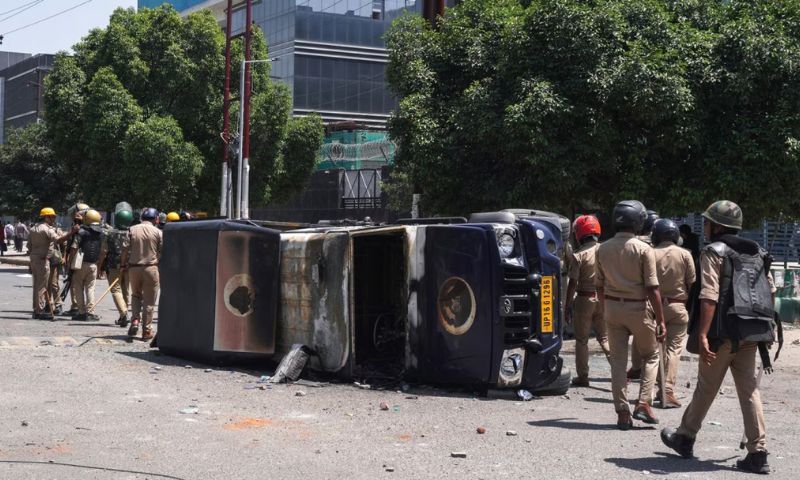



NEW DELHI: After days of unrest in India’s Manipur and Odisha states, the fresh wave of violent protests has now swept into Noida, Uttar Pradesh, marking a dangerous increase in public anger and instability.
As authorities failed to contain the situation, the spread of violence into a major industrial hub like Noida raises urgent questions about governance, law and order, and the underlying triggers fueling this nationwide unrest.
Modi and his ministers have turned India into a reel-oriented country.
Look at these rioters creating chaos outside factories in Noida.
Not only are they setting fires, but they’re also making reels of it and posting them on their social media handles. pic.twitter.com/RjGCNgtklj
— Shruti Dhore (@ShrutiDhore) April 13, 2026
The unrest was triggered by demands for significant wage hikes and improved working conditions amid rising living costs.
Workers are demanding an increase in minimum salary (reportedly up to INR 20,000) and better benefits, including overtime pay and workplace safety.
What began as a peaceful demonstration turned violent on its fourth day. Protesters torched vehicles, pelted stones at police, and vandalised industrial property in the city.
🚨🇮🇳 Indian Army massacre in Manipur!
Indian Army started firing on Manipuri people who were trying to stop them from entering Manipur.
Mass casualties and a massacre have occurred, with 200+ people, including women and children, killed.
The world is silent on Manipur. RT!! pic.twitter.com/0QQwYWIWMT
— Manipur Post (@ManipurPost5) April 7, 2026
Authorities have deployed heavy reinforcements, used tear gas, and conducted route marches to disperse crowds. As of April 14, over 350 people have been arrested and seven FIRs registered.
The Uttar Pradesh government has announced an interim wage hike of up to 21% for unskilled workers to quell the unrest while a high-level committee investigates the situation.
Officials are probing potential “external links” and have identified bot networks used to spread misinformation.
Meanwhile, Uttar Pradesh Police chief says ‘provocative elements’ are being identified, warns of strict action.
Just in:
After Manipur and Odisha, violent protests have now started in Noida, UP. https://t.co/fGTNXaPlqu pic.twitter.com/Gsw8ojFgrr— MARKHOR 𓄅 (@MarkhorTweet) April 14, 2026
Uttar Pradesh Director General of Police (DGP) Rajeev Krishna on Monday said police are identifying elements who allegedly instigated violence during workers’ protests in Noida and warned that strict action will be taken against them.
However, Samajwadi Party chief Akhilesh Yadav has blamed the BJP government’s “one-sided policies” for the violent protests by workers in Noida, alleging the regime favours capitalists while neglecting salaried employees and labourers.
15 दिन में मजदूर दिवस आ रहा है। सरकार कई आयोजन इस अवसर पर करेगी और समाज में मजदूर का योगदान बताएगी।#noida pic.twitter.com/L6UOfv8l3D
— Mukesh Mathur (@mukesh1275) April 14, 2026
The protests paralysed traffic, leaving thousands of commuters stranded on different roads leading to Delhi during the morning rush hour. Long queues of vehicles stretching for several kilometres were seen at the Delhi-Noida border.
As of April 14, 2026, there are ongoing protests and security concerns in both Manipur and Odisha, largely centered on ethnic tensions and tribal rights.
Situation in Manipur
The situation in Manipur remains highly volatile, driven by a long-standing ethnic conflict between the Meitei and Kuki-Zo communities.
On Monday, groups such as the Communist Party of India (CPI) staged protest demonstrations in Imphal, demanding an end to curfew restrictions and the immediate restoration of internet services, which authorities had suspended to curb the spread of misinformation.
Protesters have also voiced deep mistrust of central security forces and the National Investigation Agency (NIA), particularly in the aftermath of a recent terror attack in Tronglaobi.
Tensions further escalated in Churachandpur district, where fresh protests erupted following the formation of a new government that several Kuki-Zo groups have condemned as a “betrayal” by their own representatives.
Odisha protests
Meanwhile, in Odisha, protests are being fueled by issues of tribal displacement, resource control, and local governance.
The Shijimali Hills have become a focal point of resistance, with tribal communities strongly opposing mining projects that threaten their land and livelihoods.
Reports of police detentions of tribal activists have intensified public anger.
Adding to the unrest, mid-April 2026 saw widespread outrage over the alleged overcharging of essential goods such as gas cylinders, sparking political controversy and raising serious questions about government accountability.