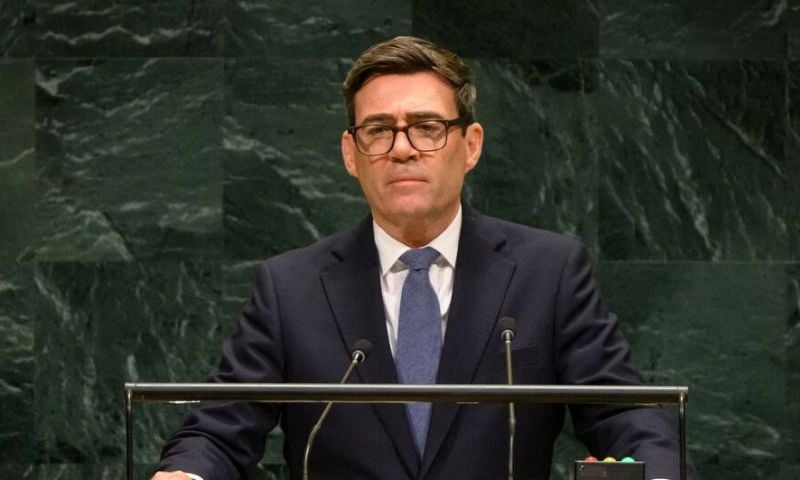
UNITED NATIONS, New York: United Kingdom will establish a National Centre for Information Defence to detect, investigate and disrupt hostile information operations at home and abroad, Prime Minister Andy Burnham said in his first address to the United Nations General Assembly.
The centre is part of a wider British plan to strengthen defences against increasingly sophisticated disinformation campaigns, including those powered or amplified by artificial intelligence (AI).
Security chiefs to set up new national centre to tackle disinformation and deepfakes from hostile states like Russia – with Andy Burnham saying government has a duty to “stem the poisonous tide” from damaging British interests.
National Centre for Information Defence will…
— Pippa Crerar (@PippaCrerar) September 23, 2026
Burnham also announced a developing UK-US AI defence partnership to protect critical national infrastructure and said Britain would work with international partners towards common principles and standards for the safe and transparent development of advanced AI.
How the new centre will work
The proposed centre will operate as a specialised hub for identifying and responding to hostile information attacks targeting Britain and its allies.
While the UK government has yet to publish its detailed operating procedures, legal powers and institutional structure, Burnham’s description of its mission, to “detect, attribute and disrupt” information attacks, indicates a six-stage process: detect, verify, attribute, assess, disrupt and monitor.
Detecting suspicious activity
The first stage will involve identifying unusual or coordinated activity across the information environment.
Analysts could monitor networks of bots and automated accounts, newly created accounts operating together, fake websites impersonating legitimate organisations, fabricated news articles and manipulated photographs, videos or audio.
They could also examine coordinated attempts to amplify particular narratives or exploit major incidents, social tensions and democratic processes.
The focus would be on identifying patterns of coordinated activity, rather than treating every inaccurate online post as a hostile information attack.
Verifying information
Once suspicious activity is identified, analysts would assess whether the material is authentic, false, manipulated or misleading.
This could involve tracing the original source, checking claims against independently verified information, examining digital material and establishing whether apparently separate accounts or websites are working together.
The process would also distinguish misinformation from deliberate disinformation. An inaccurate claim shared without an intention to deceive is different from a coordinated campaign deliberately designed to manipulate the public.
Establishing who is behind an operation
The third stage would focus on attribution, identifying the actor behind a suspected information operation.
Investigators could examine links between social-media accounts, websites, technical infrastructure, communication patterns and previously identified networks.
Where sufficient evidence exists, analysts could prepare an assessment identifying the suspected actor and indicating the level of confidence in that attribution.
Assessing the threat
The centre would then assess the scale and potential impact of the operation.
Factors could include the size and speed of the campaign, the identity and capabilities of the suspected actor, evidence of foreign backing, the intended target, possible threats to democratic institutions and the potential for public disorder.
Analysts could also assess whether AI had been used to increase the campaign’s reach, disguise its origins or generate deceptive content.
Disrupting hostile campaigns
Following verification and assessment, the centre could coordinate a response within its legal powers.
Possible measures could include alerting government departments, election authorities or law-enforcement agencies; sharing evidence with technology companies; exposing coordinated networks; warning the public about fabricated information; or taking action against malicious infrastructure where legally authorised.
The centre’s precise powers will depend on the legislation and institutional arrangements eventually established by the British government. It should therefore not automatically be viewed as having unrestricted authority to remove online content.
Monitoring after intervention
The process would continue after a campaign has been disrupted because information operations can rapidly change tactics.
Operators could create new accounts, websites or distribution methods, requiring continued monitoring of suspicious networks and emerging narratives.
🇬🇧 UK Prime Minister Andy Burnham has announced plans for a new National Centre for Information Defence during his UN General Assembly address, aimed at tackling hostile disinformation and information attacks. Defence Secretary Wes Streeting said the initiative would not be used… pic.twitter.com/RRk3tQJ2Sg
— America Recharged 🇺🇸 (@AmericaRecharge) September 23, 2026
Russia and election interference
Burnham said recent years had witnessed what he described as an “industrial-scale assault by hostile actors on the information environment” in Britain and allied countries.
He accused Russian agencies of using bots, fake websites and falsified news articles to spread disinformation and exploit public fears.
“They’ve amplified far right narratives. And we have evidence that they tried to interfere with the 2019 General Election,” he said.
Burnham also referred to the riots following the fatal stabbing of three young girls at a dance class in Southport in July 2024, saying false information shared online contributed to the unrest.
He said the Kremlin spends roughly $1.7 billion on information manipulation and noted that British companies and institutions had also suffered cyber-attacks.
“And we know that AI will multiply the threat,” he said.
UK to share election-security experience
Britain also plans to help other countries tackle foreign interference and disinformation.
Burnham said the UK had assisted Moldova in protecting its elections against alleged Russian interference.
“As more elections approach across Europe, more nations are grappling with these issues, some for the first time,” he said, adding that Britain was ready to share its understanding of how such actors operate and how countries can respond.
Read Also: AI-Powered Cyber Threats Could Destabilise Global Financial System: IMF
AI could multiply disinformation threat
Generative AI adds another dimension to the challenge by allowing deceptive material to be produced faster and at lower cost.
A coordinated operation could potentially use AI to generate large quantities of text, synthetic photographs and videos, cloned voices and multilingual content while tailoring messages to different audiences.
This could allow relatively small networks to automate significant portions of content production and distribution, making verification more difficult for governments, technology companies and news organisations.
UK-US partnership on AI defence
Burnham announced that Britain is developing a new AI defence partnership with the United States to protect critical national infrastructure.
The cooperation could involve sharing expertise and information on emerging AI-related threats and developing safeguards for infrastructure essential to national security and public services.
Read Also: UN Rights Chief Warns Tech Giants’ Power and AI Pose Threats to Global Democracy
UK seeks common global AI standards
Burnham described Frontier AI, referring to the most advanced AI systems, as one of the major challenges and opportunities of the current era.
He said fundamental decisions about AI were “too important to be left to chance” and argued that elected governments should play a central role in determining how the technology is governed.
Britain will work with international partners towards a common set of global principles and standards covering transparency, access, preparedness and safety.
What global AI standards could involve
Although the proposed international framework has yet to be negotiated, potential safeguards could include rigorous pre-deployment testing, independent safety assessments, stronger cybersecurity controls, transparency requirements, continuous monitoring, serious-incident reporting and emergency response procedures.
These represent possible components of a future international framework rather than final UK-approved rules.
Implications for journalists
The growing use of AI-generated content could require newsrooms to strengthen digital verification procedures.
Journalists may increasingly need to trace original sources, conduct reverse-image searches, examine digital provenance and metadata, and obtain independent confirmation before publishing photographs, videos, audio recordings or documents originating online.
Such precautions would be particularly important during elections, conflicts, terrorist attacks, natural disasters and other major breaking-news events when fabricated material can spread rapidly.
Read Also: UN Chief Calls for AI Curbs, End to Wars in General Assembly Address
Balancing security and free expression
The proposed information-defence system will also need to distinguish genuine hostile information operations from legitimate political debate, criticism, journalism and ordinary inaccuracies.
Its effectiveness will therefore depend not only on detection and disruption capabilities but also on clear legal powers, evidence standards, oversight and transparency.
Britain’s strategy ultimately links two emerging challenges: the ability of hostile actors to manipulate the information environment and the capacity of AI to increase the speed, scale and sophistication of such operations.