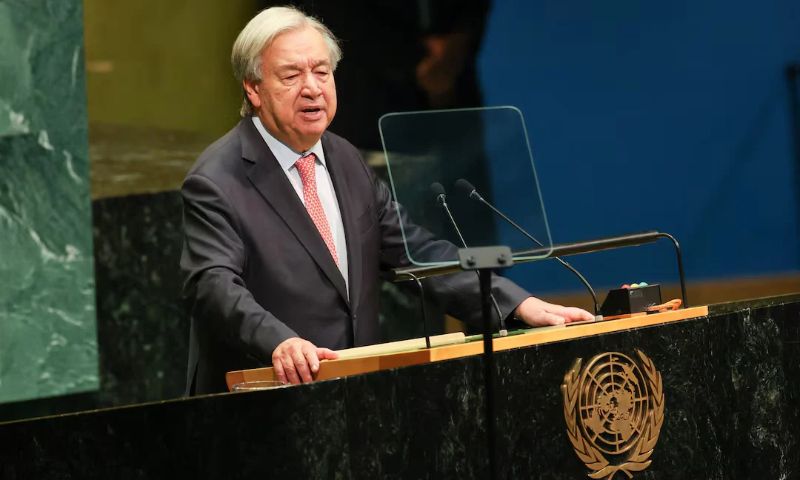
UNITED NATIONS: UN Secretary-General Antonio Guterres called on world leaders on Tuesday to strengthen global safeguards for artificial intelligence, end wars, tackle climate change and reform international institutions, warning that the mechanisms for collective action were under growing strain.
Guterres, whose second five-year term ends on December 31, was delivering his final address to the UN General Assembly after a decade at the helm of the United Nations. The 81st General Assembly’s high-level general debate began in New York on Tuesday.
His speech ranged from the risks posed by rapidly advancing AI to conflicts in Gaza and Ukraine, climate change and the changing balance of global power.
Guterres said the world faced an “unprecedented convergence of threats” while international cooperation was weakening.
“Geopolitical divides have deepened. Inequalities have intensified. Trust has frayed,” he said, according to his address.
He said the climate crisis had moved from a distant warning to a daily reality, while AI had advanced at a pace that had “blindsided even those who created it”.
Calls for global AI safeguards
Guterres urged countries leading the development of AI to share information on emerging safety risks and cooperate on testing and evaluation.
“Those countries leading this technological revolution must share information on emerging safety risks, cooperate on testing and evaluation – and work towards common safeguards that protect us all,” he told the assembly.
He called for conditions that would allow the responsible pacing of AI development and for additional safeguards to address its risks.
Guterres also called for a multilateral AI risk-management framework backed by “credible and independent oversight”.
His comments came as the UN Security Council prepared to hold a high-level briefing on AI and international security. The council first discussed the security implications of AI in 2023.
This week’s meeting is expected to include representatives from leading AI companies, including China’s DeepSeek and US firms OpenAI and Anthropic.
Guterres has made global AI governance a priority. In 2023, the UN established a 39-member advisory body on AI, bringing together technology executives, government officials and academics.
Wars and Middle East conflict
Guterres called for an end to fighting in the Middle East and urged countries to return to diplomacy.
“Together, let’s send a clear message from this hall: The fighting must stop. Humanitarian aid must flow. And navigational rights and freedoms must be fully restored in accordance with international law,” he said.
He called for de-escalation and dialogue as conflict continued to threaten shipping in the Strait of Hormuz.
On Gaza, Guterres said the response to the October 2023 Hamas attack had resulted in an Israeli military campaign in the Palestinian territory that had caused killing and destruction on a scale he had not witnessed during his time as secretary-general.
He said violence, displacement and settlement expansion in the occupied West Bank were undermining prospects for peace and warned that the two-state solution could not be allowed to disappear.
Guterres also reiterated his support for a two-state solution for Israelis and Palestinians.
Ukraine-Russia war
Turning to Ukraine, Guterres raised concerns about attacks on homes, energy and water infrastructure and transport in parts of Russia, saying they threatened food and energy supply chains globally.
Guterres urged world leaders to uphold international law and protect civilians without exception.
“The test before us is whether power will be exercised with the law – or beyond it,” he said.
Climate and corporate power
Climate change was another major theme of the address.
Guterres said major oil companies had profited heavily while the world faced the consequences of rising temperatures.
“For decades, big oil has treated the atmosphere as an open sewer – and cashed in on the consequences,” he said.
He also warned that climate-related costs were increasingly being felt by ordinary people through higher energy, food and insurance prices.
Guterres said an “extraordinary transfer of power” was taking place from governments to a small number of private corporations and individuals whose influence extended across politics, economies, information, technology and civic life.
He also warned of the growing use of AI agents and the development of lethal autonomous weapons.
UN reform
Guterres argued that global institutions had failed to keep pace with changes in the distribution of power.
“Our mechanisms for collective action are under growing strain,” he said, adding that global institutions continued to reflect “the power realities and interests of a largely bygone age”.
He called for a more representative multilateral system centred on a reformed United Nations.
Guterres also criticised the lack of permanent African representation on the UN Security Council, calling it unjust and indefensible.
He defended the UN’s role as a place where powerful countries could be held to account and said the organisation had achieved gender parity for the first time across its senior leadership, headquarters and professional staff.
“Equality is not a dream. It is a decision,” he said.
A final address
Guterres used the speech to reflect on his decade as secretary-general and to bid farewell to many of the world leaders with whom he had worked.
He said wars had erupted with devastating consequences, civilians had been targeted, human rights had been violated and international law had been disregarded.
He warned against a world divided into two rival blocs and urged major powers to recognise the limits of military, economic and technological power.
“Military power alone cannot secure peace. Economic power alone cannot command stability. And technological power alone cannot guarantee security,” he said.
Guterres ended on a personal note, saying he would continue to advocate for peace after leaving office.
“So, on January 1st, when I am no longer Secretary-General, be sure of this. Wherever I will be, whatever I will be doing – I will keep championing the conviction that peace is possible,” he said.
“I will continue to stand up for the values of the United Nations Charter and I will never, ever give up.”