
Key Points
- India’s data-centre expansion is accelerating with the growth of artificial intelligence
- Critics warn that land, water and electricity costs are falling disproportionately on local communities
- A proposed hyperscale facility in Thane has triggered protests over resource use
- Digital-rights advocate Osama Manzar says affected communities are rarely consulted
ISLAMABAD: India’s rapid expansion of data centres to support artificial intelligence and digital services is raising concerns that the costs of the technology boom could fall disproportionately on poor and local communities, particularly through increased pressure on land, water and electricity.
Without considering the plight of the locals, India seeks to establish itself as a major global data-centre hub. The country intends to attract billions of dollars of investment in facilities needed to store and process the rapidly growing volume of digital information and AI workloads.
Osama Manzar, founder of the Digital Empowerment Foundation, told Rest of World that the country risked repeating an extractive development model. In the development model, powerful technology companies benefit from infrastructure while communities providing the land and resources have little influence over decisions.
Manzar said governments were making agreements with data-centre companies without adequately consulting local populations.
He questioned whether projects being promoted as development should automatically be treated as beneficial to the communities where they are built.
The concern is particularly significant in India, where access to water and reliable electricity can already be uneven. Large data centres require continuous electricity and substantial cooling infrastructure, creating concentrated resource demand around individual facilities.
Protests in India against the data centres
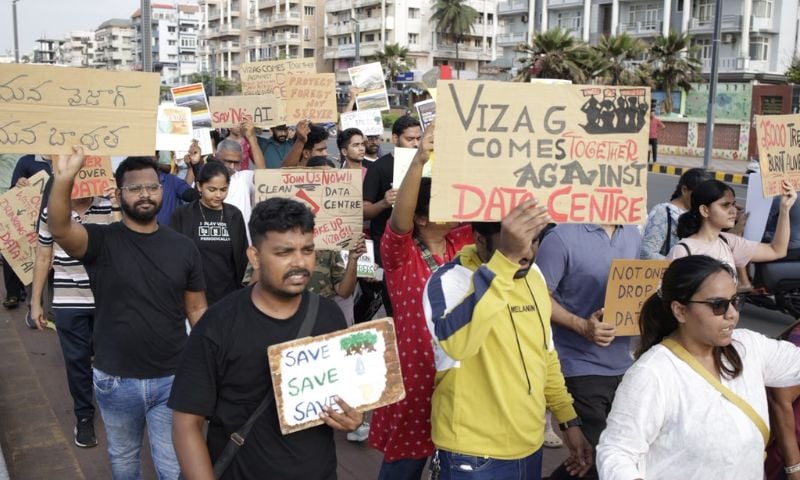
A proposed hyperscale data centre in Thane, in Maharashtra, illustrates the emerging conflict. Residents have protested against an Amazon facility planned across about 53 acres.
They highlighted its projected requirement of 422 megawatts of electricity, 125 kilolitres of treated water a day and 193 diesel generators for backup power. Residents have raised concerns about pressure on water and electricity supplies, noise and environmental impacts.
India’s data-centre electricity demand has already risen sharply. Recent analysis put data-centre power demand at about 1,575 megawatts, up from 375 megawatts in 2020, with demand potentially reaching 17 gigawatts by 2031-32 as AI workloads expand.
READ ALSO: Indian GDP Fake Figure Controversy Grows
That expansion presents India with a difficult policy choice. Data centres can generate investment, construction activity, employment and tax revenues while strengthening the country’s digital infrastructure. But the benefits can concentrate among technology companies, investors and highly skilled workers, while locals bear the resource costs.
The problem becomes more acute when projects are located in areas where water availability is already constrained or where electricity infrastructure is under pressure. Unlike conventional factories, data centres operate around the clock and cannot easily limit electricity consumption at any time.
Not limited to India
The issue is not limited to India. Communities in the United States and other countries have increasingly challenged data-centre developments over electricity consumption, water use, land conversion, noise and environmental impacts. Recent opposition in the United States has demonstrated that even wealthy communities are questioning who gains and who pays for the AI infrastructure boom.
For India, however, the stakes are particularly high because the government views data centres as an important part of its digital and AI ambitions. The challenge is to ensure that the country’s poorest communities are not left carrying the environmental and resource costs of infrastructure designed primarily to serve global technology markets.
Manzar has argued for a more decentralised approach that would connect digital infrastructure more closely to local needs, including agriculture, governance and community services, rather than concentrating investment solely in large technology campuses.