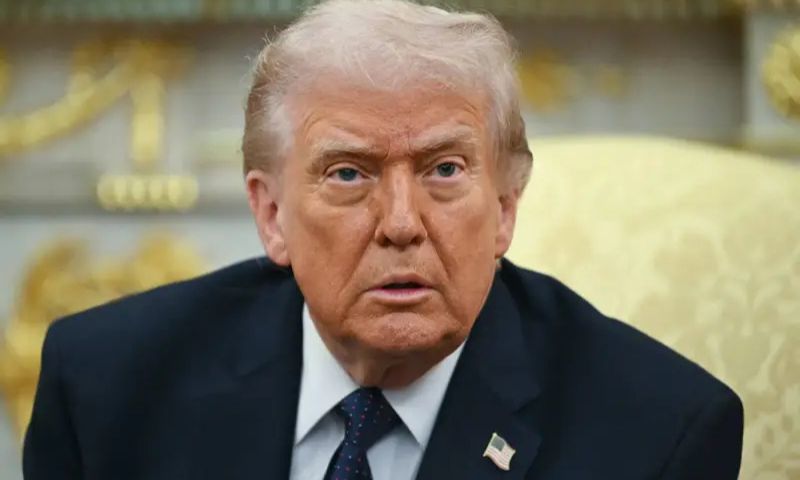
WASHINGTON: US President Donald Trump said Sunday he believes there is a “good chance” of making a deal with Iran on Monday, ahead of his deadline for Tehran to reopen the Strait of Hormuz or face heavy bombing.
“I think there is a good chance tomorrow, they are negotiating now,” the president told a Fox News journalist.
“If they don’t make a deal and fast, I’m considering blowing everything up and taking over the oil,” he added.
🚨 BREAKING: @TreyYingst details his phone call with President Trump this morning about the ongoing negotiations with Iran.
“The president tells me, ‘If they don’t make a deal, and fast, I’m considering blowing everything up and taking over the oil.'” | @foxandfriends pic.twitter.com/Si0GDQUOnH
— Fox News (@FoxNews) April 5, 2026
Trump warns of strikes on Iranian power plants
Earlier today, Trump warned to strike Iran’s power plants and bridges if it does not reopen the vital Strait of Hormuz.
The war, which erupted on February 28 with US-Israeli strikes on Iran, has engulfed the Middle East and convulsed the global economy.
Iran has virtually blocked the Strait of Hormuz shipping lane, a vital conduit for oil and gas, and launched strikes on Israel and its Gulf neighbours.
Trump warned Iran to stop choking traffic through Hormuz.
In a post on his Truth Social platform, Trump warned that Iran would be “living in Hell” if the vital waterway remained closed.
He reiterated that US forces could target key infrastructure as early as Tuesday if there was no progress.
“Open the Fuckin’ Strait, you crazy bastards, or you’ll be living in Hell,” he said, in his social media post.
“Tuesday will be Power Plant Day, and Bridge Day, all wrapped up in one, in Iran. There will be nothing like it!!!” he declared.
Later, Trump told Fox News that he believed there was a “good chance” that Iran would agree to a deal on Monday.
Trump’s 48 hours deadline
The US president has repeatedly issued deadlines to Iran in recent weeks, linking any military action to the reopening of the strategic strait, a crucial route for global oil shipments.
On Saturday, Trump said Iran had 48 hours to “make a deal” or reopen the Strait of Hormuz, warning that “all hell” would break loose if it failed to comply.
“Time is running out — 48 hours before all Hell will reign down on them,” he wrote.
Pakistan intensifies diplomatic efforts
Meanwhile, Pakistan and other regional countries are attempting to promote dialogue and diplomacy and de-escalate the conflict.
A telephone call between Pakistan’s Deputy Prime Minister and Foreign Minister Ishaq Dar and the Iranian Foreign Minister Abbas Araghchi resulted in agreement on close and continuous contact.
Islamabad geared up its diplomatic endeavour to contain the rising regional conflict.
The two sides reviewed the fast-evolving situation and committed to remaining in close coordination in the wake of ongoing developments as the war between Iran and the US-Israel alliance is escalating fast.
According to a statement issued by the Ministry of Foreign Affairs, the two leaders exchanged views on the current regional environment, with Islamabad reiterating its support for all efforts aimed at de-escalation and peaceful resolution of the conflict.
“Dialogue and diplomacy remain the only viable path forward,” the statement quoted him as saying during the telephonic counterpart.
Deputy Prime Minister / Foreign Minister Senator Mohammad Ishaq Dar @MIshaqDar50 spoke tonight with Foreign Minister Abbas Araghchi @Araghchi.
They exchanged views on the evolving regional situation.
DPM/FM reiterated Pakistan’s support for all efforts aimed at de-escalation… pic.twitter.com/PvLp2tpDM0
— Ministry of Foreign Affairs – Pakistan (@ForeignOfficePk) April 4, 2026
Continued escalation could destabilise an already volatile region and carry far-reaching consequences beyond the immediate area of conflict, it added.
The latest engagement reflects Islamabad’s growing diplomatic efforts to position itself as a mediator between Iran and the US.
Pakistan has maintained active contact with multiple regional capitals in recent days, advocating restraint and encouraging negotiated solutions and has also offered to host a dialogue between the warring parties.
Iranian attacks on Gulf countries
Critical infrastructure across the Gulf came under attack from Iran again on Sunday, with damage reported at civilian facilities in the United Arab Emirates, Bahrain and Kuwait.
In Kuwait, drone strikes damaged power plants and a petrochemical facility and disrupted a water desalination station, according to the Ministry of Electricity.
No injuries were reported in the attack.
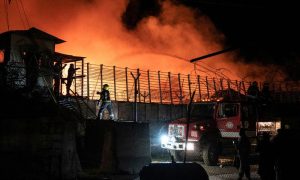
In Bahrain, a drone attack caused a fire at a storage facility operated by the national oil company, as well as at a state-run petrochemical plant, authorities said.
The fires were later extinguished.
In the United Arab Emirates, officials said debris from an intercepted attack caused fires at a petrochemical plant in Ruwais, forcing a suspension of operations.
The strikes followed an Israeli attack on Iran’s petrochemical plant, which Prime Minister Benjamin Netanyahu said had been generating revenue for Tehran’s war effort.
Bushehr nuclear plant
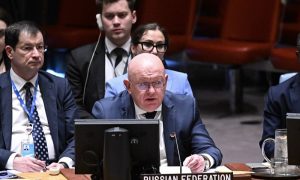
In Iran, a strike near the Bushehr nuclear plant on Saturday killed a guard and led Russia, which partly constructed the facility and helps operate it, to announce it was evacuating 198 workers and to condemn the strike as “an evil deed”.
Iranian Foreign Minister Abbas Araghchi warned that continued attacks on the plant on the southern coast could eventually lead to radioactive fallout that would “end life in GCC (Gulf Cooperation Council) capitals, not Tehran”.
Bushehr is considerably closer to Kuwait, Bahrain and Qatar than it is to the Iranian capital.
Strait of Hormuz disruption
The war between the United States, Israel and Iran, which began on February 28, has intensified, with Tehran targeting Israel and Gulf states.
Iran has also tightened control over the Strait of Hormuz, significantly slowing oil flows and pushing global fuel prices higher.
Trump had earlier urged other countries to “get your own oil” from the strait as disruptions deepened.
The conflict has already destabilised regional economies and global energy markets, with both sides striking economic and civilian infrastructure.