Key Points
- English and Urdu dominate private school instruction systems.
- Mother tongue pushed outside academic and formal learning spaces.
- Early learning in native language strengthens comprehension and confidence.
- Pashto seen as high-scoring subject in competitive examinations.
- Limited literacy leaves many fluent speakers unable to write Pashto.
- Private schools prioritise marketable subjects over regional language.
- Cultural identity increasingly disconnected from formal education system.
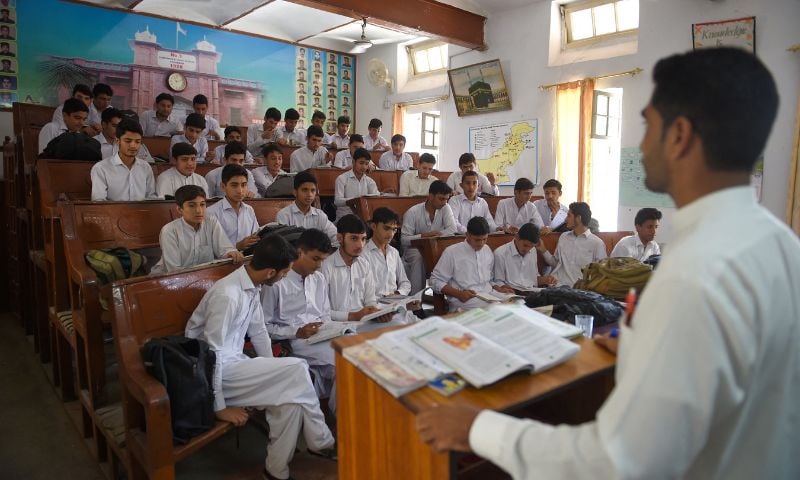
NOWSHERA, Pakistan: Fifteen-year-old Kalsoom lowers her voice before speaking in her mother tongue at school.
Inside her private school in Peshawar — the provincial capital of northwestern Khyber Pakhtunkhwa — only English and Urdu are used as mediums of instruction.
Pashto — the language she speaks at home, with relatives and friends beyond the school gates — belongs elsewhere. “Even informal conversations are expected to be in English or Urdu,” she says, describing the unspoken pressure to leave her mother tongue at the classroom door.
Enforcement and neglect
Her experience reflects a broader reality across Khyber Pakhtunkhwa, where Pashto remains largely absent from private school curricula. This is despite it being the mother tongue of 76.48 per cent of the province’s population, according to the 2017 Provincial Census Report for Khyber Pakhtunkhwa compiled by the Pakistan Bureau of Statistics.
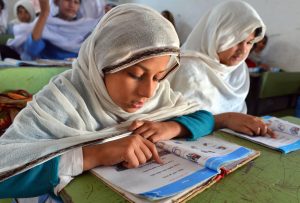
In the pursuit of academic success and social mobility, a language deeply woven into the region’s cultural identity is increasingly being pushed to the margins of formal education.
“Children learn best in the language in which they think and dream. When we ignore the mother tongue in early education, we weaken the very foundation of learning.” – Dr Israr Atal, Pashto language expert
Dr Muhammad Khalil, also known as Shakir Orakzai — a teacher at a government-run school in Kohat, around 70 kilometres southwest of Peshawar — says Pashto has officially been declared a compulsory subject in government schools across Khyber Pakhtunkhwa, with the policy intended to continue up to intermediate level (grade 12).
“The Education Department issued notifications in 2024 and again in 2026 directing schools to ensure the teaching of Pashto.”
However, he notes that implementation remains uneven.
“While Pashto is taught regularly in many government schools, the policy has yet to be fully enforced in several areas owing, in the main, to the shortages of teachers, textbooks, as well as a lack of administrative support.”
Cognitive language benefits
Against this backdrop, language experts emphasise the importance of mother-tongue instruction in early education.
Dr Israr Atal — Pashto language expert from Katlang in Mardan —believes that children learn most effectively in the language in which they dream, think and express their emotions. “Using the mother tongue as a medium of instruction, particularly during the early years of schooling, helps students build a strong cognitive and educational foundation,” he says.
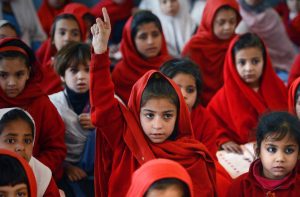
When a topic is explained in a child’s native language, students understand and absorb it more easily. Words settle quickly in their minds and hearts, allowing them to grasp concepts without requiring excessive explanation, he adds.
“Mother-tongue education improves reading comprehension because students can readily understand words, meanings and ideas in the language they hear and speak at home. It also boosts confidence and fosters a sense of pride in their culture, language and identity.”
“Pashto has officially been declared a compulsory subject in government schools, but in many areas the policy remains weakly implemented due to shortages of teachers and learning resources.” – Dr Muhammad Khalil, teacher
Many students, he says, opt for Pashto mainly in competitive examinations because it is widely regarded as a high-scoring subject that can help improve their overall aggregate.
This perception is also reflected in student choices in competitive examinations.
Hazrat Bilal, who secured the 18th position in Central Superior Services (CSS) 2025, says that he chose Pashto as an optional subject, as “Pashto can definitely help CSS aspirants secure a better aggregate score because it is a good-scoring subject.” He scored 72 marks out of 100 in Pashto.
Likewise, Muhammad Salman, 24, had hoped to choose Pashto as an optional subject in the CSS examinations but was unable to do so because he lacked formal training in reading and writing the language.
It is worth noting that the Pashto script differs from those used for Urdu, Persian and Arabic, posing an additional challenge for many aspiring candidates.
Fluent but illiterate
Dr Noor Muhammad Danish Bettani, Chairman of the Pashto Department at the University of Peshawar, estimates that only around five per cent of Pashtuns can properly read and write Pashto. He attributes this low literacy rate to the limited importance given to the language within the education system.
Most children begin their formal education in Urdu and English, leaving them with little exposure to Pashto script, spelling and literary conventions. As a result, many people grow up speaking Pashto fluently but struggle to read or write it accurately, he says.
“Although the Pashto script is derived from Arabic, it includes several unique letters and sounds that do not exist in Urdu, Arabic or Persian. These distinctions often create difficulties for learners who first become literate in Urdu or Arabic and later attempt to acquire written Pashto.”
“Only around five per cent of Pashtuns can properly read and write Pashto. Most children grow up speaking it, but never learn to write it properly in school.” – Dr Noor Muhammad Danish Bettani, Chairman, Pashto Department, University of Peshawar
Dr Bettani also pointed to dialectal variations and the absence of standardised spelling practices as factors that further complicate reading and writing. “Many people can communicate confidently in Pashto, but they cannot write it correctly,” he says, attributing the gap to the complexity of the script, inadequate teaching resources and insufficient instruction in schools.
Systemic linguistic exclusion
Khyber Pakhtunkhwa Elementary and Secondary Education Department’s Annual School Census (2025–26) shows that the province has 34,784 government schools, including 26,731 primary, 3,569 middle, and 2,714 higher secondary schools.
While the public sector reflects its own structural challenges, including a visible gender gap that widens at higher levels, the private sector has rapidly expanded its footprint in education.
Similarly, various studies also point out the issue of a lack of trained Pashto teachers and weaknesses in the teaching system in Khyber Pakhtunkhwa.
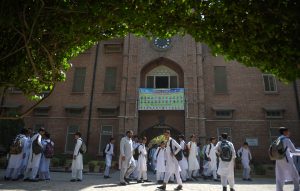
According to data from the Khyber Pakhtunkhwa Private Schools Regulatory Authority (KP-PSRA), there are around 11,000 to 12,000 registered private schools operating across Khyber Pakhtunkhwa. These institutions, often seen as providers of “quality education,” largely follow a curriculum where English and Urdu dominate, leaving little to no room for Pashto.
Despite being the mother tongue of the majority population, Pashto is rarely taught as a structured subject in private schools. Where it exists, it is often optional and inconsistently offered.
School administrators point to practical reasons behind this exclusion. Akhunzada Ahmed Khan, principal of a private school and college in Peshawar, says the absence of Pashto is tied to limited regulatory enforcement and minimal demand from parents. “Schools prioritise subjects that are perceived to offer better academic and career prospects.”
“Pashto can definitely help CSS aspirants secure a better aggregate score because it is a good-scoring subject.” – Hazrat Bilal, CSS 2025 qualifier
A similar view comes from Mujahid Khan, principal of a private school in Tordher, Swabi, who explains that curriculum decisions are largely shaped by examination systems. Since Pashto is not part of mainstream assessment frameworks, it remains sidelined in private education.
Inside classrooms, this policy translates into everyday practice. A private school teacher, requesting anonymity, reveals that in some institutions, students are actively discouraged from speaking Pashto. In certain cases, they may even face reprimand, reinforcing the idea that their mother tongue does not belong in an academic setting.
Classroom language norms
Parental expectations further reinforce this trend. A tuition teacher shares that throughout his career, not a single parent has asked him to teach Pashto. Instead, the focus remains firmly on English, Mathematics, and Science subjects seen as essential for future success. But this absence comes with consequences.
For many students in elite English-medium schools, the message is clear: Pashto has no place inside the classroom.
Hareem, a ninth-grade student at a private school in Nowshera, recalled an incident that has stayed with her. “Once, I was speaking to my principal in Pashto, and she told me, ‘You like speaking Pashto? Don’t speak Pashto in school,” she recalls.
Similar experiences were shared by others. Arif, a mathematics tutor, said one of his students, Awais, who studies at an elite school, told him that speaking Pashto on campus is considered against school rules. Likewise, Areeba Khan, an eighth-grade student at a private school in Peshawar, says teachers in her school often discourage students from using their mother tongue, telling them: “Don’t speak any language other than Urdu and English in school.”
Heritage at risk
These accounts point to a broader reality in Khyber Pakhtunkhwa: a generation that remains fluent in speaking Pashto but is increasingly disconnected from its written, literary and academic traditions.
As English and Urdu continue to dominate educational spaces, cultural identity and formal learning often move along separate paths, rarely intersecting.
In the pursuit of global competitiveness and social mobility, one of the province’s most widely spoken languages is steadily being pushed to the margins of private education. The question that lingers is not merely about language policy, but about identity itself: in preparing children for the future, what parts of their heritage are being left behind?