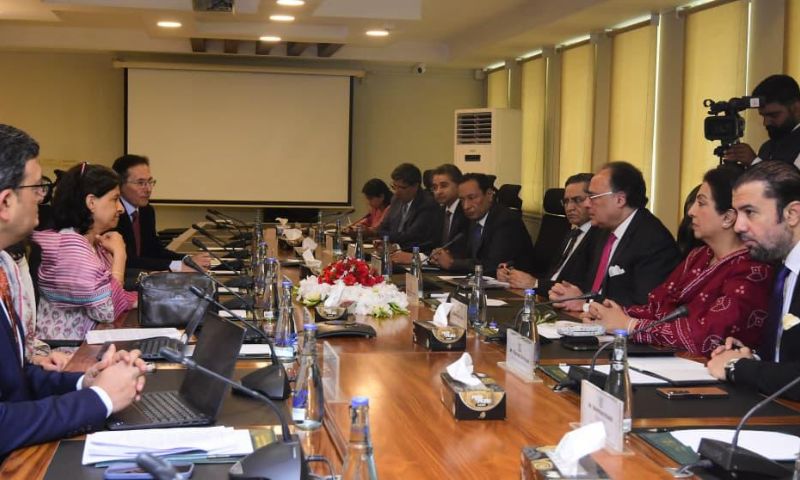



ISLAMABAD: Pakistan’s Finance Minister Muhammad Aurangzeb has reaffirmed the country’s commitment to advancing key reforms aimed at strengthening human capital, improving social outcomes, creating employment opportunities, and fostering inclusive and sustainable economic growth across the country.
He said this during a meeting with a World Bank Group delegation led by Ms. Mamta Murthi, Vice President for Human Development (Health, Education and Social Protection), an official statement said on Wednesday.
Aurangzeb expressed appreciation for the World Bank Group’s continued partnership and support for Pakistan’s development and reform agenda.
He noted that while the country has made significant strides in restoring macroeconomic stability, the government is now increasingly focused on enhancing social and human development outcomes through targeted investments in health, education, skills development, and social protection.
The Minister emphasised the importance of achieving measurable results and ensuring effective implementation under the World Bank’s long-term Country Partnership Framework for Pakistan.
He highlighted that Pakistan’s large youth population represents both a major opportunity and a key policy priority, underscoring the need to strengthen human capital, expand workforce participation, and equip young people with skills that meet the evolving demands of the labour market.
Muhammad Aurangzeb stressed that sustaining economic growth and improving competitiveness will require continued investment in people, alongside reforms aimed at boosting productivity, enhancing public service delivery, and creating greater employment opportunities across the country.
According to the statement discussions focused extensively on Pakistan’s human development agenda, including maternal and child health, nutrition, immunisation, early childhood development, education outcomes, and population-related challenges.
Ms. Mamta Murthi emphasised that long-term development outcomes would depend on sustained progress in key human capital indicators, particularly child nutrition, reduction in stunting, foundational learning, and access to quality healthcare and education services.
She noted that the World Bank’s engagement is focused on supporting measurable outcomes and strengthening service delivery systems to ensure that essential interventions reach mothers and children effectively across the country.
The meeting also covered opportunities to strengthen primary healthcare systems and expand access to essential services for mothers and children. Participants exchanged views on the growing role of artificial intelligence and digital technologies in healthcare, education, and workforce development.
The Finance Minister emphasised the need to prepare Pakistan’s workforce for a rapidly evolving global economy, while the World Bank delegation shared international experiences relating to technology-driven service delivery, healthcare financing, and private sector participation.
The Finance Minister emphasized the importance of upskilling and reskilling Pakistan’s workforce to meet emerging economic needs and create pathways to higher-value employment opportunities. He noted that strengthening employability, particularly among young people, would remain central to the Government’s broader economic transformation agenda.
The World Bank delegation shared international best practices and experiences in workforce development, technical and vocational education, and employment-oriented skills training.
Discussions underscored the need to strengthen linkages between industry and training institutions, encourage greater private sector involvement in skills development initiatives, and adopt outcome-based approaches that better align training programmes with labour market needs and employment opportunities.
The participants also highlighted the importance of ensuring that skills development efforts translate into tangible job creation and improved workforce productivity.
The meeting further explored opportunities for broader collaboration between the Government, the World Bank Group, and the private sector in support of Pakistan’s human capital objectives.