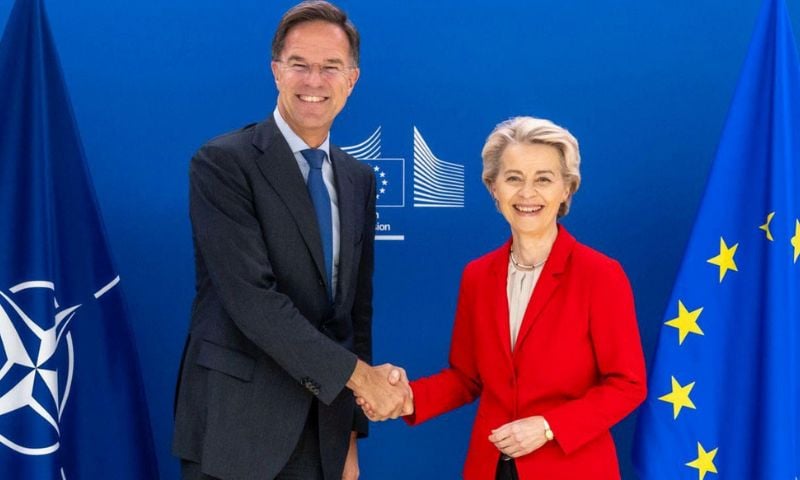
BRUSSELS: The heads of the European Union and NATO on Thursday called for an increase in Europe’s arms production, citing growing security challenges and uncertainty over the United States’ long-term commitment to the transatlantic alliance.
“We need to invest more, to produce more and to do both faster,” European Commission President Ursula von der Leyen said in a social media post after meeting NATO Secretary General Mark Rutte.
Today with @SecGenNATO we took stock of our common work to bolster European defence and continue support to Ukraine.
We discussed the upcoming NATO Summit and how we can upscale defence industrial output in Europe. We need to invest more, to produce more and to do both faster.… pic.twitter.com/eGO5BEXYbk
— Ursula von der Leyen (@vonderleyen) April 16, 2026
European nations are moving to strengthen their military capabilities amid ongoing Russia-Ukraine war and mounting pressure from US President Donald Trump.
Concerns over Washington’s role in NATO have intensified after Trump signalled he could reconsider US participation in the alliance, criticising Europe’s response to the US war with Iran.
NATO allies last year pledged to increase core defence spending to 3.5 percent of gross domestic product in an effort to address US concerns over burden-sharing.
Despite increased spending commitments, European officials have acknowledged that the region’s defence industry is struggling to meet rising demand.
Officials say production capacity has not kept pace with the higher targets, despite a series of initiatives launched by the European Union to boost output.
The issue of defence industrial capacity is expected to feature prominently at NATO’s upcoming summit in Ankara, alliance officials said.
Rutte said discussions with von der Leyen focused on deepening cooperation between NATO and the EU.
“A stronger Europe means a stronger NATO,” he said in a post, adding that talks covered increasing defence production, sustaining support for Ukraine and protecting critical infrastructure.
Great to see @EU_Commission @vonderleyen and discuss how to further strengthen our essential NATO-EU cooperation, including ramping up defence industrial production, continuing vital support to Ukraine, and protecting critical infrastructure
A stronger Europe means a stronger… pic.twitter.com/vT0QzoCGto— Mark Rutte (@SecGenNATO) April 16, 2026
The United States has urged European allies to assume greater responsibility for the continent’s conventional defence.
European governments, for their part, are increasingly acknowledging that decades of reliance on US security guarantees are diminishing.
The EU, which historically avoided a direct role in defence, has expanded its efforts to support the sector in recent years, with some member states advocating a larger role for the bloc.