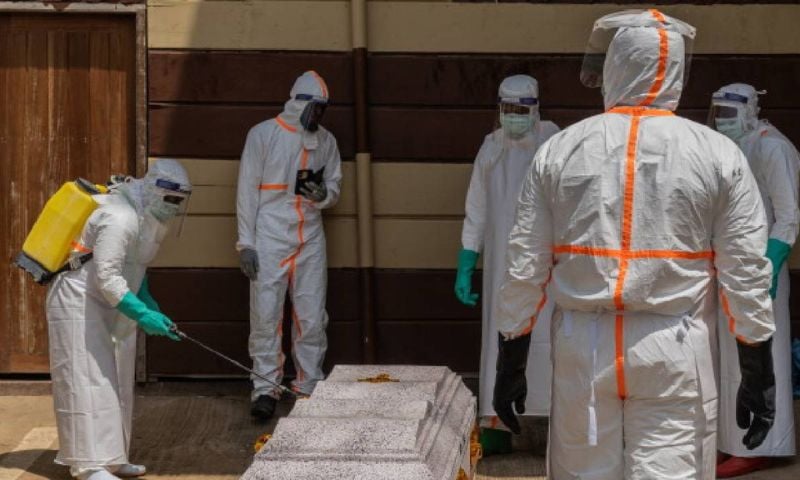
KINSHASA, Democratic Republic of Congo: The number of confirmed Ebola infections in the Democratic Republic of Congo has surpassed 1,000, with 254 deaths recorded since the latest outbreak was declared in May, according to official figures released on Monday.
The country’s National Institute of Public Health (INSP) confirmed 1,003 cases and 254 deaths, placing the fatality rate at about 25%.
The outbreak, declared on May 15, is centred in the northeastern province of Ituri. Cases have also been reported in neighbouring North Kivu and South Kivu provinces, home to an estimated 15 million people.
According to Congo’s Ministry of Health, 100 people have recovered from the disease, while at least 365 patients remain hospitalised or in isolation.
Health officials say tracing people who have been exposed to infected patients remains one of the biggest obstacles to containing the outbreak.
The Ministry of Health said contact-tracing coverage currently stands at 55%.
“If you want to control an outbreak, especially an Ebola outbreak, you must know the index case. We don’t have confidence on when this outbreak started,” Africa Centres for Disease Control and Prevention Director-General Dr Jean Kaseya told The Associated Press last week.
Authorities have yet to identify the first patient and were still trying to trace more than 35,000 contacts as of last week, officials said.
The World Health Organization has declared the outbreak an international public health emergency and warned that it could continue for months.
“The outbreak was declared around two months after the first suspected deaths were reported. During that time, the disease spread unchecked in ways we still don’t fully understand,” a representative of an international aid organisation told AFP on condition of anonymity.
The outbreak is being driven by the rare Bundibugyo strain of the Ebola virus, for which there is currently no approved vaccine or specific treatment.
Existing Ebola vaccines developed between 2018 and 2019 are effective only against the Zaire strain, which was responsible for previous major outbreaks.
The virus has also spread into neighbouring Uganda, where the World Health Organization has recorded 20 cases and two deaths. Ugandan authorities said earlier this month that the situation was under control.
More than a month into the outbreak, officials acknowledge that the disease may still be outpacing response efforts and that its full scale remains unknown.
At the Kigonze displacement camp in Bunia, the capital of Ituri province, camp officials reported 10 unexplained deaths last week, raising concerns about a possible spread of disease among the camp’s more than 20,000 residents.
No Ebola cases have been confirmed at the camp, officials said, but they described the death rate as unusual and called for an investigation.
The United Nations refugee agency said at least 2 million internally displaced people and more than 320,000 refugees live in areas at risk from Ebola in Congo.
In a statement issued on Friday, the agency said it was “deeply concerned by the accelerating spread” of the virus and the growing threat posed to displaced populations.
“If a disease or epidemic were to spread among the thousands of people living at this site, it would be a real catastrophe given our already very precarious living conditions,” said Charité Banza, a civil society leader in Ituri.