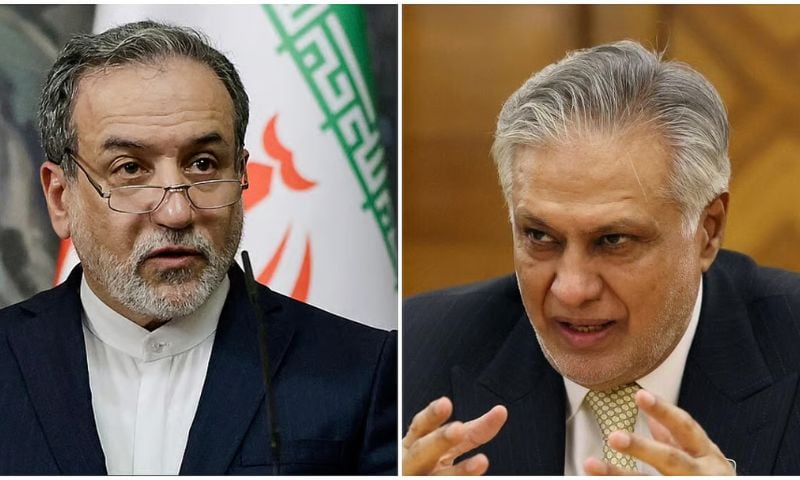
ISLAMABAD: Pakistan’s Deputy Prime Minister and Foreign Minister Ishaq Dar has reaffirmed Pakistan’s commitment to diplomacy as the primary means of resolving regional disputes, telling his Iranian counterpart Abbas Araghchi that dialogue remains the only viable route to lasting peace and stability.
According to a statement issued by the Foreign Office on Sunday, Dar held a telephone conversation with the Iranian foreign minister to discuss the rapidly evolving security situation in the region amid escalating tensions involving Iran, the United States and Israel.
During the exchange, the two leaders reviewed recent developments and emphasised the importance of preventing further escalation. Dar urged all parties to exercise maximum restraint and pursue de-escalation in accordance with the Islamabad Memorandum of Understanding (MoU) reached in June.
The deputy prime minister stressed that peaceful engagement and diplomatic efforts offered the only sustainable solution to regional disputes. He also reiterated Pakistan’s readiness to continue playing a constructive role in supporting initiatives aimed at promoting regional peace and long-term stability.
The Foreign Office said both ministers agreed to remain in close contact as the situation continues to develop.
The conversation came against the backdrop of a sharp deterioration in regional security. Iran and the United States exchanged heavy missile and drone strikes after Tehran allegedly launched attacks on US military facilities in Gulf states. The escalation followed renewed hostilities linked to the conflict involving Iran and the United States.
US President Donald Trump had earlier declared an end to a ceasefire intended to halt the fighting, while also indicating that negotiations could still continue despite the renewed violence.
The conflict has also disrupted international shipping in the Gulf. Iran announced that it had again closed the strategically important Strait of Hormuz, claiming it had fired a warning shot at a vessel travelling along an unauthorised route before disabling another ship.
Iran’s Revolutionary Guards said the waterway would remain closed until what they described as “the end of US interference in this region”.
The Strait of Hormuz, through which around one-fifth of the world’s oil supply normally passes, is a vital global energy corridor. Its closure has pushed energy prices higher and raised concerns over inflation and supply disruptions worldwide.
Meanwhile, Iranian Foreign Minister Abbas Araghchi accused the United States of breaching the ceasefire arrangement, saying that any agreement could only succeed through mutual compliance.
Separately, Iran’s senior negotiator, Mohammad Baqer Qalibaf, wrote on X that “the era of one-sided deals is over”, warning that commitments must be honoured or there would be consequences.
Pakistan has consistently called for restraint, dialogue and diplomatic engagement, maintaining that negotiated solutions remain essential for ensuring peace and stability across the region.