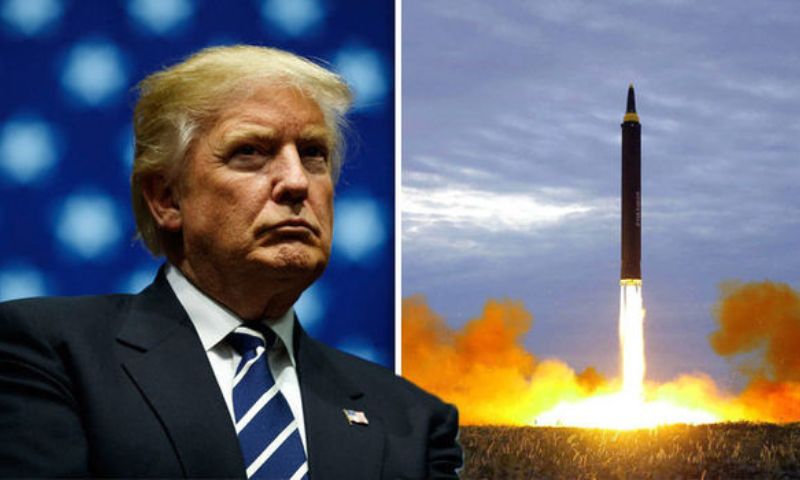
MOSCOW/BEIJING: Russia and China on Thursday strongly criticised US President Donald Trump’s order to the Pentagon to resume nuclear weapons testing, warning that the move risks undermining decades of global non-proliferation efforts and reigniting superpower tensions.
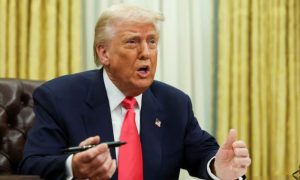
Trump made the surprise announcement on Truth Social ahead of his talks with Chinese President Xi Jinping in Busan, South Korea, saying the United States must begin testing “on an equal basis” with Russia and China.
His statement, however, did not clarify whether he was referring to actual nuclear detonations or non-explosive weapons system tests.
Global reaction to Trump’s announcement
In his post, Trump claimed the United States had more nuclear weapons than any other country and that the arsenal was modernised during his first term in office.
However, independent estimates from the Stockholm International Peace Research Institute (SIPRI) contradict that claim, showing Russia with 5,489 nuclear warheads, the United States with 5,177, and China with around 600.
‘Russia will act accordingly’
“If someone departs from the moratorium, Russia will act accordingly,” Kremlin spokesman Dmitry Peskov warned in Moscow.
The spokesman clarified that Russia’s recent testing of the Burevestnik missile did not amount to a nuclear weapons test.
“All nations continue to advance their defence systems, but this does not constitute a nuclear test,” the Kremlin spokesman said.
Earlier this week, Russian President Vladimir Putin announced successful tests of the Poseidon nuclear-powered underwater drone and the Burevestnik long-range cruise missile, both capable of carrying nuclear warheads. Russian officials said these trials did not violate international testing bans.
China calls for restraint
At a briefing in Beijing, Chinese Foreign Ministry spokesman Guo Jiakun urged Washington to “earnestly abide by” its commitments under the Comprehensive Nuclear-Test-Ban Treaty (CTBT) and its longstanding moratorium on nuclear testing.
“China hopes the United States will take practical actions to safeguard the international nuclear disarmament and non-proliferation regime and maintain global strategic balance and stability,” Guo said.
China’s last known nuclear test was in 1996, the same year the CTBT was signed. While both Washington and Beijing are signatories, neither has ratified the treaty, meaning it has not yet entered into full legal force.
Criticism from Russia and arms control experts
Russian Federation Council Vice Speaker Konstantin Kosachev said Trump’s directive violated US obligations under international law.
“Even without ratifying the CTBT, the United States is obliged to refrain from actions that would deprive the treaty of its object and purpose,” he said, citing Article 18 of the 1969 Vienna Convention on the Law of Treaties.
Kosachev argued that Washington’s actions sought to dismantle existing arms control agreements to gain unilateral military advantage.
“They have been acting impudently and self-confidently, under the illusion that they would not receive a response,” he said on Telegram.
Daryl Kimball, Executive Director of the Arms Control Association, said Trump’s statement was dangerously ambiguous.
“Trump’s post is not clear about whether he is talking about nuclear-explosive testing or flight testing of nuclear-capable missiles,” Kimball wrote on X (formerly Twitter).
“Trump’s policy is incoherent: calling for denuclearisation talks one day, threatening nuclear tests the next. A resumption could trigger a chain reaction of nuclear testing by US adversaries.”
Uncertainty over US testing plans
Speaking to reporters aboard Air Force One, Trump defended his decision, saying it was “appropriate” to begin testing again after decades.
The US President also repeated that he wanted to pursue nuclear arms reduction talks with Russia and China, describing denuclearisation as “a tremendous thing.”
The United States last conducted a full-scale nuclear test in September 1992, when a 20-kiloton device was detonated underground in Nevada.
Then-President George H.W. Bush imposed a moratorium the following month, which has been upheld by successive administrations.
Since then, Washington has relied on subcritical experiments and advanced computer simulations to ensure the reliability of its nuclear stockpile without conducting live explosions.
According to an August report by the Congressional Research Service, the United States could technically resume nuclear testing within 24 to 36 months of a presidential order.
Political opposition at home
Trump’s announcement also drew criticism from lawmakers in Washington. Nevada congresswoman Dina Titus said she would introduce legislation to “put a stop” to any plans for live weapons testing in her state.
Senator Jacky Rosen said the order “directly contradicts commitments” made by Trump’s own nominees, who previously assured Congress that explosive nuclear testing would not resume.