BEIJING: China on Monday expressed concern over the United States’ seizure of an Iranian-flagged cargo ship near the Strait of Hormuz, urging all parties to avoid escalation and sustain ongoing diplomatic efforts.
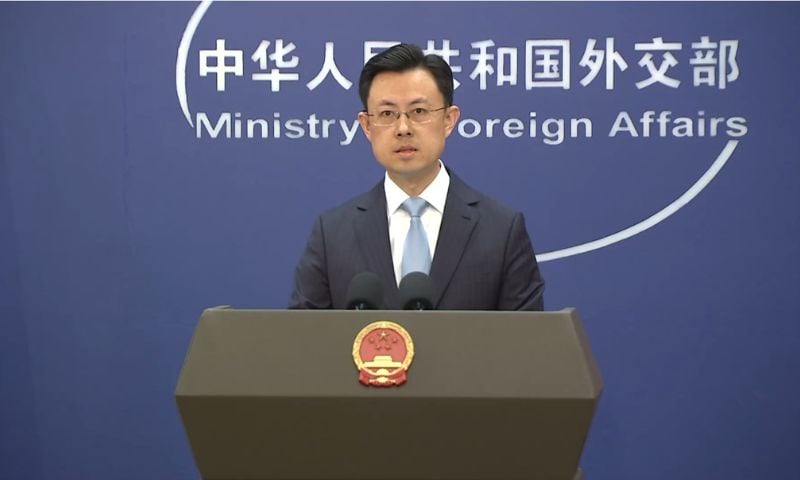
Chinese foreign ministry spokesperson Guo Jiakun described the incident as a “forced interception” and called for restraint.
“The situation in the Strait of Hormuz is sensitive and complicated,” spokesperson Guo Jiakun told a regular press briefing.
He said relevant parties should act responsibly, avoid further escalation, and “create the necessary conditions for normal transit through the strait to resume”.
On Sunday, the United States said it had fired on and seized an Iranian cargo ship that attempted to breach a naval blockade on Iranian ports.
Iran’s military condemned the incident, vowing retaliation against what it described as “armed piracy by the US military”.
China also urged all sides to maintain the progress achieved through recent diplomatic efforts.
Beijing called on relevant parties to “continue to maintain the momentum of the ceasefire and negotiations”, according to the foreign ministry.
“Now that a window for peace has opened, favourable conditions should be created to bring the war to an end as soon as possible,” Guo said.
US-Iran talks in Islamabad on track
Meanwhile, diplomatic efforts have focused on Islamabad, where a second round of US–Iran talks is scheduled to commence as the US negotiation team is set to land today.
The US and Iran have privately assured participation in a second round of talks in Islamabad, despite public rhetoric and mixed signals from Tehran.
Syed Muhammad Ali, a senior security analyst, told WE News English that both sides remain committed to dialogue and that recent statements by the US and Iranians were largely aimed at domestic audiences rather than reflecting a breakdown in diplomacy.
“Despite public posturing, both Iran and the US have assured participation in the second round of talks in Islamabad,” he said, adding that the rhetoric was primarily intended for domestic audiences and that the talks were expected to proceed as planned.
Pakistan has stepped up high-level contacts with both Washington and Tehran over the past 24 hours to keep the talks on schedule, expressing confidence that negotiations will proceed as planned.
The renewed push comes as a ceasefire between the two sides approaches its expiry on April 22, increasing pressure to secure an extension or broader agreement.
Active and constructive engagement
While Iran’s foreign ministry has said no final decision has been made on participation, Pakistani security analysts indicated that behind-the-scenes engagement remains active and constructive.
Security analysts in Islamabad said discussions are expected to focus on extending the ceasefire and moving towards a more comprehensive settlement.
Pakistan, which brokered the initial 14-day truce earlier this month, continues to position itself as an “honest broker”, facilitating communication between the two sides.
The first round of talks helped establish rare direct channels between Washington and Tehran, laying the groundwork for continued engagement despite ongoing tensions.
Security analysts said progress so far, combined with intensified diplomatic outreach, offers a realistic opportunity to sustain dialogue and prevent escalation.
US negotiators arriving in Islamabad
Pakistan’s Prime Minister Shehbaz Sharif has also remained actively engaged, holding discussions with regional leaders and Iranian President Masoud Pezeshkian to build support for the peace process.
Deputy Prime Minister and Foreign Minister Ishaq Dar has emphasised that Pakistan’s objective goes beyond a temporary truce, aiming instead for a lasting and comprehensive resolution.
On Sunday, US President Donald Trump said American negotiators would head to Islamabad on Monday.
Meanwhile, Iran’s parliament speaker, Mohammad Bagher Ghalibaf, said Tehran remained engaged in dialogue but was prepared for escalation, reflecting deep mistrust of Washington.