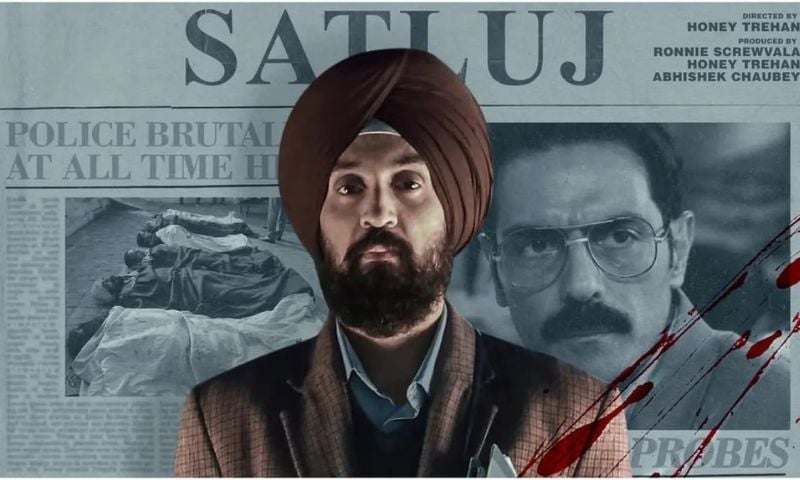
NEW DELHI: A film portraying the life and abuses uncovered by Sikh human rights activist Jaswant Singh Khalra has gained popularity in India after authorities ordered its removal from a streaming platform, with supporters organising screenings in temples and public spaces.
The removal has sparked outrage across political and religious lines. India, often described as the world’s largest democracy, has banned Satluj (formerly Punjab 95), a film portraying state atrocities against Sikhs and the courageous struggle of human rights activist Jaswant Singh Khalra.
The nearly three-hour biopic, Satluj, focuses on Khalra, who documented thousands of extrajudicial killings in Punjab during the height of the armed Sikh movement for separation and independence in the 1980s and 1990s.
The film was released on the streaming platform ZEE5 in July but was removed shortly afterwards following a government directive, according to Indian media reports.
Authorities cited security concerns, while critics argued that the action amounted to censorship and an attempt to suppress discussion of state abuses. The film’s removal has instead helped draw greater attention to it.
In Bandala village in northern India, residents have organised screenings at a Sikh temple, where hundreds of people have gathered to watch the film. Local organisers have reportedly arranged several additional screenings, while copies of the film have also circulated through social media and messaging platforms.
The film is set against the backdrop of the violent period in Punjab when an armed movement seeking an independent Sikh homeland confronted the Indian state. Thousands of people were killed during the conflict, including fighters, civilians and security personnel.
Khalra, who had previously worked at a bank, began investigating disappearances and killings after becoming involved in human rights work. He examined official records, including municipal and crematorium documents, and alleged that large numbers of unidentified bodies had been secretly cremated.
His research led him to estimate that the number of such cases across Punjab could have reached about 25,000. Khalra disappeared in September 1995 after being abducted from outside his home.
His disappearance became one of the most prominent cases associated with human rights violations during the conflict. Human rights lawyer Sarabjit Singh Verka, who has represented victims of violence in Punjab, has said that some families received compensation but that many perpetrators escaped accountability.
The film’s removal has also triggered political protests and renewed debate over freedom of expression and the limits of government intervention in cinema.
READ ALSO: India’s Democracy a Farce as film ‘Satluj’ banned for Highlighting State-Sanctioned Killings
Supporters of the ban have argued that a film dealing with the violent history of Punjab could revive separatist sentiment. Jagmohan Singh Raju, a senior official of India’s ruling Bharatiya Janata Party, said authorities were concerned that the portrayal of police violence could influence public sentiment and potentially be exploited by those seeking to revive separatism.
Critics, however, contend that suppressing the film has had the opposite effect by increasing public curiosity and encouraging people to seek alternative ways to watch it.
Film journalist Anna M.M. Vetticad described Satluj as part of a wider pattern in which films have faced pressure to alter or restrict content that is politically sensitive. The Indian Ministry of Information and Broadcasting did not respond to requests for comment on the film’s removal.
Meanwhile, screenings have continued in parts of Punjab, including at religious sites and in public spaces. Some viewers have also shared unauthorised copies through WhatsApp and YouTube.
For many young viewers, the controversy has turned the film into an introduction to a painful chapter of Punjab’s recent history. At one village screening, children told reporters they had watched the film several times and described it simply as “our history”.
The growing interest in Satluj highlights how attempts to restrict politically sensitive cultural works can sometimes generate greater public attention, particularly when the subject involves unresolved questions about human rights, state power and historical accountability.