KEY POINTS
- UK government urges FIFA to investigate after players display ‘Las Malvinas son Argentinas’ banner following semi-final victory over England
- FIFA’s anti-political messaging rules under scrutiny after Argentina’s post-match display reignites 1982 war tensions
- Argentine Vice President doubles down with provocative statements as football’s governing body faces pressure to act
ISLAMABAD: The British government has formally called on FIFA to investigate Argentina’s national team after players celebrated their World Cup semi-final victory over England by unfurling a banner asserting sovereignty over the disputed Falkland Islands, reigniting a decades-old territorial conflict on football’s biggest stage.
Argentina secured a dramatic 2-1 comeback win against England in Atlanta on Wednesday, with late goals from Enzo Fernandez and Lautaro Martinez sending the defending champions through to Sunday’s final against Spain.
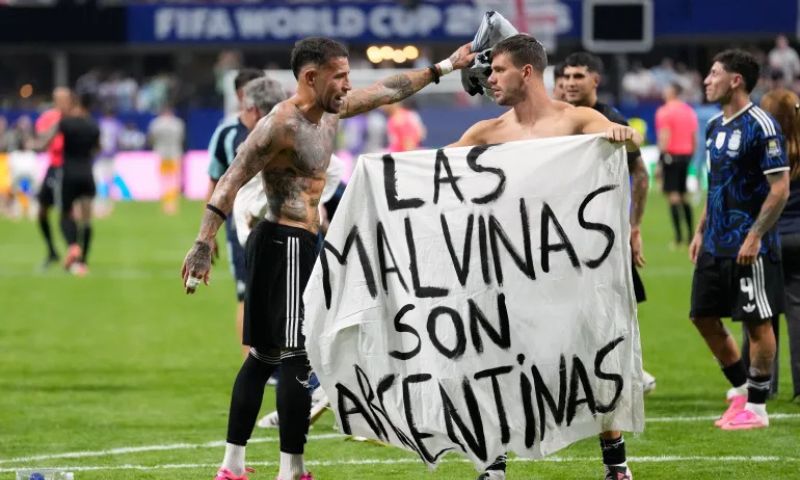
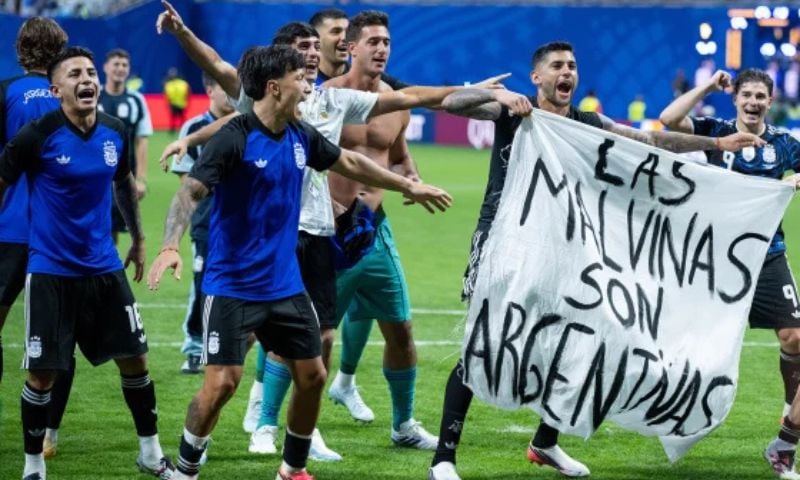
However, the on-field triumph was quickly overshadowed by political controversy when Argentina players, including Lisandro Martínez and Giovani Lo Celso, displayed a banner reading “Las Malvinas son Argentinas”, “The Falklands are Argentine”, during post-match celebrations.
WAR ON AND OFF THE PITCH! 🇦🇷🏴
Argentina players celebrate their victory over England by proudly holding up a “LAS MALVINAS SON ARGENTINAS” banner on the pitch.
Bringing the Falklands war to the World Cup—too far, or elite football shithousery? 👇 pic.twitter.com/KiSu2v00CA
— Impact Index Daily (@IndexImpact) July 15, 2026
The banner, which appeared to have been passed from supporters in the stands, directly challenges Britain’s sovereignty over the South Atlantic archipelago, a British overseas territory located approximately 300 miles off Argentina’s eastern coast.
The sovereignty dispute between the two nations culminated in the 1982 Falklands War, a 74-day conflict that claimed the lives of 649 Argentine troops, 255 British service personnel, and three islanders.
UK demands FIFA action
British Business Secretary Peter Kyle condemned the players’ actions as “entirely inappropriate” and urged football’s world governing body to conduct a thorough investigation.
“I think [an investigation] is certain to happen because it was such an egregious violation of the rules of not having political activity as part of the football,” Kyle told BBC Breakfast.
‘What they did was entirely inappropriate… but that is now a matter for FIFA.’
@PeterKyle reacts to Argentina players waving a Falklands banner at yesterday’s World Cup semi-final highlighting the England team showed ‘dignity, perseverance and real professionalism’. pic.twitter.com/DK6sf56wf8— LBC (@LBC) July 16, 2026
“The World Cup has one of its central tenets that politics is separate from football. That is now a matter for FIFA. I expect FIFA to do its investigation thoroughly,” he added.
FIFA’s political messaging rules
The incident appears to contravene FIFA’s Stadium Code of Conduct, which explicitly prohibits “banners, flags, flyers, apparel and other paraphernalia that are of a political, offensive, and/or discriminatory nature” inside stadiums. The International Football Association Board (IFAB) also mandates that “equipment must not have any political, religious or personal slogans, statements or images”.
🇦🇷🏴After beating England at the World Cup, Argentine players including Cristian Romero, Lisandro Martinez, and Nicolas Otamendi unfurled a banner reading “Las Malvinas son Argentinas”, the Falklands are Argentine.
The timing, right after beating England, was no accident.…
— Mario Nawfal (@MarioNawfal) July 16, 2026
The governing body has yet to comment on whether it will open disciplinary proceedings, though such action would follow precedent.
In 2014, FIFA fined the Argentine Football Association 30,000 Swiss francs ($37,000) after players displayed the same “Las Malvinas son Argentinas” slogan before a World Cup warm-up match against Slovenia.
Political tensions escalate
The controversy has been amplified by rhetoric from Argentina’s political leadership. Vice President Victoria Villarruel posted on X following the match, writing “it wasn’t just another match” alongside a video appearing to show Argentine soldiers.
“The Falklands are Argentine,” Villarruel wrote. “They banned bringing them to the stadium and forgot that we carry them in our blood and our hearts”. Ahead of the semi-final, she had described the match as “about putting the invaders in their place”.
🚨The Vice President of Argentina on their upcoming match vs England:
“Tomorrow we play against the usurping pirates. This isn’t just another match. Against the English, it’s always something more. It’s the Malvinas, it’s Diego, it’s Leo’s last one, and it’s putting the brakes… pic.twitter.com/EGlApV3dJe
— Polymarket Sports (@PolymarketSport) July 15, 2026
Argentina coach Lionel Scaloni had sought to downplay political connotations before the match, stating he was “not going to mix” football and politics. “The reality is that this is a football match. I can’t mix things up, especially out of respect for what happened so many years ago,” Scaloni told reporters.
However, midfielder Leandro Paredes acknowledged the historical weight carried by the fixture. “We were aware of what this match meant for the country,” he said. “We tried to represent our nation and all those who lived through that sad moment in our history”.
Argentinian vice president Victoria Villarruel on her x account talking about the match against England calling the english “usurping pirates”and they have to win for the Falklands, for Diego Maradona and for Messi’s last stand. pic.twitter.com/LLUN2KiFIG
— Crazy Ass Moments in LatAm Politics (@AssLatam) July 15, 2026
Historical context and precedent
The sporting rivalry between Argentina and England has long been intensified by political tensions over the islands, known as the Malvinas in Argentina. Argentina claims it inherited the territory from Spain after independence in 1816 and that Britain took control in 1833 through an illegal colonial act.
Britain maintains its territorial claim dates to 1765 and points to a 2013 referendum in which 99.8% of Falklands residents voted to remain British.
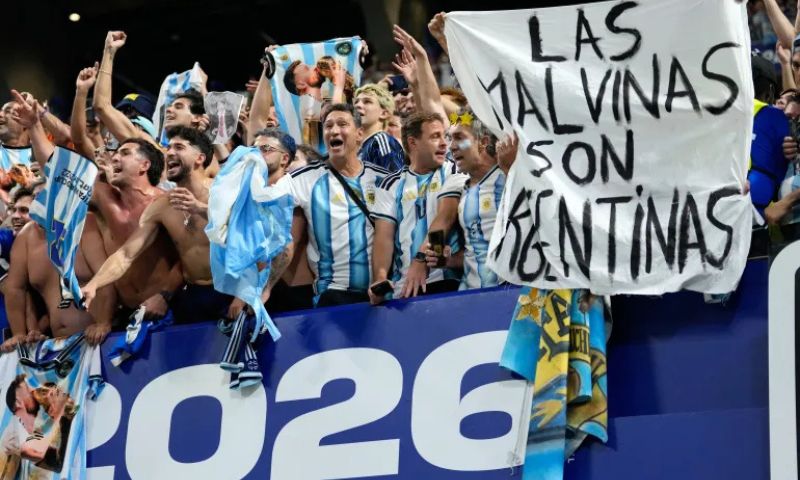
This is not the first time the Falklands dispute has surfaced at a World Cup. Argentina players sang chants referencing the islands following their round-of-16 victory over Egypt. The semi-final itself was held under increased security measures due to historical tensions between the two nations.
Read Also: Argentina Stun England with Late Comeback to Reach World Cup Final
FIFA has previously taken action against political displays. In 2012, South Korean player Park Jong-woo was banned for two World Cup qualifying matches after holding a banner asserting territorial claims against Japan at the London Olympics. Serbia was also fined 20,000 Swiss francs ($24,800) at the 2022 World Cup for hanging a political banner about Kosovo in its locker room.
Looking ahead
FIFA president Gianni Infantino is expected to attend Sunday’s World Cup final between Argentina and Spain in East Rutherford, New Jersey, alongside U.S. President Donald Trump and Argentine President Javier Milei.
Read Also: World Cup 2026: Lionel Messi Returns to Top of Golden Boot Race
It remains unclear whether any disciplinary decision will be made before the tournament concludes, as FIFA typically waits for match reports before determining sanctions.