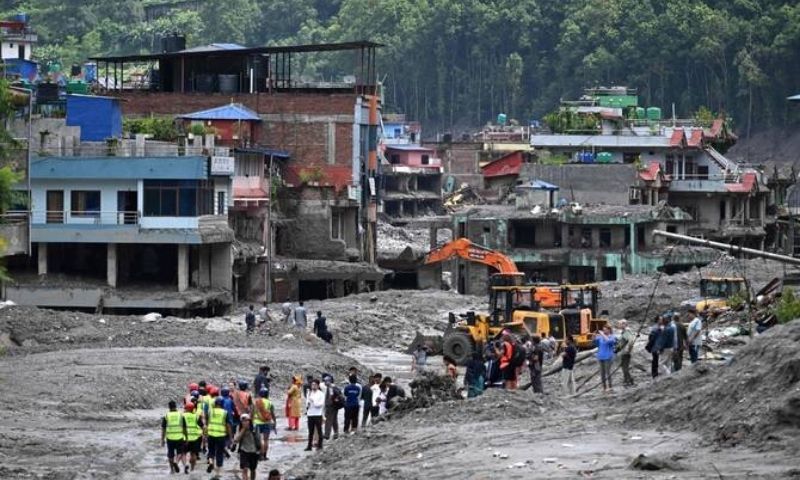
KATHMANDU, Nepal: A month after devastating floods swept through parts of Nepal, thousands of people remain displaced while rescuers continue searching for thousands missing, including people believed to be trapped inside hydropower project tunnels.
The disaster has destroyed homes, livelihoods and infrastructure, leaving the government facing a costly recovery effort and families struggling to locate loved ones and rebuild their lives.
Narayan Prassan, who had previously worked in the Gulf for five years, returned to Nepal with savings but lost his home in the 2015 earthquake. He later went abroad again, earned enough to rebuild and settled with his family.
Last month’s floods destroyed his home once more.
With the property now in a designated danger zone and no clear resettlement plan, Prassan is staying with his wife and children at a relative’s house and considering another stint overseas.
“This flood has taken everything,” he said. “I don’t know what to do.”
Rising Climate Risks
Prime Minister Balendra Shah used his first address to the United Nations General Assembly on Thursday to warn that the disaster demonstrated the growing climate risks facing the Himalayan region.
“The disaster was not just a local tragedy, but a warning to the world,” Shah said. “I ask you today: Have we really heard that warning?”
He called for greater international support for Nepal’s recovery and stronger regional cooperation to prepare for climate-related disasters.
“Climate change does not recognise borders. Glaciers and floods do not travel with stamps and passports,” he said.
Families Await Answers
Nepal’s disaster management agency said 1,453 bodies had been recovered and 5,644 people remained missing. Only 112 bodies had been handed over to relatives, while 1,333 were temporarily buried pending identification.
Authorities have established DNA collection facilities at the Nepal Police Hospital in Kathmandu, where relatives are providing samples to help identify recovered remains.
Experts from India, China, the United States, Singapore and South Korea are assisting with the identification process.
Some families have already held symbolic funerals after being unable to see or recover their relatives.
Pasang Maya Tamang, 32, lost her young son in the floods. His body was recovered three days later, but she could not travel to see him.
“I hear in my dreams him saying why I left him alone,” she said.
Recovery Underway
The government estimates reconstruction and recovery will cost $4.77 billion. Nearly 33,000 people have been affected, while about 7,500 homes were damaged or destroyed.
Authorities are prioritising the restoration of roads and bridges, particularly in remote areas where damaged infrastructure has restricted access to relief supplies.
Roads engineer Ishmita Shah said crews had been working with the army since the second day after the floods to reopen routes.
“The upcoming few days are going to be very challenging because of the weather, but we are fully prepared for that too,” she said.