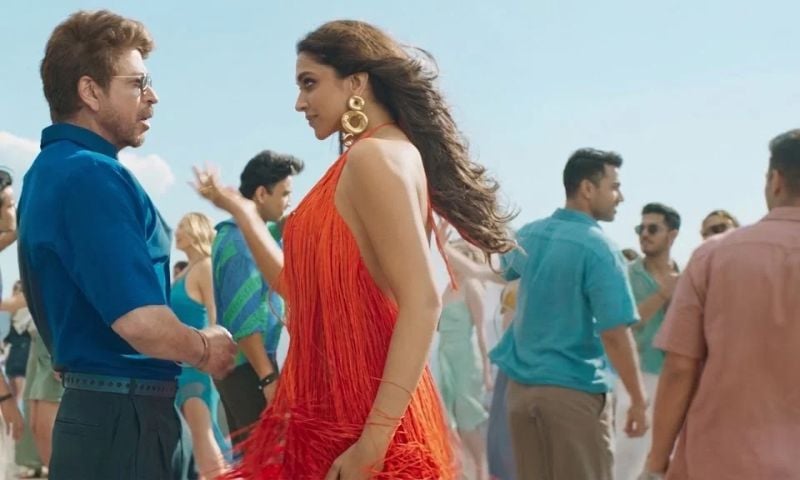
ISLAMABAD: A saffron-coloured outfit worn by Bollywood actress Deepika Padukone in a song from Shah Rukh Khan’s upcoming film King has triggered a fresh political controversy in India, after a ruling Bharatiya Janata Party (BJP) legislator attacked the actor with a communal slur and threatened nationwide protests unless the scene was removed.
The controversy surrounding the song Tu Mil Jaaye has once again brought Bollywood into the crossfire of religious and political disputes, raising questions about whether filmmakers and artists can make creative choices without facing threats of boycotts and public demonstrations.
KING currently One of the THE MOST ANTICIPATED FILMS! 👑🔥
Why King is EXTRA Special ???
– Shah Rukh Khan and Suhana Khan’s first on-screen collaboration.
– SRK and Kareena Kapoor reunite after 15 years.
– Abhishek Bachchan as the antagonist.
– Directed by Siddharth Anand.
#KING arrives in cinemas on December 24, 2026! ❤️🔥 @iamsrk
— Let’s X OTT GLOBAL (@LetsXOtt) November 3, 2026
BJP MLA Ravinder Singh Negi, popularly known as Ravi Negi, objected to Deepika’s saffron outfit, alleging that the scene was part of a conspiracy to insult Sanatan Dharma, a term commonly used to refer to Hindu religious traditions.
In remarks to Dainik Samachar, Negi called Shah Rukh Khan a “Jihadi”, accused him of earning money in India while allegedly defaming the country, and described Deepika as a pawn in what he claimed was a wider conspiracy.
He warned that protests would be organised across the country if the filmmakers did not remove the sequence, invoking religious sentiments to justify his demand.
Read Also: Nepal Blocks ‘Udta Teer’ as Bollywood’s Pakistan-Centric Formula Faces Backlash
Saffron colour becomes a political flashpoint again
The latest episode reflects a recurring pattern in which elements of popular entertainment, including costumes, songs and artistic performances, become subjects of political and religious confrontation.
Rather than limiting criticism to the film’s creative choices, Negi’s remarks turned the issue into a question of religious identity, targeting the film’s lead actor with inflammatory language.
People with Saffron Syndrome must avoid this.😭
Last time you boycotted a saffron outfit, Shah Rukh Khan smashed ₹1,050 CRORE globally. #KingMovie https://t.co/kz3H5Mg7RU
— Rajat Jain (@RajatJain) November 1, 2026
Saffron has religious significance in Hindu traditions and is also closely associated with the BJP’s political symbolism. However, its appearance in a film costume does not, by itself, establish an intention to insult any faith.
The demand to alter a cinematic scene over its colour raises a broader question: should political representatives have the authority to dictate how artists use colours and cultural symbols in fictional performances?
The latest controversy also highlights the pressure that threats of nationwide protests can place on filmmakers, even before a movie reaches cinemas.
From ‘Pathaan’ to ‘King’: Bollywood faces repeated boycott threats
The dispute has revived memories of the controversy surrounding Shah Rukh Khan’s 2023 blockbuster Pathaan, when Deepika Padukone’s saffron-coloured bikini in the song Besharam Rang prompted objections from religious organisations and political figures.
The then Madhya Pradesh home minister Narottam Mishra demanded changes to the song’s visuals and warned of a possible ban on the film in the state. The controversy eventually became a national debate over religious sentiments, censorship and artistic expression.
Read Also: Shahrukh Khan’s ‘Pathaan’ Movie Submitted to Indian Censor Board, Changes Suggested
Three years later, the same actress and a similar colour choice have again become the centre of a political dispute, this time involving another BJP legislator.
The recurrence raises concerns about whether creative expression in India’s film industry is increasingly being judged through political and religious interpretations rather than artistic merit.
This was the scene outside Shah Rukh Khan’s house last night. Police wouldn’t even let fans get close to his home because apparently Narendra Modi and Amit Shah can’t ensure the security of India’s biggest stars.
https://t.co/hNspkwpY9x— r (@bekhayalime) November 2, 2026
Religious identity enters the entertainment debate
Negi also brought actress Dia Mirza into the controversy, questioning her reported position on firecrackers during Diwali and comparing it with animal sacrifices during Eid.
His remarks extended the dispute beyond a film costume into a broader confrontation over religious practices and the public positions taken by celebrities.
Such arguments risk turning cultural and entertainment debates into tests of religious allegiance, placing artists under pressure to justify their personal views and creative decisions.
Read Also: India’s War Movies are Unreal: Top Indian Defence Analyst
While political representatives and religious groups have the right to express disagreement with films, threats of nationwide protests and the use of communal labels against individual artists raise serious questions about the space available for dissent and creative freedom.
The distinction between an individual legislator’s remarks and the official position of the BJP is also important; the reported comments do not, by themselves, establish a formal party directive.
Neither Shah Rukh Khan nor Deepika Padukone had publicly responded to Negi’s remarks at the time of the reports. The filmmakers had also not announced any decision to alter the song.
The film King, directed by Siddharth Anand, is scheduled for release on December 24, 2026.