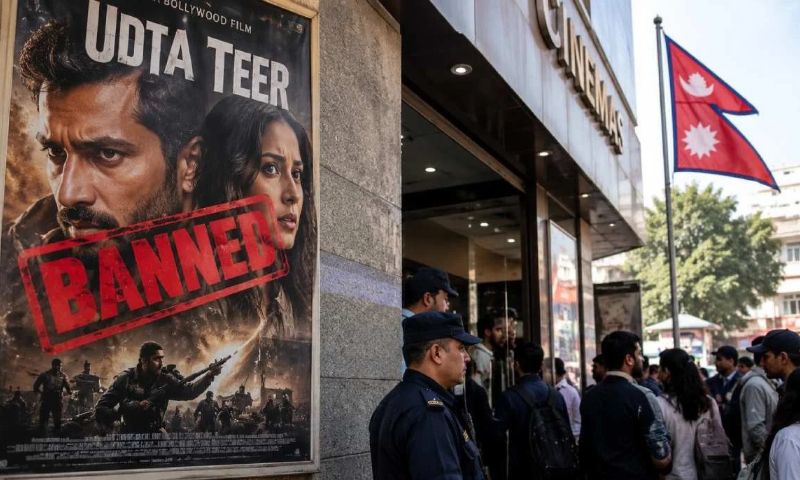
ISLAMABAD: Bollywood’s recurring reliance on India-Pakistan tensions as a cinematic selling point has come under renewed criticism after Nepal denied public-screening permission to Udta Teer, with social media users questioning whether Indian filmmakers have become so dependent on Pakistan-centred storylines that they are running short of original ideas.
Udta Teer new movie is banned in Nepal #NewMovie #UdtaTeer #breakingnews #CalvinKleinxTeeTee #TheChase #YokoatEFW26ICONSIAM #AyushmannKhurrana #Prabhas https://t.co/G4hYlgi2ii
— Quetta Wala Vlogs (@DoctorGame99) October 22, 2026
The spy comedy, starring Ayushmann Khurrana and Sara Ali Khan, was scheduled to reach cinemas on October 23. However, Nepal’s Ministry of Communication and Information Technology refused permission for its public exhibition following a review by the country’s Central Film Censor Board. The decision was communicated to the film’s distributor under provisions of Nepal’s cinema law.
Although Nepal’s official communication did not identify the specific scenes that prompted the refusal, Nepali film writer and critic Samipyaraj Timilsina reportedly linked the decision to the film’s India-Pakistan storyline.
Read Also: India’s War Movies are Unreal: Top Indian Defence Analyst
The restriction has placed fresh scrutiny on a familiar Bollywood formula: build a plot around a Pakistani spy, add patriotic messaging and political tension, and use the controversy to generate attention before release.
‘Does Bollywood have any story beyond Pakistan?’
The film has triggered criticism among Pakistani social media users, several of whom argue that Pakistan has become an overused subject in Indian commercial cinema. Some have sarcastically suggested that Bollywood should pay royalties for repeatedly using Pakistan-related themes to attract viewers and generate publicity.
Others have questioned why an industry with access to a vast pool of stories about social change, poverty, inequality, corruption, history, science, family relationships and everyday human struggles continues to return to the familiar territory of cross-border rivalry.
A report by Koimoi documented reactions from Pakistani social media users who questioned Bollywood’s repeated focus on Pakistan, with some asking whether Indian filmmakers could find other subjects for their movies.
Read Also: Bollywood Faces Criticism for Allegedly Copying Pakistani Drama Song ‘Laal Suit’
The criticism is blunt: if a film needs Pakistan to generate curiosity, controversy or a sense of patriotism, is that evidence of compelling storytelling, or an increasingly convenient commercial shortcut?
The debate does not mean every Indian film follows this pattern, nor does online criticism represent every viewer. Bollywood has produced acclaimed films across many genres. Yet the repeated return to Pakistan-related espionage and nationalist narratives has given critics grounds to question whether some producers are prioritising a politically charged formula over creative risk-taking.
Nepal’s decision challenges the controversy-as-publicity formula
For filmmakers, controversy can bring visibility, online discussion and promotional momentum. But the refusal to screen Udta Teer in Nepal demonstrates that a politically sensitive storyline can also restrict access to an overseas market.
The film’s producers may still find audiences in markets where it receives clearance. Nevertheless, the Nepal episode underscores a basic commercial reality: a controversial subject can attract attention, but it can also create regulatory and distribution obstacles.
Read Also: Beyond the Screen: How Bollywood’s Movie ‘Dhurandhar’ Exposes India’s Propaganda Machine
Rather than assuming that nationalist themes will guarantee audience interest, filmmakers could invest in more original plots that appeal to viewers across national boundaries. Political tension may provide a dramatic setting, but it cannot substitute for a strong script, layered characters and convincing performances.
An industry with millions of stories to tell
Critics argue that when Pakistan repeatedly becomes the central antagonist or a convenient source of conflict, the result risks becoming predictable rather than imaginative. A spy narrative can be gripping, but repeatedly dressing familiar political tensions in different cinematic styles does not automatically make each new film original.
Read Also: Bollywood’s Obsession with Pakistan
The sharper criticism from social media is that Bollywood appears increasingly comfortable exploiting a familiar political divide instead of taking creative risks. Some go further, questioning whether an industry that repeatedly returns to the same geopolitical subject deserves its reputation for innovation.
Patriotism is no substitute for creativity
The controversy surrounding Udta Teer raises a question that extends beyond one release: can Bollywood continue to rely on Pakistan-related narratives without exhausting audience patience or encountering further resistance in overseas markets?
Read Also: Indian Intelligence Agency Funding Anti-Pakistan Bollywood Movies Exposed
Nepal’s refusal to permit the film’s public screening has made that question more pressing. The decision is not proof that the Pakistan-centred formula has stopped making money, but it is a reminder that controversy does not guarantee universal acceptance.