
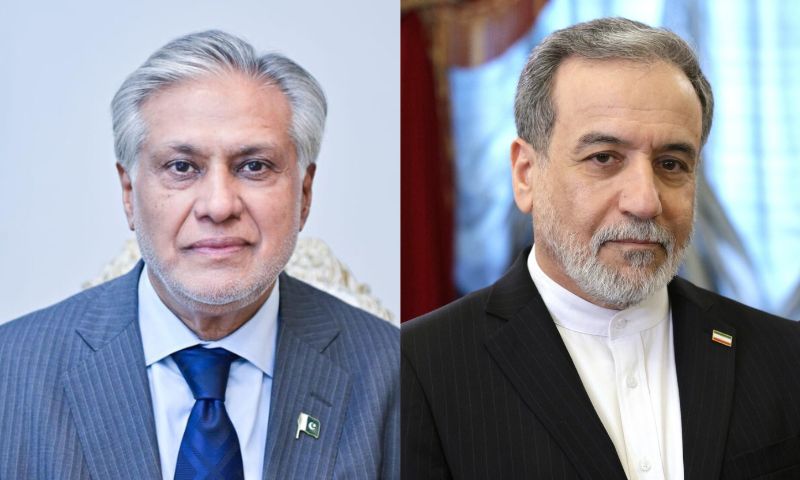
ISLAMABAD: Pakistan’s Deputy Prime Minister and Foreign Minister Ishaq Dar has said that sustained diplomatic efforts remain essential to achieving lasting peace, security and stability in the region.
Deputy PM Dar made the remarks during a phone conversation with the Foreign Minister of Iran Seyed Abbas Araghchi, a Foreign Office statement said on Thursday.
The two Foreign Ministers exchanged views on recent regional developments.
Deputy Prime Minister/Foreign Minister Senator Mohammad Ishaq Dar @MIshaqDar50 spoke with Foreign Minister of Iran, Seyed Abbas Araghchi @Araghchi.
The two Foreign Ministers exchanged views on recent regional developments. DPM/FM underscored the importance of sustained dialogue and diplomacy to address outstanding issues, emphasized the need for all parties to remain constructively engaged, and reaffirmed that active and sustained diplomatic efforts remain essential to achieving lasting peace, security and stability in the region.
— Ministry of Foreign Affairs – Pakistan (@ForeignOfficePk) November 5, 2026
Ishaq Dar underscored the importance of sustained dialogue and diplomacy to address outstanding issues, emphasized the need for all parties to remain constructively engaged.
JD Vance backs diplomatic solution to Iran war
Earlier on Wednesday, US Vice President JD Vance backed a “diplomatic solution” to the Iran war, acknowledging that the conflict was a major reason behind the Republicans’ defeat in the US midterm elections.
In a lengthy post on X, JD Vance said many voters who supported President Donald Trump and him in the 2024 presidential election had switched their support to Democrats in the midterms, with the Iran war emerging as the main reason for their decision.
“The main problem is that many people who voted for Trump/Vance in 2024 voted for Democrats in 2026,” he wrote, adding that the reasons behind the shift were clear.
Pakistan continues efforts to promote peace in Middle East
Prime Minister Shehbaz Sharif on Wednesday reiterated that Pakistan was continuing its efforts for the restoration of peace in the Middle East amid escalating global fuel prices.
The Prime Minister made the remarks while addressing a meeting of the federal cabinet. In his address, he noted that global oil prices had “skyrocketed” due to the instability in the region.
ALSO READ: Pakistan Continues Efforts to Promote Peace in Middle East: PM Sharif
“Pakistan is playing its role as before in restoring peace in the region,” he said, adding that Pakistani delegations had visited Tehran twice over the past two to three weeks as part of efforts to address the ongoing regional crisis.
Pakistan has been actively pursuing diplomatic efforts to facilitate dialogue between the United States and Iran, as regional hostilities have disrupted shipping through the Strait of Hormuz and driven up global energy prices.
Last month, Pakistan, Saudi Arabia, Turkiye and Iran agreed to continue a four-way dialogue on regional peace and security following an unprecedented meeting of senior military, defence and intelligence officials in Tehran.
Pakistan’s Chief of Army Staff and Chief of Defence Forces Field Marshal Syed Asim Munir, Saudi Defence Minister Prince Khalid bin Salman bin Abdulaziz Al Saud and Turkiye’s intelligence chief, Ibrahim Kalin, travelled to Tehran for talks with senior Iranian officials.
Pakistan brokered a ceasefire between Tehran and Washington
Pakistan brokered a ceasefire between Tehran and Washington on April 8 that halted the war involving the United States, Israel, and Iran.
On April 11, Pakistan hosted high-stakes direct talks between the US and Iranian negotiators in Islamabad.
The Islamabad Talks concluded without a final agreement; however, they paved the way for further negotiations between Washington and Tehran to permanently resolve the conflict.
The war started after the US and Israel launched strikes on Iran on February 28, prompting retaliatory action from Tehran against Israel and the Gulf countries.
The confrontation also contributed to disruptions in maritime traffic around the Strait of Hormuz.