
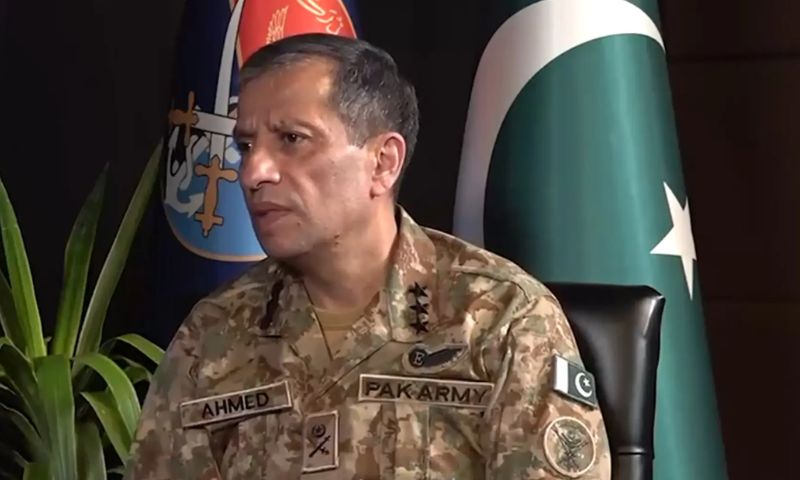
ISLAMABAD: Pakistan’s military spokesperson Lieutenant General Ahmed Sharif Chaudhry has said India is sponsoring terrorist groups operating from Afghan territory and that the Afghan Taliban regime is acting as a proxy in attacks against Pakistan.
In an interview with Reuters earlier this week, the Director General of Inter-Services Public Relations (ISPR) rejected claims that Pakistan was supporting former Afghan government officials, military figures or other groups opposed to the Taliban, questioning the credibility of the Afghan authorities.
He said Afghanistan was being governed by a non-state actor, while multiple armed groups and foreign proxies had established their presence in the country following decades of external interventions.
Chaudhry identified the Tehreek-e-Taliban Pakistan (TTP) and the Balochistan Liberation Army (BLA) as Indian-backed groups operating from Afghanistan.
He also referred to the presence of the East Turkestan Islamic Movement (ETIM), Islamic Movement of Uzbekistan (IMU), Al-Qaeda and Islamic State Khorasan Province (ISKP) in the country.
He said the presence of such groups could not be tolerated in any country, adding that their activities in Afghanistan were documented in United Nations reports and intelligence assessments by the United States and other countries.
Responding to concerns that isolating Afghanistan could worsen its humanitarian and economic crisis, the Director General ISPR said Pakistan did not want the country to be isolated but expected the Taliban authorities to fulfil their responsibilities as a state.
He said Afghanistan must stop supporting terrorism and drug production, describing them as two major sources of threats emanating from the country that endangered regional and international security.
Chaudhry said Pakistan was engaging with the Afghan authorities and urging them to stop facilitating attacks inside Pakistan and providing shelter to terrorist leaders.
He identified TTP chief Noor Wali Mehsud, BLA commander Bashir Zeb and Gul Bahadur as individuals present in Afghanistan. He further stated that terrorist formations, weapons and logistical support for attacks inside Pakistan were being provided from Afghan territory.
“If they do it, then there will be a cost,” he said, adding that Pakistan had a clear strategy and the capability to impose that cost.
Discussing the growing threat posed by drones and other emerging military technologies, the military spokesperson said the nature of warfare had changed and Pakistan’s armed forces were adapting to developments in conventional, cyber and non-contact warfare.
He said the spread of drones and other non-contact warfare capabilities among non-state actors, including the Afghan Taliban and the Houthis, posed serious security challenges and required countries to reassess their defence arrangements.
READ ALSO: India Running Terror Network in Pakistan as DG ISPR Presents Irrefutable Evidence
Asked about the Afghan Taliban’s drone capabilities, Chaudhry said Afghanistan had neither its own drone industry nor the necessary technology, maintaining that such equipment was being supplied by external sponsors.
He reiterated that India was providing support to the Afghan Taliban, adding that Pakistan had demonstrated its ability to counter sophisticated drones during its previous conflict with India.
He said Pakistan’s armed forces were better prepared operationally and possessed the capability to respond effectively to potential drone threats.
On the use of artificial intelligence and other advanced technologies in military operations, Chaudhry said Pakistan’s armed forces were adopting technologies considered essential to modern warfare.
He declined to disclose details about the military’s use of artificial intelligence, quantum technology and cyber capabilities. “We are using all sorts of technologies. We are a technology-savvy army,” he said.