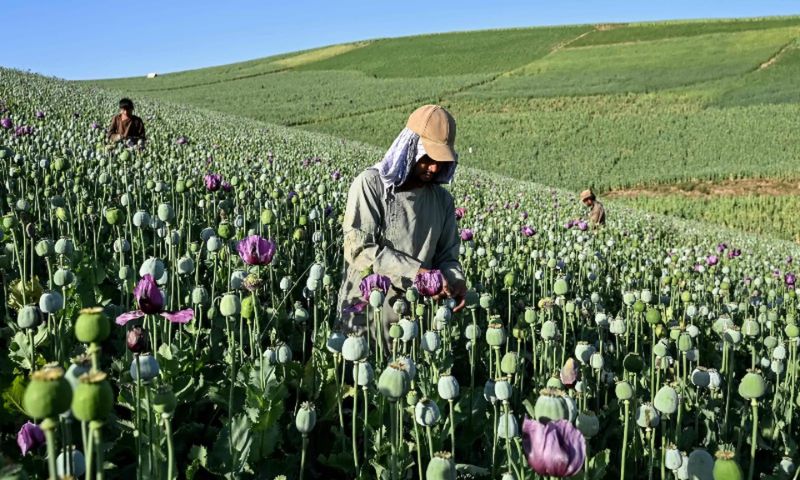
KABUL: Opium poppy cultivation in Afghanistan has surged despite a nationwide Taliban ban, with worsening poverty and a lack of viable alternatives pushing farmers back towards the lucrative crop, the United Nations said on Thursday.
The area under poppy cultivation reached 43,000 hectares (106,200 acres), up from 10,000 hectares in 2025, while estimated opium production rose fivefold to 1,500 tonnes from 300 tonnes, according to a report by the United Nations Office on Drugs and Crime (UNODC).
Afghanistan was once the world’s largest opium producer but lost that position to Myanmar following the Taliban’s 2022 crackdown on the trade. Myanmar cultivated 53,000 hectares in 2025, although figures for 2026 are not yet available.
Despite the ban, severe economic hardship has forced some Afghan farmers to resume poppy cultivation, particularly in the northeastern province of Badakhshan, which has emerged as the country’s main opium-producing region.
UNODC’s 2026 Afghanistan Opium Survey shows a sharp increase in poppy cultivation and production compared with 2025.
Why are they rising despite a nationwide ban? What can help farmers move from illicit poppy to licit crops?
Find out in the new report: https://t.co/nZJWecvS47 https://t.co/lFtOKNWN6G
— UN Office on Drugs & Crime (@UNODC) October 29, 2026
Farmers said they cannot afford even basic food without income from opium cultivation. They said Taliban authorities threatened growers and prohibited poppy cultivation, forcing them to work in fear.
However, they said income from opium was essential to meeting basic needs and life goals, including buying food, purchasing transport, building a house and getting married.
The Taliban authorities have claimed to have destroyed more than 22,000 hectares of poppy fields. However, UNODC said some farmers concealed their crops among cereal fields or behind walls, making them difficult to detect.
In May, two people were killed in clashes that broke out when Afghan security forces moved to destroy poppy fields in Badakhshan. According to a farmer, growing wheat did not generate enough income to support his family, leaving poppy cultivation as his main source of earnings.
“It is the only way to cover living expenses,” he said, adding that he would continue growing poppies despite threats from the authorities and the destruction of some crops.
The financial incentive remains substantial. According to UNODC, one hectare of wheat generated just over $770 in 2023, compared with approximately $10,000 for a hectare of poppy.
Opium prices have declined slightly, from $570 per kilogramme in 2025 to $500 in 2026, but remain well above pre-ban levels of less than $100 per kilogramme, the UN agency said.
“The fourfold increase in opium poppy cultivation shows the difficulty in sustaining decreases in illicit opium cultivation when poor farmers have no alternatives to feed their families,” UNODC Executive Director Monica Juma said.
The Taliban government has acknowledged that the ban is not a “sustainable and long-term solution” without alternative livelihoods and economic support for farmers.
The challenge has intensified as Afghanistan struggles with the return of 6.6 million Afghans since 2023, climate-related disasters, declining international aid and banking isolation following the Taliban’s return to power in 2021.
With support from Japan and the European Union, UNODC has financed programmes to help farmers switch to alternative crops and other sources of income.
Through the non-governmental organisation Afghan Aid, a 35-year-old farmer named Zikrullah, who supports an extended family of 12 in Badakhshan, received improved wheat seeds and fertiliser. “We’re satisfied, it takes less effort than opium and we’re more at ease,” he said.
Another farmer, 30-year-old Mohammad, said he had converted 80 per cent of his land to wheat. However, he warned that water shortages in recent years had affected crops other than poppy, highlighting the difficulties of switching to alternative farming.
UNODC Country Representative for Afghanistan Polleak Ok Serei said replacing poppy with other crops alone would not provide a lasting solution.
READ ALSO: Afghan Drugs Production Shifting from Poppy Cultivation to Synthetic Drugs: UN Report
He said farmers needed access to markets, including international trade, as well as better roads, irrigation systems and storage facilities.
The UNODC estimated in 2025 that the strategy would require approximately $500 million. However, only 10 per cent of the amount had been funded by donors and the Taliban authorities, according to Ok Serei.
He cited Thailand as an example, saying the country had spent 15 years investing in alternative livelihoods before beginning eradication efforts.
Ok Serei stressed that Afghanistan’s opium problem required international cooperation, as Afghan drugs were consumed across several continents.
Afghan opium remains the main source of heroin in the European Union, where approximately 850,000 people used opioids in 2024, according to the European Union Drugs Agency.
The UN representative called for a coordinated strategy to reduce demand for drugs both inside and outside Afghanistan, arguing that sustainable progress would require efforts beyond crop eradication alone.