RAJSHAHI, Bangladesh: Bangladesh is pressing India to negotiate a new Ganges water-sharing agreement before their 30-year treaty expires in December, warning that failure to reach a deal could deepen water shortages and threaten millions of livelihoods.
In Bangladesh’s drought-prone Barind region, farmers and fishing communities are already feeling the consequences of dwindling river flows.
Residents describe shrinking catches, damaged crops and increasingly uncertain access to freshwater as the river struggles to sustain livelihoods during the dry season.
“For almost three months a year, you hardly see the river flowing,” said Bikash Soren, a 72-year-old Protestant priest who remembers when large boats travelled past his village throughout the year.
The Ganges, known as the Padma in Bangladesh, flows through one of the world’s most densely populated river basins. The 2,525km river basin is home to about 655 million people, including more than 50 million in Bangladesh, according to the World Bank.
The water-sharing treaty, signed on 12 December 1996, governs the distribution of dry-season flows at India’s Farakka Barrage, about 20km upstream of Bangladesh. It has no automatic extension clause, raising the prospect of renewed uncertainty if the two countries fail to agree on a replacement.
Treaty Deadline
Bangladesh wants a new agreement based on “mutual benefit and respect”, Rashed Al Mahmud Titumir, a prime ministerial adviser who heads a technical committee on water-sharing, told AFP.
Dhaka has called for negotiations to secure its share of the river’s water, particularly during the dry season when declining flows can severely affect agriculture, fishing and access to freshwater.
Bangladesh’s Water Resources Minister Shahiduddin Chowdhury Anee has said the country wants a new or revised treaty with guarantees to protect its dry-season water supply. He hopes an agreement can be reached before the December deadline.

India, meanwhile, has said discussions on shared rivers and water-related matters fall under the framework of the Joint Rivers Commission (JRC), the bilateral body responsible for cooperation on transboundary waterways.
The latest dispute comes amid strained relations between New Delhi and Dhaka following the 2024 uprising that led to the fall of former Bangladeshi prime minister Sheikh Hasina, who fled to India.
Bangladesh has said India has not responded to its request to begin treaty-renewal negotiations. The last confirmed ministerial-level JRC meeting took place in 2022, following a 12-year gap, while technical talks were last held in May, according to the report.
Rivers at Risk
Disputes over shared waterways have shaped relations between the two countries for decades. India and Bangladesh share 54 transboundary rivers, with the Ganges among the most important.
Tensions over water intensified after India opened the 2.2km Farakka Barrage in 1975. Bangladesh accused India of diverting much of the river’s flow, prompting prolonged negotiations over how water should be distributed downstream.
The United Nations became involved in the dispute, and a five-year water-sharing agreement was reached in 1977. That arrangement later lapsed, leaving the countries without a formal agreement for years.

Sheikh Rokon, of the Dhaka-based environmental group Riverine People, said the period without a treaty had severe consequences.
“The Ganges suffered during the years without a treaty, and at least three rivers almost dried up,” he said.
One was the Gorai River, which carries freshwater towards the Sundarbans, the world’s largest mangrove forest and a UNESCO World Heritage site. Reduced freshwater flows can increase saltwater intrusion, threatening a fragile ecosystem already facing pressure from rising sea levels.
A proposed water-sharing agreement for the Teesta River, another major waterway shared by the two countries, has also remained stalled since 2011.
Farming Under Pressure
The consequences extend beyond the rivers themselves. Bangladesh’s agriculture-dependent economy is vulnerable to changing water flows, with droughts and dry-season shortages alternating with intense monsoon floods that can destroy farmland and homes.
The Ganges-Kobadak Irrigation Project, designed to irrigate 955 square kilometres of farmland, was rendered inoperative because of water scarcity, Rokon said.
Even with the 1996 treaty in force, the area served by the project has reportedly shrunk to 550 square kilometres, according to Bangladesh’s state news agency BSS.
“If the river does not carry enough water, the consequences could be disastrous,” said Chowdhury Sarwar Jahan, a geology professor at the University of Rajshahi.
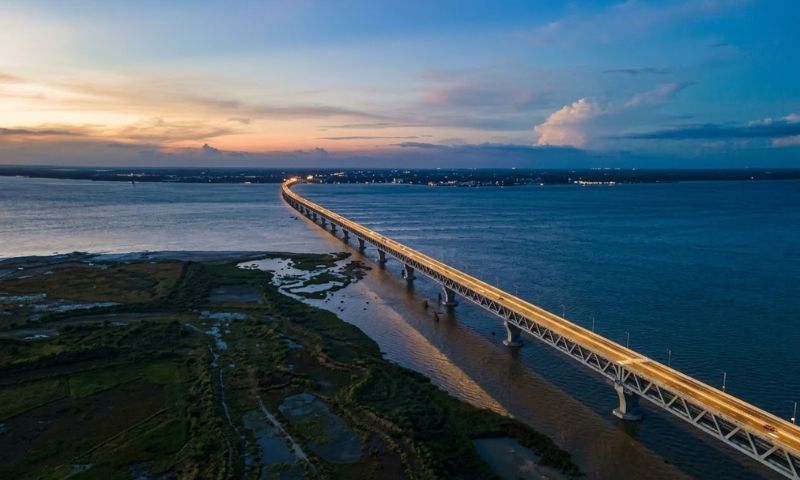
Bangladesh approved a $2.8 billion Padma Barrage project in May to help address water shortages. The proposed project also includes a 113-megawatt hydropower plant.
However, infrastructure alone may not resolve the problem without a reliable agreement governing the flow of water across the border.
Livelihoods Lost
For communities living along the river, declining flows and increasingly severe floods have brought different but connected hardships.
In Chapainawabganj district, the river has widened by about 3km in recent years, nearly doubling its size in some areas, according to Bangladesh’s Water Development Board.

Rehana Khatun, 50, described the devastation after floodwaters destroyed her home in Fielder Bazar village.
“The river turned wild and started swallowing everything along the bank,” she said. Now living in a bamboo shelter, she added: “And the trauma stays with children long after the waters recede.”
Lower water levels have also affected fishing communities. Abu Bakar Siddique, 55, has switched to raising fish in ponds after catches from the river declined.
“Where will we find fish now?” he said. “I used to catch many kinds.”
Soren said two farmers had taken their own lives during the previous season after dwindling water levels damaged their rice and wheat crops.
The accounts illustrate the human cost of water insecurity, as communities face both the consequences of insufficient dry-season flows and the destructive force of flooding.
A Difficult Negotiation
The approaching expiry of the Ganges treaty adds urgency to efforts to improve water cooperation between India and Bangladesh.
Dhaka wants stronger guarantees for dry-season supplies, while both countries must navigate competing demands for drinking water, farming, industry and environmental protection.
The outcome could affect not only agricultural production and fishing but also the health of rivers and wetlands that support communities across the region.
“If we fail to reach a deal, I fear the situation will be worse than what we experienced during the years without a treaty,” Rokon said.
“Demand for freshwater on both sides has increased significantly.”
With the 12 December deadline approaching, the two countries face mounting pressure to find common ground before the existing agreement expires.