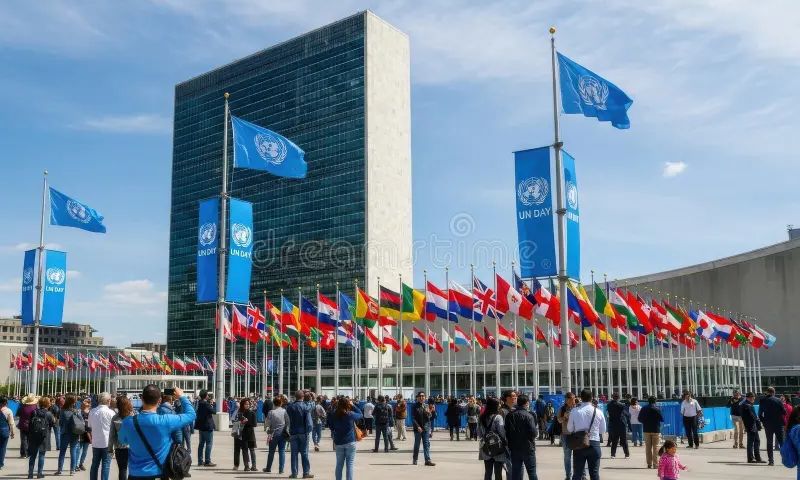
ISLAMABAD: The United Nations has warned that the veto power exercised by the five permanent members of the Security Council is hindering international efforts to prevent and resolve conflicts, as growing geopolitical rivalries weaken multilateral cooperation.
The World Social Report 2026, prepared by the UN Department of Economic and Social Affairs (DESA), says the resulting paralysis has undermined collective decision-making and highlighted the need to reform global governance institutions.
The report calls for changes to the Security Council, including an expansion of its membership to ensure fairer representation of Africa, Latin America and the Caribbean, and the Asia-Pacific region.
It notes that these regions remain underrepresented despite bearing a substantial share of the burden of peacemaking in an increasingly multipolar world.
According to the report, geopolitical fragmentation has significantly heightened global risks, with multiple centres of power competing for economic, military and political influence.
The number of countries exercising substantial influence over other countries has increased from six in the 1970s to 34 today, reflecting a significant shift in the global balance of power.
Relations between neighbouring countries have also deteriorated. In 2024-25, 59 countries recorded poor relations with their neighbours, while only 19 registered an improvement, the report says.
READ ALSO: Russia Vetoes Sudan Ceasefire Resolution at UN Security Council
The emerging international order marks a shift from the bipolar rivalry of the Cold War era towards a multipolar system in which several countries compete for economic, military and political dominance.
Although multipolarity could, in principle, strengthen multilateralism, the report cautions that geopolitical fragmentation and the pursuit of strategic dominance are undermining collective action.
These trends are encouraging countries to rely increasingly on smaller groups and selective partnerships, often described as “minilateralism” or “coalitions of the willing”.
Rising military spending adds to global risks
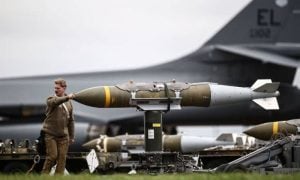
The report highlights a sharp rise in military expenditure amid intensifying conflicts and geopolitical tensions.
More than half of the world’s countries increased defence spending as a share of gross domestic product between 2020 and 2024, while all nine nuclear-armed states expanded their arsenals after 2022, it says.
Growing conflicts and geopolitical rivalries are also disrupting trade and supply chains and diverting financial and political resources away from development priorities.
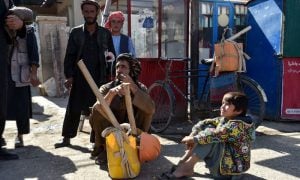
The consequences are particularly severe for low-income and vulnerable economies affected by conflict and fragility, including least developed countries.
Conflict destroys productive assets, discourages investment and weakens institutions, while displacement disrupts education, healthcare and livelihoods.
At the same time, limited financial and institutional capacity makes it harder for these countries to obtain the funding, technology and expertise required to address climate change, reduce poverty and pursue digital transformation.
UN calls for renewed international cooperation
The report stresses that accelerating climate change, rapid technological advances and geopolitical fragmentation require a new approach to development planning, with social inclusion placed at the centre of economic, digital and energy transitions. It outlines three priorities for revitalising international cooperation.
The first is to expand governments’ capacity to finance social investment through stronger international tax cooperation, improved domestic resource mobilisation and systematic support for developing countries to reduce borrowing costs and debt-servicing burdens.
The second is to widen access to technology, innovation and digital infrastructure, enabling developing countries to participate more effectively in the global economy.
The third is to reform global governance institutions to make them more representative, inclusive and responsive to contemporary challenges, restoring confidence in collective action and strengthening accountability for development outcomes.
The report says international cooperation remains essential to addressing structural challenges that individual countries cannot adequately tackle alone, including mounting debt burdens, financing shortfalls, digital taxation, technological inequalities and climate-related vulnerabilities.
It adds that, despite economic, digital and energy transformations reshaping the world at an unprecedented pace, billions of people remain excluded from the jobs, skills, services, infrastructure and social protection needed to benefit from these changes.
Strengthening multilateral cooperation, the report concludes, is therefore crucial to ensuring that global transformations deliver more inclusive development and that vulnerable populations are not left further behind.