KABUL: Afghanistan’s worsening unemployment and poverty crisis is driving families into hunger and desperation, with citizens reporting shrinking job opportunities, collapsing purchasing power and growing difficulty in securing even basic food under the Taliban regime.
The Norwegian Refugee Council (NRC) has warned that nearly 16 million people in the country lack sufficient food, while one-third of the population could face hunger in the coming winter.
Despite Taliban claims of economic progress, residents across Afghanistan say the absence of employment opportunities and declining household incomes have made survival increasingly difficult.
Shopkeepers and small business owners are also reporting mounting losses as impoverished customers can no longer afford goods beyond basic necessities.
Citizens describe a worsening economic situation, accusing the Taliban authorities of favouring their own members and associates in government recruitment while ordinary Afghans struggle to find work.
According to a resident of Kandahar, he had a university education but remained unable to secure even an ordinary job. He stated that recruitment often favoured people lacking the necessary qualifications and professional abilities.
“Unemployment here is very widespread,” he said, adding that many young people in Kandahar province were considering dangerous, irregular journeys abroad because they could see little prospect of a future at home.
He said the lack of employment had left him and others in deep despair. He also described the loss of family members who had travelled abroad in search of better opportunities, saying unemployment and injustice had intensified the suffering of ordinary households.
The economic hardship is also forcing families to consider sending children abroad through dangerous smuggling routes. A woman from Herat said she wanted to send her 16-year-old son to Iran because his father could not find work and the family was struggling with hunger.
She said many people who previously had jobs had also become unemployed as poverty deepened and employment opportunities dwindled.
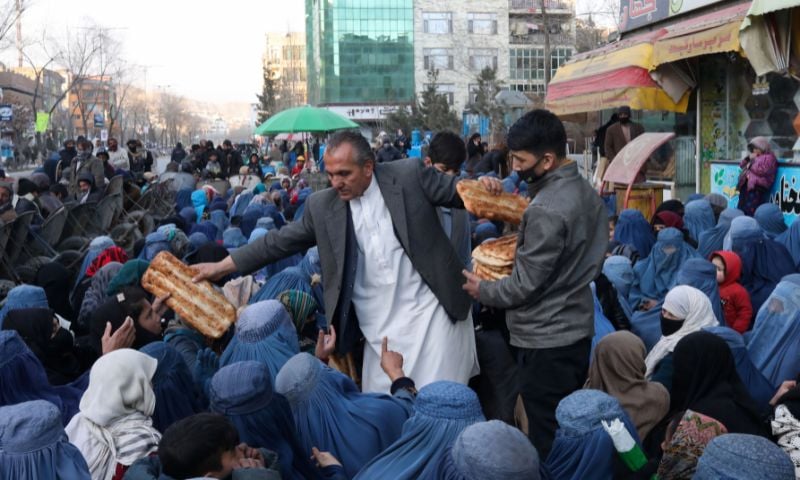
Another Herat resident said she had been unable to bring even half a loaf of bread home for two days. She attributed her predicament to extreme poverty, physical weakness and the lack of work.
The crisis has also driven some families towards begging. A journalist in Herat said that he had seen women begging alongside their husbands on roadsides after repeated attempts to find employment failed.
In Ghor province, a resident described the struggle to feed his children amid unemployment and drought. “I cannot find even a piece of dry bread to give to my children,” he said, explaining that his family had abandoned various foods and was struggling to obtain even the most basic nourishment.
The crisis is also undermining small businesses, further reducing opportunities for income and employment. According to a shopkeeper in the Tawhidabad area of central Ghazni, declining purchasing power had made his cosmetics and handicrafts business unprofitable. He said he had put his shop up for sale because he could no longer afford the rent, electricity bills and his apprentice’s wages.
“When people have no income, undoubtedly no one buys goods from us, and we suffer losses as well,” he said, adding that he was considering moving to Iran or another country.
A woman who had established a small business producing pickles and jam has also been forced to suspend operations. She said rising raw-material costs and falling consumer purchasing power had made production financially unviable.
“This year we did not produce even one kilogramme of product,” she said, explaining that impoverished households were prioritising bread over products such as pickles and jam. The mounting hardship comes amid warnings from the Norwegian Refugee Council about the scale of Afghanistan’s food insecurity as winter approaches.
NRC chief Jan Egeland said in a post on X on Friday that nearly 16 million people in Afghanistan lacked access to sufficient food. He warned that at least two million more people had been added to the number facing inadequate food access this year.
A third of the population of Afghanistan will go hungry this winter.
Close to 16 million people are currently unable to access the food they need as inflation, high unemployment, climate change and diminishing aid collide – 2 million more than this time last year. And this number will rise further if action is not taken today.
Mothers I met last month in Kabul and Kandahar told me they have too little food for their children, and feared the coming winter.
This is the consequence of the abandonment of Afghanistan since the Taliban took over – now among the worst funded humanitarian responses in the world.
We need an urgent scale up in support – particularly for women and children and those recently returned from Iran and Pakistan – to prevent families going hungry and the situation worsening further.
— Jan Egeland (@NRC_Egeland) October 16, 2026
Egeland attributed the crisis to the combined effects of inflation, high unemployment, climate change and reductions in humanitarian assistance.
He warned that the number of people struggling to obtain sufficient food could continue to rise without urgent intervention. He also highlighted the fears of mothers facing another winter of hunger and hardship.
The accounts from Kandahar, Herat, Ghazni and Ghor illustrate how unemployment, drought, rising costs and declining purchasing power are affecting households and small businesses across Afghanistan.
Preferential recruitment under Taliban rule has further fuelled public frustration, while the lack of viable livelihoods is prompting some families to consider dangerous migration routes.
With winter approaching and millions already facing food shortages, the growing crisis presents a major challenge for Afghanistan’s de facto authorities, whose claims of economic improvement are increasingly at odds with the hardship described by ordinary citizens.