










The World Championship of Legends (WCL) sells a simple idea: former international cricketers, old rivalries and one more look at players who defined an era. No fixture delivers that better than India against Pakistan, and in 2026 the tournament will not have it.
Pakistan Champions confirmed their withdrawal during the opening week of the competition, which began on October 3, after the Pakistan Cricket Board declined to issue the No-Objection Certificates its players needed. The side, to be led by Shahid Afridi, had been expected to include Shoaib Malik, Mohammad Hafeez, Sarfaraz Ahmed and Wahab Riaz.
Pakistan Champions team owner Kamil Khan formally requested the board to reconsider, and the organisers postponed Pakistan’s match against Bangladesh while talks continued. The PCB did not move. Pakistan Champions said they were disappointed but accepted the board’s authority.
No verified figure exists for what the absence will cost the tournament. The commercial logic is plain enough: an India-Pakistan match reaches an audience few fixtures can match, across South Asia and its diaspora.
How 2025 Set It Up
The 2026 withdrawal was the end of a dispute that began a year earlier. In the 2025 edition, India Champions refused to play Pakistan Champions in the group stage and later withdrew from their semi-final against them. The group match was abandoned and the points shared; Pakistan advanced to the final, where they lost to South Africa Champions.
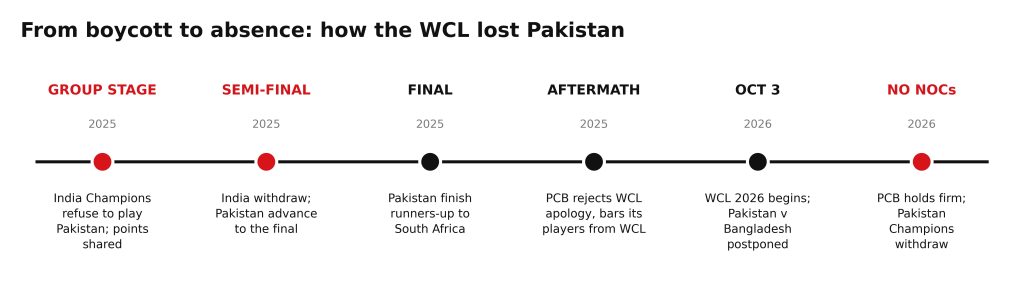
Twelve months from the first boycott to Pakistan’s exit.
The shared point was the sharpest grievance. India earned it without playing, and it helped them reach the semi-finals. For the PCB, the issue was not only a cancelled match but a boycott that carried a competitive reward. Its statement at the time was unusually blunt, describing a cancellation “not based on cricketing merit but on appeasing a specific nationalistic narrative”.
The board also objected to the WCL’s apology for “hurting sentiments”, reading it as an admission that political considerations had outweighed sporting fairness, and announced that Pakistani players would no longer take part in the competition. When the 2026 edition approached, it simply held that position. This was not a scheduling clash or a late change of heart by individual players, but a stance the board had framed as a matter of principle twelve months earlier.
When Sponsors Pick a Side
The 2025 edition also showed that commercial backing could turn with the political mood. EaseMyTrip, one of the tournament’s prominent sponsors, announced before the semi-final that it would not associate with matches involving Pakistan.
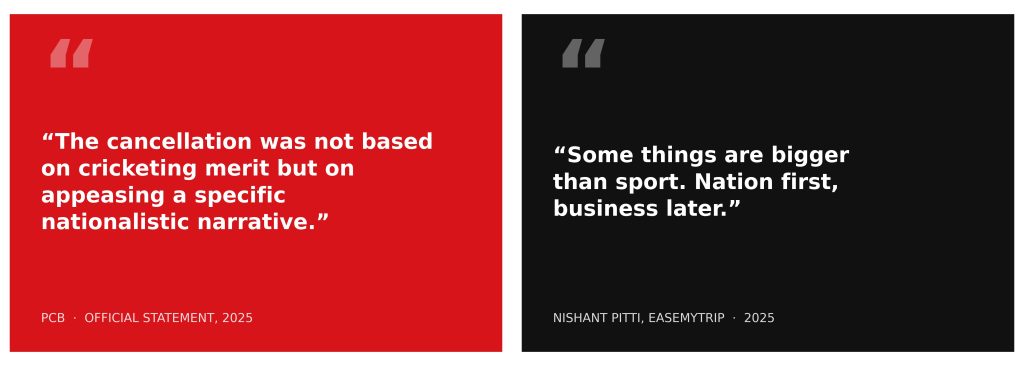
Two statements that framed the dispute from opposite sides.
That left the organisers caught between two pressures. Keeping Pakistan risked alienating partners in India, cricket’s largest commercial market. Accommodating the boycott damaged the credibility of a competition marketed around international rivalries. The apology satisfied neither side, and the fixture meant to anchor the tournament became its biggest liability.
Why ICC Events Hold Where Private Leagues Struggle
India and Pakistan still meet at ICC events despite the state of relations between the two countries. The reason is not that international cricket is free from politics, but that the structure around it is different.
At ICC tournaments, participation rests on formal agreements between the governing body and its members, and withdrawals can carry financial and sporting consequences. The value of those events gives every stakeholder a strong reason to negotiate rather than walk away. The ICC’s framework has its limits, however; its events, too, depend on negotiation between boards and, at times, governments.
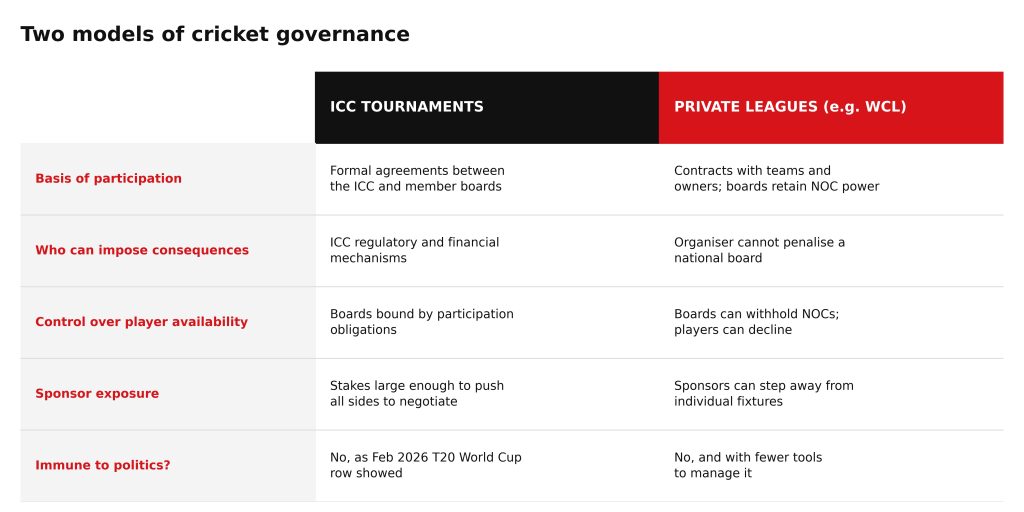
The difference is institutional leverage, not immunity from politics.
A private league has fewer levers. Some competitions require ICC sanction and must meet conditions on player payments and integrity, but approval to stage an event does not guarantee that every match is played. The WCL cannot penalise a national board or compel a retired player to take the field. The PCB, by contrast, needs only to withhold clearances. The organiser carries the commercial risk; the boards control the players on whom the event depends.
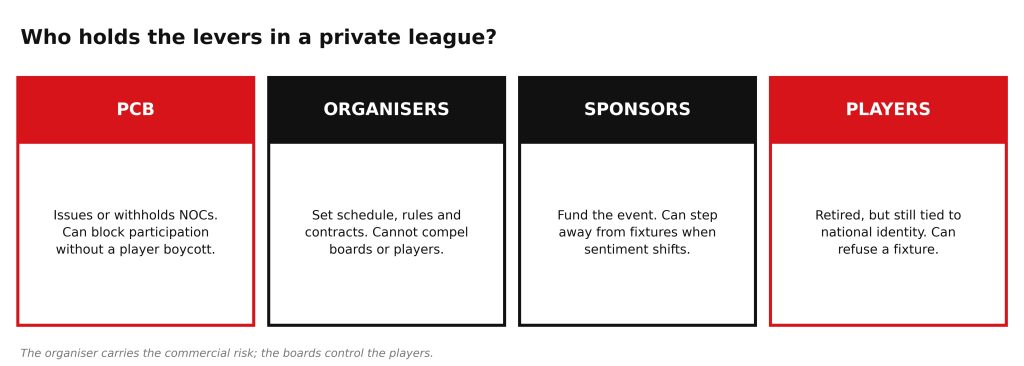
Four parties, and only one of them carries the commercial risk.
What Does This Mean for Future India-Pakistan Matches?
The WCL withdrawal should not automatically be read as a preview of every future India-Pakistan encounter. The two countries’ international cricket relationship is governed by different arrangements, and major ICC events have their own participation obligations, commercial stakes and diplomatic considerations.
But the dispute offers a warning about the limits of assuming that a scheduled fixture will necessarily take place.
In international cricket, India-Pakistan matches are valuable to broadcasters and tournament organisers because of the extraordinary interest they generate. That value creates pressure to find solutions when political disputes threaten participation. Yet commercial importance alone does not compel either country to play: decisions can still be shaped by government positions, board negotiations and the wider political environment.
The WCL operates with fewer institutional tools to manage those pressures. It cannot rely on the same multilateral framework as an ICC tournament, and it has less leverage when a national board refuses to release its players.
The episode also illustrates why exhibition cricket is not necessarily less political than international cricket. Retired players may no longer be part of their countries’ active international squads, but their public identities remain closely tied to national teams. Their participation in a private league can become a political statement regardless of whether the organisers intended it to be one.
That reality has implications for other franchise competitions seeking to bring together players from countries whose political relations are strained. Organisers will need to consider not only the sporting schedule and commercial contracts, but also the conditions under which teams and players can withdraw.













