
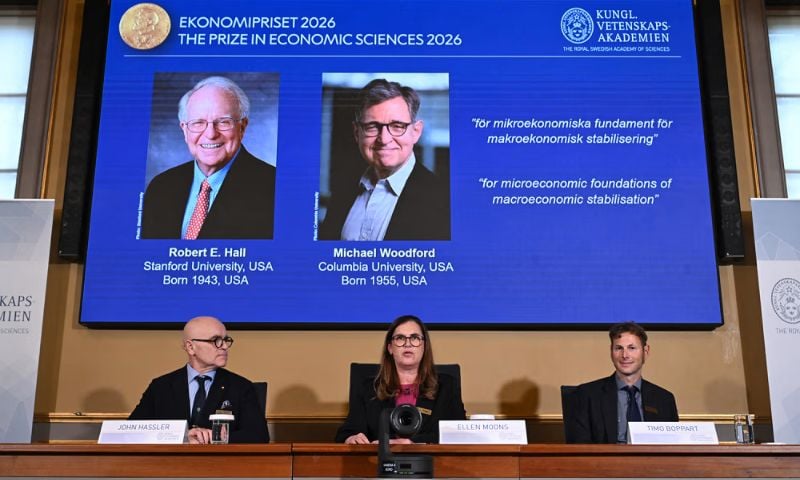
STOCKHOLM, Sweden: Two American economists, Robert Hall and Michael Woodford, were awarded the 2026 Nobel Prize in Economic Sciences on Monday for developing models that explain how monetary and fiscal policies can help stabilise economies during recessions and other periods of economic turbulence.
BREAKING NEWS
The Royal Swedish Academy of Sciences has decided to award the 2026 Sveriges Riksbank Prize in Economic Sciences in Memory of Alfred Nobel to Robert E. Hall and Michael Woodford “for microeconomic foundations of macroeconomic stabilisation.”#NobelPrize https://t.co/2i7ktB1Q2b
— The Nobel Prize (@NobelPrize) October 12, 2026
The Royal Swedish Academy of Sciences honoured the economists for their contributions to understanding how governments and central banks can reduce economic fluctuations through well-timed policy decisions, particularly when traditional approaches fail to deliver the desired results.
“On the basis of these models, well-timed fiscal and monetary policy measures can reduce the economy’s peaks and troughs,” the prize committee said.
Hall, 83, a professor at Stanford University, and Woodford, born in 1955 and a professor at Columbia University, independently developed approaches that strengthened the theoretical foundations of modern economic policymaking.
Read Also: South African Jurist Wins 2026 Nobel Peace Prize
New models reshape economic policy
The academy said conventional economic models rooted in the theories of British economist John Maynard Keynes had long helped policymakers determine when government intervention could support growth and economic stability.
However, the oil shocks of the 1970s exposed limitations in the Keynesian models then used to guide economic decisions, prompting economists to explore alternative frameworks.
Hall and Woodford developed models based on microeconomic foundations rather than relying primarily on statistical relationships between major economic indicators such as inflation, production and consumption.
“This affects our lives in a very concrete way.”
Following the announcement of the prize, we spoke to Timo Boppart, member of the committee for the prize in economic sciences. Boppart explained how the work by this year’s laureates Robert E. Hall and Michael Woodford is used around the world by policy institutions, central banks and governments.
— The Nobel Prize (@NobelPrize) October 12, 2026
Their work examines how the collective decisions of households and businesses influence the wider economy, including how people decide whether to spend or save based on their expectations of future economic conditions.
This approach also highlights the importance of communication by governments and central banks. Clear signals about future policy decisions can shape public expectations and influence household spending, saving and business investment.
Read Also: Kagan, Soai Win 2026 Nobel Chemistry Prize for Solving Century-Old Molecular Mystery
A foundation for central banks and governments
John Hassler, chair of the Committee for the Prize in Economic Sciences, said the laureates’ work had established a theoretical foundation for economic models now used by central banks and governments around the world.
Woodford expressed surprise and delight at receiving the award, describing it as a tremendous honour during a telephone conversation with reporters following the announcement.
He said his research had not been driven by a particular political agenda but aimed to improve the foundations of economic policy discussions and contribute to public understanding of how economies are managed.
Congratulations to Robert E. Hall, winner of the 2026 Nobel Memorial Prize in Economic Sciences. The professor emeritus of economics and @HooverInst senior fellow emeritus shares the prize with Michael Woodford for developing macroeconomic models built on how households and businesses actually make decisions. Those models have helped governments and central banks time their policies to soften economic shocks.
📸: Patrick Beaudouin
— Stanford University (@Stanford) October 12, 2026
The Nobel Prize in Economic Sciences differs from the original five Nobel awards established under the will of Swedish scientist Alfred Nobel, who died in 1896. It was created in 1968 through a donation from Sweden’s central bank and is administered through a selection process similar to that of the other Nobel prizes.
Last year, the economics prize was awarded to Joel Mokyr, Philippe Aghion and Peter Howitt for their research into technological progress and its role in economic growth.
Read Also: Nobel Prize Money Rises to Record 12 Million Kronor in 2026
The 2026 economics laureates will receive a diploma, a gold medal and prize money of approximately $1.2 million. The award ceremony is scheduled for December 10, the anniversary of Alfred Nobel’s death.