RIYADH: Saudi Arabia’s Energy Minister Prince Abdulaziz bin Salman bin Abdulaziz on Monday underscored that navigating energy crises requires a strong focus on flexibility and maintaining a broad range of options and alternatives to respond effectively to emerging circumstances.
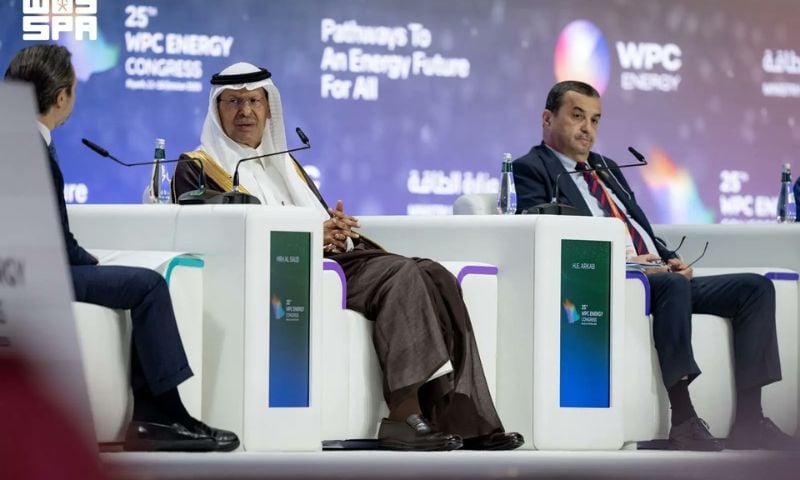
The Saudi minister’s remarks came during a ministerial dialogue titled “Perspectives on Global Oil and Gas Markets” at the 25th WPC Energy Congress in Riyadh. Saudi Arabia is hosting the congress for the first time in its more than 90-year history. The event runs through 15 October as part of Energy Week in Riyadh, the Saudi Press Agency (SPA) reported.
Energy Minister Highlights Saudi Advance Planning for Crises, Importance of Diverse Options to Address Emerging Circumstances.
https://t.co/aKRxjDZ0SA
#SPAGOV https://t.co/jW4VU61iGM— SPAENG (@Spa_Eng) October 12, 2026
The session also featured Algeria’s Minister of State, Minister of Hydrocarbons and Mines Mohamed Arkab; Nigeria’s Minister of State for Petroleum Resources (Oil) Heineken Lokpobiri; and OPEC Secretary General Haitham Al Ghais.
Prince Abdulaziz stressed the importance of being fully prepared in advance for a range of potential scenarios, with plans and capabilities in place before they materialise.
He said that recognising that challenges to energy security or supplies can arise enables countries to prepare for them and respond effectively when they occur.
Prince Abdulaziz said the energy sector has demonstrated considerable resilience over recent decades in overcoming successive challenges, despite the duration and impact of recent energy crises compared with those of the past.
He pointed to the conditions facing the sector today and the challenges it has confronted over the past eight months, describing the current crisis as unprecedented in its duration.
Turning to net-zero ambitions and energy transitions, Prince Abdulaziz addressed the implications of recent events for long-term investment in hydrocarbons. He said the issue was not whether to remain committed to net zero, but rather the need to strike a comprehensive balance between energy security, sustainability, price stability and affordability.
The Saudi minister warned that disregarding economic fundamentals and energy security considerations could increase operating costs and exposure to emergencies, calling instead for a more flexible approach capable of accommodating these considerations rather than an excessive fixation on net zero.
Prince Abdulaziz also noted that Saudi Arabia, while a leading oil producer, is also setting records in renewable energy, battery storage and other areas, while achieving highly competitive costs.
The Kingdom’s ambition, he said, is to continue expanding these capacities to meet future demand, including additional demand driven by artificial intelligence.
Addressing the current disruption to energy supplies and the role of Saudi Arabia’s East-West Pipeline in mitigating its impact, Prince Abdulaziz reviewed the historical and strategic foundations of the Kingdom’s pipeline infrastructure.
He explained that the strategic East-West Pipeline originated as a pioneering initiative under the direction of the late Custodian of the Two Holy Mosques King Fahd bin Abdulaziz Al Saud in the early 1980s to diversify the Kingdom’s export outlets. In the 1990s, clear directives were issued to increase its capacity to 5 million barrels per day.
Prince Abdulaziz added that the infrastructure underpinning the East-West Pipeline and other strategic projects, including the Master Gas System and its expansions, was developed with government funding and support, with the state bearing the costs before these assets later contributed to enhancing the investment value of the Kingdom’s national infrastructure.
He said development plans are under consideration to enhance pumping stations, transmission pipelines and the gas system, with the aim of increasing the East-West Pipeline’s throughput capacity to around 10 million barrels per day in the coming years. Such investments, he said, reinforce the Kingdom’s role as a key pillar of global energy supply security and market stability.
Algeria’s Minister of State, Minister of Hydrocarbons and Mines Mohamed Arkab expressed his country’s solidarity with Saudi Arabia and strongly condemned the attacks against the Kingdom, affirming Algeria’s support for Saudi Arabia under the current circumstances.
Arkab said Algeria is moving forward with the development of its energy infrastructure, focusing on projects to increase production and expand crude oil transportation and refining capacity.
These efforts, he said, are intended to strengthen domestic downstream industries while contributing to the balance and stability of global oil and gas markets.
He noted that growth in emerging economies continues to support strong demand for energy, particularly natural gas.
Algeria, he said, is preparing to launch a new 2026 exploration and production licensing round covering seven promising hydrocarbon areas, building on the investment framework established by the country’s 2019 Hydrocarbons Law to attract international partners and increase investment in the sector.
Arkab added that Algeria currently exploits only around 47% of its mining domain, leaving significant scope for further exploration and production.
The country is also continuing to develop its gas export infrastructure and strengthen connectivity with European markets.
He also said feasibility studies for the Trans-Saharan Gas Pipeline have been completed and field-route implementation has begun. The project is designed to transport 20 billion cubic metres of gas to Europe, with the potential to increase volumes to 30 billion cubic metres.
Nigeria’s Minister of State for Petroleum Resources (Oil) Heineken Lokpobiri highlighted the depth of the strategic partnership between Nigeria and Saudi Arabia.
He pointed to the structural and regulatory reforms Nigeria has undertaken over the past three years to attract international and domestic investment in exploration and production, strengthen export capacity and meet market needs.
OPEC Secretary General Haitham Al Ghais warned of the cumulative shortfall in global investment in the oil and gas sectors, noting that OPEC estimates investment requirements in the two sectors at approximately $18 trillion through 2050.
Al Ghais commended Saudi Arabia’s policies and highlighted the East-West Pipeline as a genuine insurance policy for global energy security amid market volatility and growing energy demand driven by urbanisation and advances in artificial intelligence.