ISLAMABAD: Pakistan’s Deputy Prime Minister and Foreign Minister Ishaq Dar has called for stronger multilateral cooperation, adherence to international law and reform of the United Nations to address growing geopolitical tensions, conflicts and emerging global challenges.
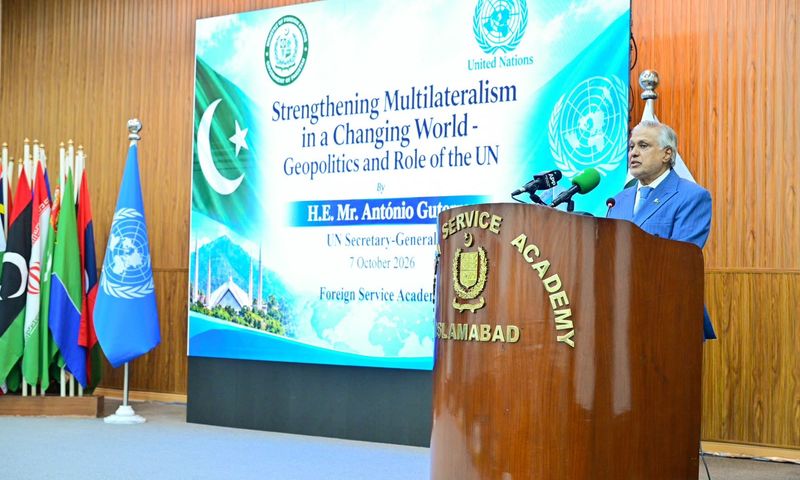
Addressing a gathering at the Foreign Service Academy in Islamabad on “Strengthening Multilateralism in a Changing World: Geopolitics and the Role of the United Nations”, Deputy PM Dar said the international order was undergoing profound change amid shifting power balances, geopolitical competition and rapid technological advances.
UN Secretary-General António Guterres was also present on the occasion.
Ishaq Dar said growing interdependence among states was being accompanied by a weakening willingness to act collectively, making effective multilateralism more important than ever.
Deputy Prime Minister/Foreign Minister Senator Mohammad Ishaq Dar @MIshaqDar50 delivered remarks at a talk by UN Secretary-General António Guterres @antonioguterres on “Strengthening Multilateralism in a Changing World – Geopolitics and the Role of the United Nations”, arranged by the Foreign Service Academy.
In his remarks, the DPM/FM reaffirmed Pakistan’s unwavering commitment to the purposes and principles of the UN Charter. He underscored that multilateralism, with the United Nations at its core, remains a fundamental pillar of Pakistan’s foreign policy.
The DPM/FM also reiterated the need to uphold international law and implement UN Security Council resolutions. He stressed the importance of diplomacy and a just and peaceful settlement of the Palestinian question and the Jammu and Kashmir dispute.
The UN Secretary-General highlighted Pakistan’s generosity, resilience, and solidarity over his two decades of service to the United Nations, including as High Commissioner for Refugees. He warned that the world is now facing a series of interconnected challenges—conflict, inequality, climate change, and artificial intelligence—stressing that stronger multilateral cooperation through a reformed and more representative United Nations is essential. He concluded by expressing confidence in the people of Pakistan and their spirit of dialogue, cooperation, and mutual respect.
The talk was attended by members of the diplomatic corps, representatives of think tanks, and officers of the Ministry of Foreign Affairs.
— Ministry of Foreign Affairs – Pakistan (@ForeignOfficePk) October 7, 2026
Rising conflicts underline need for cooperation
Dar noted that 65 armed conflicts involving at least one state were recorded in 2025, the highest number since 1946, while selective application of international law, widening inequalities and climate emergencies were further fuelling instability.
“Confidence in international institutions is fast eroding precisely when cooperation is most urgently needed,” he said.
The deputy prime minister stressed that a more multipolar world would not automatically become more peaceful or equitable.
“It needs effective institutions through which power is exercised responsibly, differences are managed peacefully, and common challenges are addressed collectively,” he said.
Video of the remarks by Deputy Prime Minister/Foreign Minister Senator Mohammad Ishaq Dar @MIshaqDar50 on “Strengthening Multilateralism in a Changing World: Geopolitics and the Role of the United Nations” at the Foreign Service Academy, Islamabad. https://t.co/qkxAXdRkJY
— Ministry of Foreign Affairs – Pakistan (@ForeignOfficePk) October 7, 2026
UN remains central to global diplomacy
The UN continues to play an important role in international affairs, he said, noting that states continued to turn to the Security Council for endorsement of diplomatic initiatives and support for peace agreements.
Even initiatives negotiated outside the UN often sought its backing, he added, demonstrating the continuing value and international legitimacy of the multilateral system.
Dar also highlighted the contribution of UN peacekeepers in maintaining ceasefires, protecting civilians and preserving space for political solutions.
As one of the leading troop-contributing countries, Pakistan took pride in its contribution to UN peacekeeping, he said, adding that Pakistani peacekeepers had sacrificed their lives under the UN flag in the service of peace.
Humanitarian agencies need protection, access
Dar also commended UN humanitarian agencies and their personnel for continuing to deliver life-saving assistance in conflict zones, including Gaza and Sudan.
He said humanitarian workers remained on the ground despite conflict, obstruction and grave personal risks, and continued to uphold humanitarian principles.
“Their courage must be matched by protection, unimpeded access, and adequate resources,” he said.
He also pointed to counter-terrorism as another area where the UN had demonstrated the practical value of multilateral action.
Dar said Pakistan had remained an active partner in international counter-terrorism efforts, drawing on its extensive experience and commitment to combating terrorism in all its forms.
Pakistan advocates four priorities
He outlined four priorities that he said were essential to making the multilateral system more effective.
First, he called for consistent adherence to the UN Charter and international law, saying sovereign equality, territorial integrity, non-interference, the prohibition of the threat or use of force and the right to self-determination must be respected.
Treaty obligations and Security Council resolutions must also be implemented, he said, adding that a just and peaceful settlement of the Palestinian question and the Jammu and Kashmir dispute remained fundamental tests of this commitment.
UN Secretary-General António Guterres @antonioguterres visited the Foreign Service Academy today, where he was received by Deputy Prime Minister/Foreign Minister Senator Muhammad Ishaq Dar @MIshaqDar50.
The UNSG signed the Visitors’ Book before delivering a keynote address to the diplomatic community in Islamabad and young diplomats of the Foreign Service of Pakistan.
— Ministry of Foreign Affairs – Pakistan (@ForeignOfficePk) October 7, 2026
Second, Dar called for diplomacy to remain at the centre of international relations.
He cited UN Security Council Resolution 2788, adopted unanimously during Pakistan’s Security Council presidency in July 2025, saying it reaffirmed the primacy of peaceful settlement.
He also highlighted Pakistan’s diplomatic role in facilitating Iran-US direct talks in Islamabad after 47 years, followed by a ceasefire and the Islamabad Memorandum of Understanding, which helped avert a potentially catastrophic global crisis.
Dar also referred to Pakistan’s support for the Gaza Peace Plan through the Group of Eight Arab-Islamic countries in 2025, describing these efforts as practical manifestations of Islamabad’s commitment to negotiated solutions.
Call for UN Security Council reform
Third, Dar stressed the need to strengthen the UN’s legitimacy and capacity to deliver.
He called for Security Council reform that would expand elected representation and accountability while limiting privilege, permanence and veto powers.
“Reform for all, privilege for none,” he said.
ALSO READ: Pakistan Stresses Concrete, Verifiable Actions Against Terrorist Groups in Afghanistan
The General Assembly and the Economic and Social Council (ECOSOC) should also be empowered, he added, while the UN80 reform process should strengthen all three pillars of the organisation.
Dar stressed that such reforms must be backed by predictable financing, saying development, humanitarian action, peacekeeping and peacebuilding all required sustained resources and political support.
Emerging technologies pose new risks
Fourth, Dar called for greater international attention to the security implications of emerging technologies.
He said the United Nations must develop inclusive frameworks to prevent the misuse of artificial intelligence and other emerging technologies, reduce the risks of arms races and escalation, and ensure compliance with international law.
The deputy prime minister said trust in multilateralism would ultimately be restored through consistent conduct, fair decisions and tangible results.
“Our strongest affirmation of the United Nations is to enable it to fulfil its mandate,” he said.
Dar maintained that the primary responsibility rested with member states, which must fulfil their obligations under the UN Charter.
“Pakistan stands ready to work for an international order where disputes are resolved through dialogue and diplomacy, and peace is sustained through justice,” he concluded.
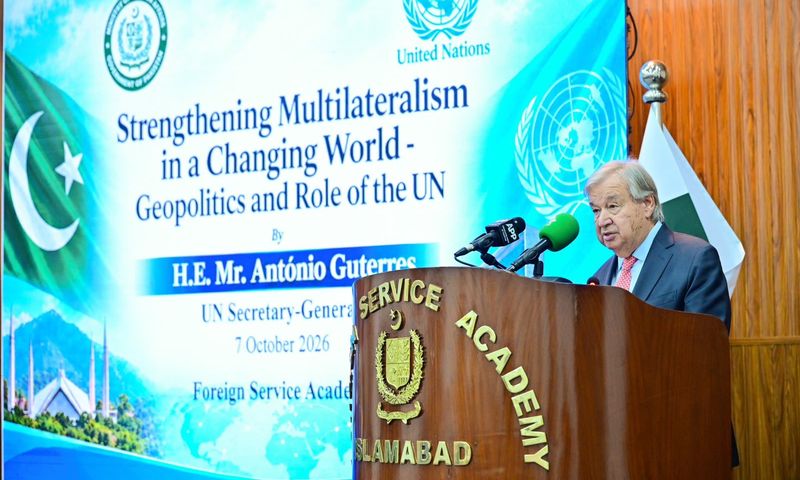
World is now facing a series of interconnected challenges: UN Chief
The UN Secretary-General António Guterres in his remarks said the world is now facing a series of interconnected challenges —conflict, inequality, climate change, and artificial intelligence—stressing that stronger multilateral cooperation through a reformed and more representative United Nations is essential.
He highlighted Pakistan’s generosity, resilience, and solidarity over his two decades of service to the United Nations, including as High Commissioner for Refugees.
He concluded by expressing confidence in the people of Pakistan and their spirit of dialogue, cooperation, and mutual respect.