
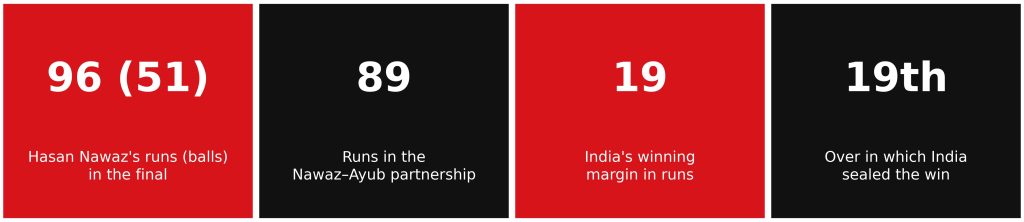
Pakistan cricket team’s Asian Games campaign in Japan ended with a silver medal. In the semi-final on October 1, they held Bangladesh to 111 for 7 and knocked off the target in 11.3 overs, winning by six wickets with nine balls to spare. Two days later, India posted 211 for 6 in the gold-medal match, and Pakistan finished on 192 for 6, 19 runs short.
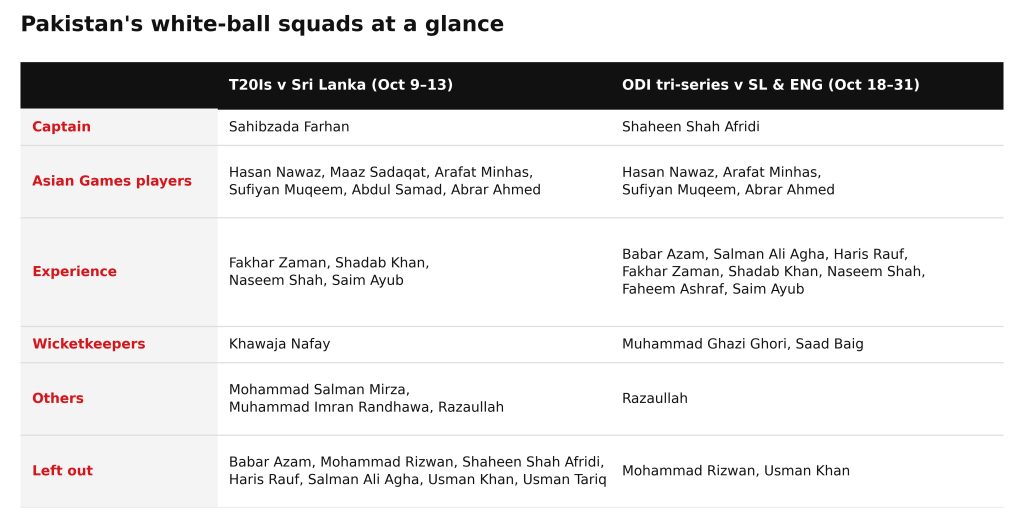
On October 05, the PCB named separate squads for the home T20I series against Sri Lanka (October 9–13) and the home ODI tri-series with Sri Lanka and England (October 18–31). Sahibzada Farhan, who led in Japan, keeps the T20I captaincy in place of Salman Ali Agha, who is out of the T20I side altogether. Shaheen Shah Afridi leads a 16-man ODI squad that keeps most of the established core.
Why a Young Team Went to the Asian Games
Sending an emerging group to Japan was less a gamble than a deliberate use of the tournament. Three concerns drove it.
The first was tempo: Pakistan’s senior T20 batting had long been criticised for a conservative start, and the selectors wanted players whose default is to attack from ball one.
The second was depth. With a crowded calendar, a fixed core of 11 or 12 players left Pakistan exposed whenever injuries or slumps struck, and a multi-sport event offered domestic performers high-pressure international cricket away from the main bilateral schedule.
The third was structural. Under Agha’s leadership, both he and Babar Azam played in the middle order, while an out-of-form Saim Ayub was also at times pushed to No. 3 or No. 4. That left little room for acceleration through the middle overs, the phase power-hitters such as Hasan Nawaz and Abdul Samad are meant to own.
Beaten by India, But not Outplayed
Recent meetings with India had too often been one-sided, with experienced Pakistan line-ups falling away well before the finish. This final was different in character, if not in outcome.
The defeat had its roots in the first innings of the match. Abhishek Sharma’s 61 off 28 balls tore through the powerplay, and questions followed over the field settings Farhan used to contain him.
The bowling order drew sharper scrutiny. Ahmed Daniyal went for 43 in three overs and Saim, as a part-time option, for 47 in four, while the two specialist spinners were the most economical bowlers on the day: Abrar Ahmed took 1 for 29 from four overs and Arafat Minhas 2 for 25 from three. Minhas did not complete his allocation. At the death, Tilak Varma’s unbeaten 51 off 22 carried India past 200.
Turning to part-time spinners at the most demanding stages of the innings backfired. Saad Masood conceded 24 runs in the second over, during the powerplay, and Saim Ayub went for 23 in the 19th. Masood’s later spells told a different story: he gave away just nine runs across the 11th and 13th overs (five and four), suggesting he is far more effective in the middle overs than with the field up.
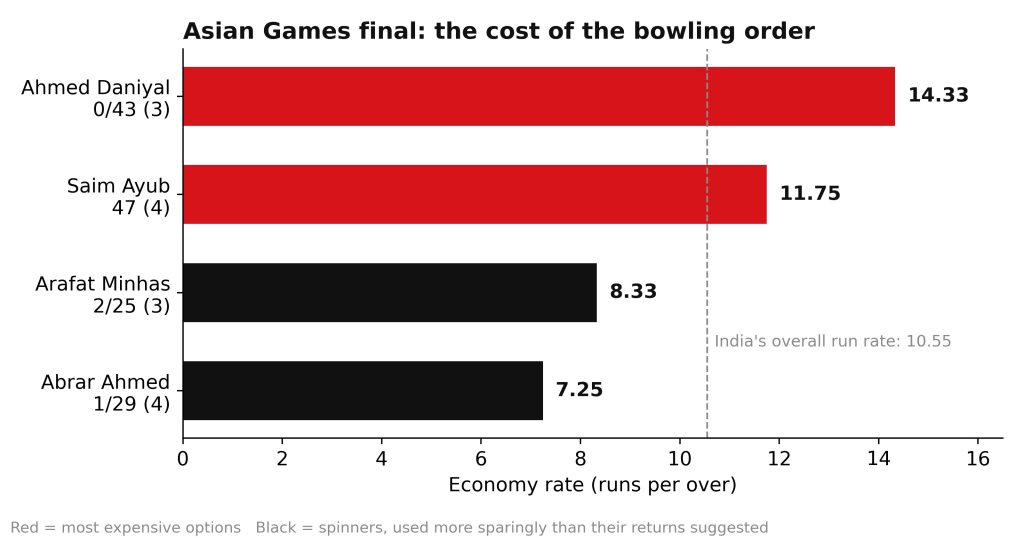
Pakistan’s two most expensive bowlers bowled seven overs between them; the specialist spinners returned the best figures.
Chasing 212, Pakistan needed more than 10.5 an over from the start, and Hasan Nawaz responded with 96 off 51 balls, including seven sixes and five fours. His 89-run partnership with Saim, who made 29 off 22, kept Pakistan level with the rate, and the result stayed open until India’s death bowlers closed it out in the 19th over.
The scorecard also shows how much rested on one player. Nawaz scored half of Pakistan’s runs at a strike rate of 188; the rest of the innings, extras included, managed 96 from 69 balls. Usman Khan (3 off 6) and Samad (9 off 9) could not find the boundary when it was most needed, an old Pakistan problem in a new set of hands.
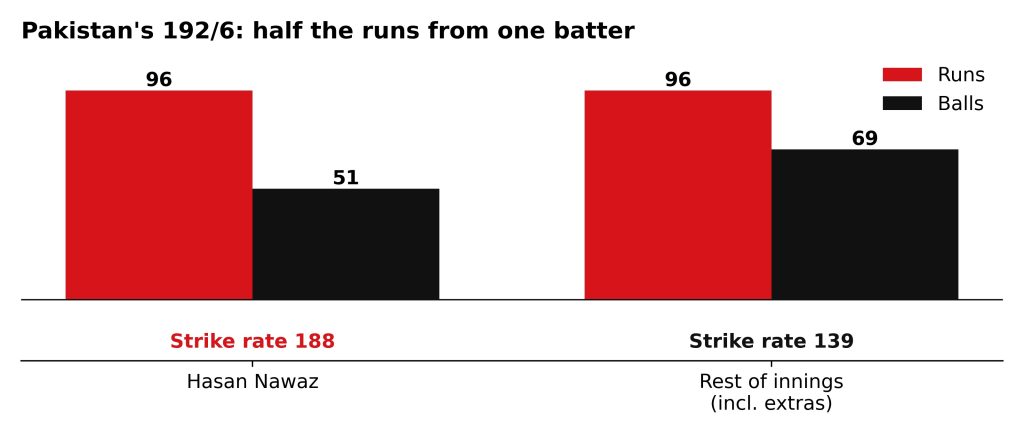
Hasan Nawaz faced 51 of the 120 balls and scored 96 of Pakistan’s 192.
A Different T20I Side for Sri Lanka
The squad for Sri Lanka keeps the core of the Asian Games group. Hassan Nawaz, Maaz Sadaqat, Arafat Minhas, Sufiyan Muqeem, Abdul Samad and Abrar Ahmed retain their places, and Fakhar Zaman, Shadab Khan and Naseem Shah return to add experience.
The omissions are as notable: Babar, Shaheen, Rauf and Agha are all out of the T20I side, and Usman Khan has been left out of both white-ball squads.
Some calls reflect role rather than form alone. Usman Tariq has lost his spot to Muqeem, whose record in leagues around the world is stronger, and to Minhas, whose all-round value fills the slot once held by Imad Wasim and Mohammad Nawaz.
Razaullah, rewarded for his Test performances in England, is in both squads. Mohammad Rizwan is absent from all formats while an NCCIA inquiry continues; no finding has been made against him.
Why the Seniors Stay for the ODIs
The 50-over squad tells a different story, and for sound cricketing reasons. One-day cricket rewards innings construction and tempo control in a way T20s do not, and that remains the strength of Babar and Agha. Modern ODIs are increasingly decided in the middle overs, where sides either take control or collapse, and chases are often finished, or innings ended, well before the 40th over.
Shaheen, Naeem and Rauf bring the new-ball threat and middle-overs wicket-taking skills in ODIs on the pitches of South Africa where World Cup 2027 will be held. With England and Sri Lanka both in the tri-series, there is little room for experiment, and the youngsters who remain with the ODI squad, including Razaullah, Hasan Nawaz, Minhas and Muqeem, will learn alongside an established group rather than in place of one.
The Road Ahead
Both upcoming World Cups will test Pakistan in conditions they have already sampled. South Africa co-hosts the 2027 ODI World Cup, and Australia co-host the T20 World Cup in 2028. Pakistan’s 2024 tours of those countries told two stories. In ODIs, they won 2-1 in Australia, their first series win there since 2002, and swept South Africa 3-0. In T20Is, they lost 3-0 in Australia and 2-0 in South Africa.
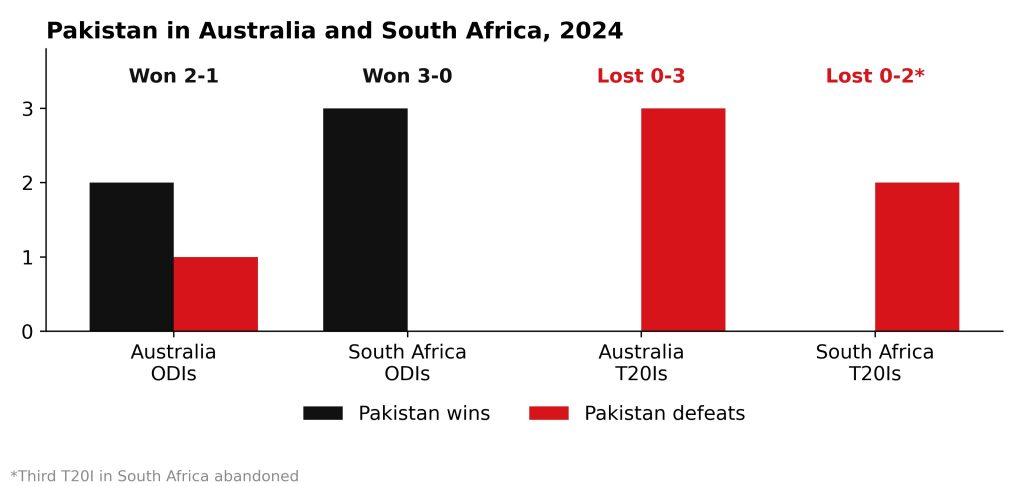
Bounce and pace rewarded Pakistan’s bowlers in the longer format; their batters struggled in the shorter one.
Pace and bounce suited Pakistan’s bowlers, who carried the ODI wins, but the T20I batting repeatedly fell short. That makes the T20 batting group the area most in need of work, and the reason the selectors are prioritising intent.
For Farhan, the test will be whether he can manage his bowlers better than he did in the Asian Games final, and whether his batters can turn aggressive intent into runs rather than wickets.
With the T20 World Cup two years away, there is room to experiment till 2027. As in past cycles, experienced players may yet return for T20 WC 2028 if they win back the trust of the team management. For now, Pakistan have chosen a direction, and the series against Sri Lanka is the first measure of whether it holds.