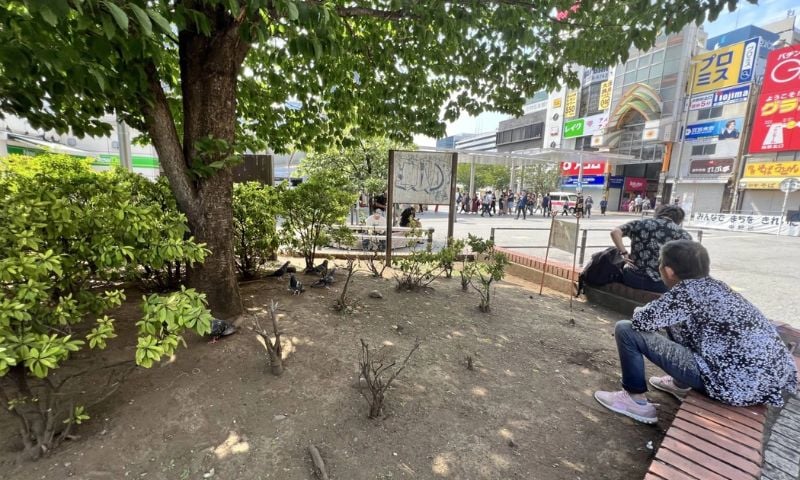
TOKYO: Residents in Tokyo are urging authorities to increase tree cover as rising temperatures and shrinking greenery make summers increasingly difficult to endure.
Kaoru Morimoto, 66, launched a campaign last year calling on officials to set a target for tree canopy cover in the Japanese capital, where the amount of shade provided by trees has been declining.
Morimoto and fellow Nakano resident Susumu Nirasawa, 71, organise expert talks, share temperature data on social media and attend local council meetings to press officials to address the issue. About 30 other residents have joined their campaign.
“Everyone says the summer has become more intense,” Morimoto said, adding that public awareness of Tokyo’s lack of tree cover remained low.
Japan recorded its hottest summer on record in 2025, while extreme heat has become more frequent globally as climate change drives temperatures higher.
Nearly 120 people died from heat-related causes in Japan between May and August this year, while more than 73,000 people required emergency medical treatment.
A 2024 University of Tokyo study found that Tokyo had lost tree canopy equivalent to about three-and-a-half times the area of New York’s Central Park in less than a decade.
The study found that canopy cover in central Tokyo fell from 9.2 per cent in 2013 to 7.3 per cent in 2022, a reduction of about 12 square kilometres.
By comparison, tree canopy covers about 23 per cent of New York, which aims to increase the figure to 30 per cent by 2040. London plans to raise its current coverage of about 20 per cent by 10 per cent by 2050, while Paris also has plans to expand its tree cover.
University of Tokyo urban forestry expert Kinya Shiraishi said trees were important for improving urban life, reducing temperatures and flood risks, and helping residents feel calmer.
READ ALSO: Japan Heatwave Overwhelms Hospitals as Temperatures Soar
He attributed much of Tokyo’s decline in tree cover to the loss of private gardens as ageing landowners sell properties and large plots are divided for new housing. Mature trees are often removed in the process.
Tokyo’s narrow streets also leave limited space for greenery, while officials are concerned that trees could fall during typhoons and other extreme weather.
According to a Tokyo metropolitan government official, the city was working to expand tree canopies through careful pruning, particularly along roads with wider pavements where trees have enough space to grow.
But experts say excessive pruning can itself reduce tree cover. At a street near Japan’s finance ministry, one plane tree stood almost bare, with its upper branches cut back close to the trunk.
Eijiro Fujii, professor emeritus at Chiba University, said excessive pruning and frequent changes among officials responsible for managing street greenery had contributed to the decline.
In Nakano, Morimoto and Nirasawa said the ward’s mayor had recently begun highlighting the importance of tree shade, but local officials had yet to establish a specific canopy-cover target. “Deaths from heat stroke are rapidly increasing in Japan,” Fujii said. “We need to act before it’s too late.”