
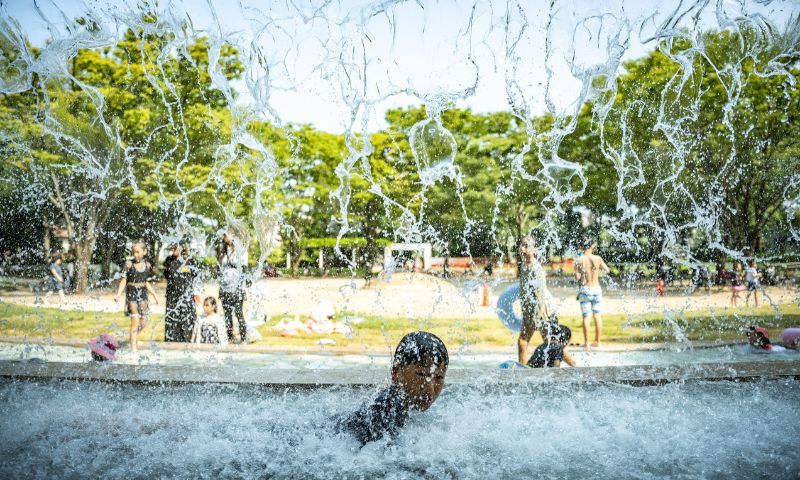
TOKYO: Japan’s relentless heatwave intensified on Thursday, pushing temperatures beyond 40°C in several regions and sending a record number of people to hospital with heat-related illnesses, as authorities warned that the extreme conditions had become a national “disaster”.
Emergency services in Tokyo said 453 people required hospital treatment for heat-related illnesses on Wednesday — the highest single-day figure since records began in 2010. The Tokyo Fire Department also reported the largest number of emergency call-outs linked to extreme heat since comparable records started in 1963.
Officials said the sharp rise in hospital admissions coincided with soaring temperatures earlier this week, particularly on Tuesday and Wednesday, and urged residents to remain indoors where possible, stay well hydrated and make full use of air conditioning.
In Tokyo, which has a population of around 14 million, one person has died during the current heatwave, while four others remain in critical condition and 18 are being treated for serious heat-related illnesses.
The wider impact across Japan has been severe. The Fire and Disaster Management Agency reported that at least 14 people died nationwide over the past week due to heatstroke, while approximately 11,000 people sought emergency medical treatment during the same period.
Describing the situation as unprecedented, the agency said the sustained period of extreme temperatures had led to a significant rise in hospitalisations and fatalities, making it appropriate to regard the heatwave as a “disaster”. It warned that unusually high temperatures are expected to persist across much of the country.
Heatstroke alerts issued to 125 million residents
Heatstroke alerts have been issued for almost all of Japan’s 125 million residents, with authorities advising vulnerable groups, including the elderly and young children, to avoid prolonged exposure to the sun.
The central prefecture of Aichi, home to the city of Nagoya, has been among the worst-affected areas. Local officials said 116 people were taken to hospital on Wednesday alone after suffering heat-related illnesses.
By early Thursday afternoon, temperatures had exceeded 40°C in at least six locations nationwide. The highest reading was recorded in Hamamatsu, in Shizuoka Prefecture, where the mercury reached 41.1°C. Other cities experiencing extreme heat included Toyota in Aichi Prefecture at 40.8°C and Kuwana in Mie Prefecture at 40.7°C.
READ ALSO: Japan Faces First Lawsuit Over Climate Inaction
Japan’s all-time highest temperature remains 41.8°C, recorded in Isesaki, north of Tokyo, on 5 August 2025. In response to increasingly frequent extreme heat events, Japan this year introduced the term “kokushobi”, meaning “cruelly hot day”, to describe temperatures exceeding 40°C. Although the designation carries no automatic legal measures, officials hope it will encourage the public to take heat warnings more seriously.
Scientists have repeatedly warned that human-induced climate change is making heatwaves more frequent, longer-lasting and more intense in Japan and around the world. The country experienced its hottest summer on record last year, and forecasters expect the current spell of extreme heat to continue into the coming weeks.
Visitors and residents alike described the conditions as exceptionally harsh. Many tourists said they were altering their sightseeing plans to spend more time in air-conditioned buildings and public transport, while local residents relied on portable fans, umbrellas and regular hydration to cope with the oppressive temperatures.
With August traditionally bringing even hotter weather to many parts of Japan, health officials continue to urge the public to remain vigilant and take precautions against heatstroke as the country endures one of its most severe heatwaves in recent years.