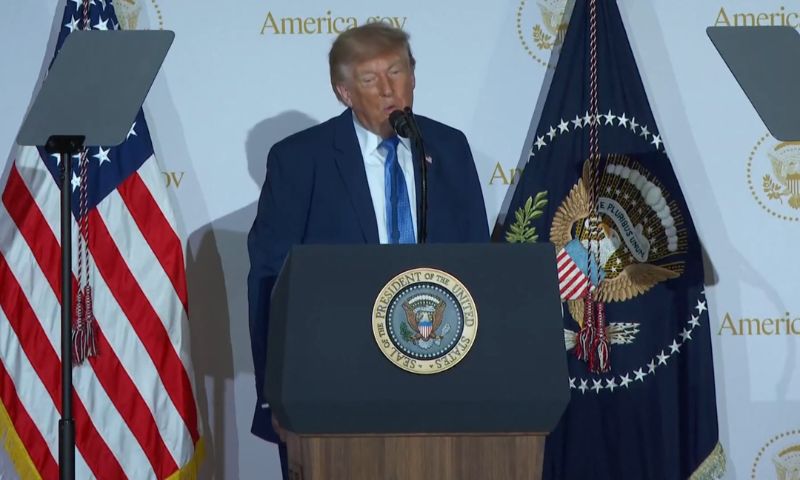
WASHINGTON: US President Donald Trump on Tuesday said the war with Iran would end “very, very soon”, while reiterating that Tehran would not be allowed to have a nuclear weapon.
Trump also said oil prices would fall after the conflict ends, as the US and Iran continued indirect negotiations through mediators to end the conflict.
“Iran will not have a nuclear weapon, and they’re failing very badly. It’ll be over with very, very soon … and oil prices are going to be tumbling down, just like they were before I had to make that little excursion to the Islamic Republic of Iran,” Trump said at an event in Washington.
Trump on Iran War: That’ll be over with very soon and oil prices are going to be tumbling down. I think in the years to come they’ll be writing books and they’ll be writing the history of our country, and they’ll say that’s one of the most important things that we did pic.twitter.com/1DCtAVNc9I
— Acyn (@Acyn) September 29, 2026
On Monday, Trump had also told reporters that the United States would win the war “very soon” and that it would end “pretty quickly”. Trump said US officials had been speaking with Iran through mediators to end the conflict.
Trump calls the Iran war one of his administration’s most important actions
“I think in the years to come, they’ll be writing … the history of our country, and they’ll say that it was one of the most important things that we did,” he said.
“That is, actually one of the most important things that we’ve done under my administration,” Trump added.
His comments came as diplomatic efforts continued over the conflict and the future of the Strait of Hormuz, a key route for global energy supplies.
Vance says deal with Iran remains possible
US Vice President JD Vance said there was still scope for an agreement with Iran if Tehran honoured its commitments to Washington.
Speaking to commentator Vince Coglianese, Vance said Trump had been clear that “there is a universe where we can strike a deal with Iran”.
“But that requires the Iranians to behave,” he said.
“That requires the Iranians to honour their commitments to the United States,” Vance added.
NEW… @VP @JDVance on who’s actually in charge in Iran, and on whether the supreme leader is *even alive*…
VINCE: “I saw the Iranian president was on with @BretBaier last week and Bret asked him like 15 different ways: Are you in charge? Is the IRGC calling the shots? Like,… pic.twitter.com/VbZdvN6eIP
— Vince Coglianese (@VinceCoglianese) September 29, 2026
He said the administration’s approach would be guided by the principle of negotiating around “actions and not words” over the coming months.
Vance also blamed Iranian leaders for the breakdown of the Islamabad Memorandum of Understanding, saying they had “screwed up” by targeting commercial shipping in regional waters.
“I think the Iranians recognise that they screwed up, that they signed a deal with us, we had a ceasefire, we had energy prices that had come down and we had the possibility … that if the Iranians behaved, they would get a lot out of a better relationship with the United States,” he said.
“But what happened? They didn’t behave. They started shooting at commercial shipping,” Vance added.
Vance also said Washington believed Iran’s Supreme Leader Ayatollah Mojtaba Khamenei was alive. “We think that he’s alive. We don’t know, of course,” Vance said in the interview.
Vance said the new supreme leader was “very detached” and was not involved in the negotiations on a day-to-day basis.
Iran’s conditions for reopening Hormuz
Iranian Foreign Minister Abbas Araghchi said Tehran’s conditions for reopening the Strait of Hormuz had not changed, according to Iranian news agency ISNA.
“The mediators will present the ideas that have been put forward to the American side. After that, the American side’s final response will be conveyed to us. I hope this process will be completed by tomorrow morning,” Araghchi was quoted as saying.
عراقچی: شروط ایران برای بازگشایی تنگه هرمز تغییری نکرده است
-میانجیگران ایدههای مطرح شده را با طرف آمریکایی مطرح خواهند کرد و بعداز آن پاسخ نهایی طرف آمریکایی به ما منتقل خواهد شد که امیدوارم اینکار تا فردا صبح انجام شود— خبرگزاری ایسنا (@isna_farsi) September 29, 2026
Araghchi has said Iran’s conditions for reopening the strategic waterway had been conveyed to the United States and the international community.
He said the conditions were “fair and reasonable” and were in line with directives from Iran’s Supreme Leader.
The Iranian foreign minister said Tehran had presented a seven-point proposal to Washington and was awaiting an official response through intermediaries.
He said recent discussions with Qatari mediators had focused on ways to meet Iran’s conditions for reopening the strait.
🔴 Iran's FM Araghchi:
🔺We discussed ways with Qatari mediators to meet Iran’s conditions.
🔺The US response will be relayed to Tehran through the Qatari mediators, hopefully by tomorrow.
🔺Iran has put forward a solution if the US wants a deal. pic.twitter.com/dIpswklSiD
— Press TV 🔻 (@PressTV) September 29, 2026
Araghchi said the reopening of the waterway remained conditional on fulfilment of those demands.
Araghchi expected a formal US response on Tuesday, AFP, citing Iranian state media, reported. “The Qataris hope this will be done by tomorrow,” he said on Monday.
“The current focus is solely on the Strait of Hormuz, and the reopening of the strait is contingent upon the fulfilment of certain conditions that we have communicated to the other side,” he added.
Oil prices rise on supply concerns
Oil prices rose for a second consecutive session on Tuesday as concerns over supply disruptions continued, Reuters reported.
Brent crude futures for November rose $1.71, or 1.6%, to $106.99 a barrel at 0626 GMT. The more actively traded Brent December contract rose $1.68 to $99.51 a barrel.
US West Texas Intermediate crude was trading at $94 a barrel, up $1.40, or 1.5%.
Both benchmarks had closed nearly $1 higher on Monday.
Trump has repeatedly said fuel prices would fall once the conflict ends. On Monday, he said gas prices would “come tumbling down” after the United States wins the war.
Mediators Continue Diplomacy
Mediators are working to revive diplomatic efforts between Washington and Tehran.
Qatar’s Prime Minister and Foreign Minister Sheikh Mohammed bin Abdulrahman Al Thani said Doha had spent recent weeks trying to bring the diplomatic track between Washington and Tehran back on course.
Speaking to CNN’s Christiane Amanpour in New York last week, Sheikh Mohammed said the latest indirect talks had shown “positive progress”.
“We believe that we have sensed that from both parties, that they want to see some positive progress,” he said, adding that the exchanges suggested “diplomacy can prevail at the end and we can find a solution”.
Pakistan is the key mediator between the US and Iran after helping secure a ceasefire on April 8. Later, Pakistan hosted high-level US and Iranian delegations for talks in Islamabad on April 12 and 13.
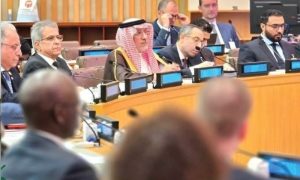
On Wednesday, Pakistan’s Prime Minister Shehbaz Sharif said Islamabad was “completely focused” on mediating an end to the war between the United States and Iran through dialogue and diplomacy.
“Pakistan is playing the role of a sincere and honest mediator between Iran, our neighbourly country, and the United States,” Prime Minister Sharif told reporters at the United Nations.
Prime Minister Sharif said he signed the Islamabad Memorandum of Understanding (MoU) in June with Iranian President Masoud Pezeshkian and US President Donald Trump.
“Unfortunately, events after that got a bit unpredictable, but Pakistan is completely focused. We have not lost hope; we are absolutely determined that we will further make efforts and make progress to de-escalate the situation,” the Prime Minister added.
رئيس الوزراء الباكستاني شهباز شريف: باكستان “تركز تماماً” على الوساطة لإنهاء الحرب المتعلقة بإيران pic.twitter.com/g9vR38RMKQ
— العربية (@AlArabiya) September 23, 2026
Pakistan has repeatedly urged a return to the Islamabad Memorandum of Understanding (MoU) between the US and Iran, maintaining that dialogue and diplomacy were the only way to resolve the months-long conflict.
The Pakistan-brokered Islamabad MoU, signed in June, provides the framework for ending the US-Iran conflict and pursuing a negotiated settlement.
ALSO READ: Trump Open to Iran Sanctions Relief for ‘Concrete Progress’ on Nuclear Issues
Under the Islamabad MoU, Iran and the United States committed to halt military operations, reopen the Strait of Hormuz to commercial shipping and negotiate a comprehensive agreement covering Iran’s nuclear programme, US sanctions and a permanent ceasefire within 60 days.
Pakistan and Qatar later co-mediated the first round of high-level talks in Lucerne, Switzerland, on June 21. The meeting was attended by Vance and Ghalibaf.
Pakistan is making efforts to revive talks under the Islamabad MoU framework to permanently end the conflict through diplomacy and dialogue.