Key Points
- IAEA Board approved the agreement unanimously in March
- The unit is expected to become operational by 2030
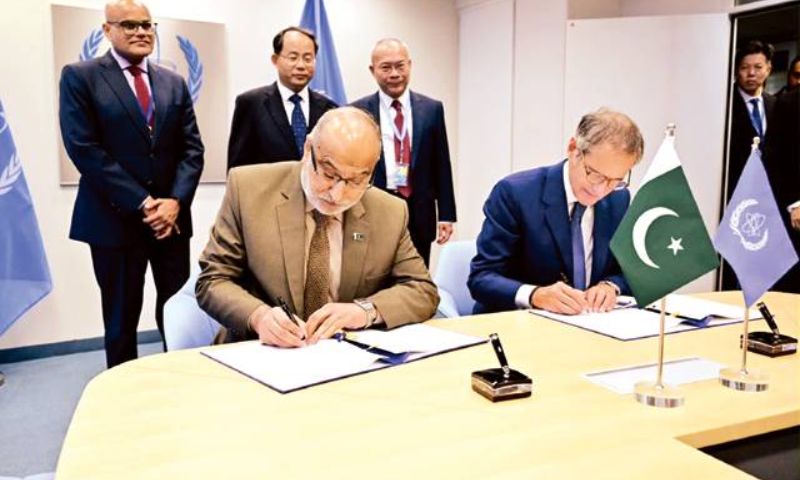
ISLAMABAD: Pakistan and the International Atomic Energy Agency (IAEA) have signed a safeguards agreement covering the 1,200-megawatt Chashma-5 nuclear power plant, marking another step towards bringing the Chinese-built reactor into operation.
Pakistan Atomic Energy Commission (PAEC) Chairman Raja Ali Raza Anwar and IAEA Director General Rafael Mariano Grossi signed the agreement at the IAEA headquarters in Vienna on the sidelines of the agency’s 70th General Conference.
China Atomic Energy Authority Chairman Zhang Kejian also attended the ceremony.
The IAEA Board of Governors unanimously approved the safeguards agreement in March 2026.
The IAEA Safeguards are designed to allow the agency to verify that nuclear material and facilities covered by an agreement are being used for peaceful purposes.
Chashma Nuclear Power Complex
Chashma-5, also known as C-5, is being constructed at the Chashma Nuclear Power Complex in Punjab with Chinese cooperation. The 1,200MW reactor will use China’s Hualong One design, the same reactor technology used for Pakistan’s two large Karachi nuclear units.
The IAEA says C-5 is under construction and would become operational by 2030. The reactor will expand Pakistan’s nuclear generation capacity and add a large source of low-carbon electricity to the national grid.
Pakistan currently operates four nuclear power units at Chashma, while two additional Chinese-built reactors operate at the Karachi Nuclear Power Plant.
The four existing Chashma nuclear power generation units are already covered under the IAEA safeguards.
The latest agreement follows decades of cooperation between Pakistan and the IAEA on the peaceful use of nuclear technology.
READ ALSO: IAEA Chief Lauds Pakistan’s Nationwide Cancer Care Network
Nuclear power has become an important component of Pakistan’s electricity mix, providing relatively stable generation while reducing reliance on fossil fuels.
The signing also reflects Pakistan’s continued expansion of nuclear power in cooperation with China.
C-5 is the latest major addition to a programme that has expanded Pakistan’s nuclear generating capacity through Chinese-designed reactors at Chashma and Karachi.
Pakistan has sought to increase nuclear generation as part of efforts to meet rising electricity demand and diversify its energy mix.
The government has also highlighted nuclear power as a reliable electricity source that can help reduce exposure to fluctuations in imported fuel prices.
Pakistan’s nuclear power programme has expanded steadily over the past several decades, with China playing a central role in developing new generation capacity.
Nuclear energy has become an important part of Pakistan’s efforts to diversify its electricity mix, reduce dependence on imported fossil fuels and provide reliable power for households and industry.
The Chashma Nuclear Power Complex in Punjab has been central to this expansion. Four nuclear power units are already operating at the site, while additional Chinese-designed reactors have strengthened Pakistan’s nuclear generation capacity.
The Karachi Nuclear Power Plant has also added two large units based on China’s Hualong One reactor technology.
Chashma-5 represents the next stage of this cooperation. With a planned capacity of 1,200 megawatts, the unit is expected to provide a substantial amount of stable electricity once completed.
Its development also reflects Pakistan’s longer-term endeavour to promote nuclear energy while maintaining international safeguards and regulatory oversight.
The International Atomic Energy Agency’s safeguards framework provides an established mechanism for verifying that nuclear material and facilities covered by an agreement remain dedicated to peaceful purposes.
Pakistan’s continued engagement with the IAEA therefore provides an important international framework for its expanding civilian nuclear programme.
The nuclear sector also supports specialised employment, engineering expertise, scientific research and technology development.
Continued cooperation with China and the IAEA can help Pakistan strengthen these capabilities while expanding access to reliable and relatively low-carbon electricity.