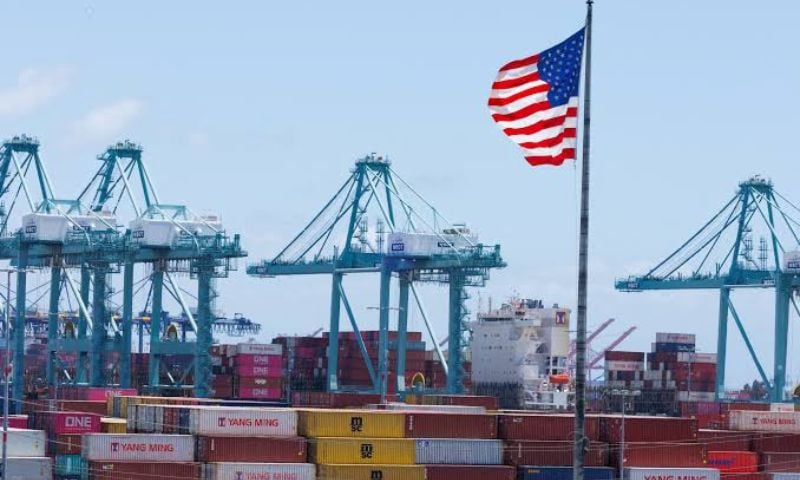
WASHINGTON: The US trade deficit in July widened to $88.6 billion, its largest monthly gap since March 2025, the US government data showed Thursday, as imports of computers, semiconductors and other technology equipment surged amid a boom in artificial intelligence investment.
The goods and services deficit rose 24.4 percent from June, according to data from the US Department of Commerce. The June deficit was revised to $71.2 billion.
The July figure was above the $75.3 billion deficit forecast by economists, according to the consensus estimate cited in market data.
The increase came as imports rose while exports declined. Imports climbed 2.8 percent from June to $399.3 billion. Exports fell 2.1 percent to $310.7 billion.
The figures underscore the difficulty facing President Donald Trump’s administration as it seeks to reduce the US trade deficit through tariffs.
Technology imports surge
The sharp rise in imports was led by capital goods, a category that includes computers, computer accessories, semiconductors and telecommunications equipment but excludes automobiles.
Imports of capital goods jumped 11.4 percent in July, their largest monthly increase since records began in 1993, according to the data.
Computers and related equipment were among the main drivers of the increase as US companies continued to invest heavily in data centres and infrastructure needed to support artificial intelligence.
Imports of capital goods reached a record level in July, according to the data.
The surge highlights a key tension for US trade policy. While the Trump administration has used tariffs to discourage foreign imports and encourage domestic manufacturing, some of the goods entering the country are critical to the expansion of the US technology sector.
The United States has also exempted chips, smartphones and some other electronics from tariffs for more than a year.
Goods deficit expands
The July increase in the overall deficit was driven primarily by a larger goods gap.
The goods deficit increased by $17.6 billion to $119.6 billion, while the surplus in services rose by $0.2 billion to $31.0 billion.
The rise in imports contrasted with weaker exports of several major commodities.
Exports of industrial supplies, including crude oil and gold, declined during the month, contributing to the 2.1 percent fall in total exports.
The widening deficit with major Asian manufacturing economies also reflected the technology-led increase in imports.
The US trade deficits with Mexico, Vietnam, Thailand and South Korea also increased.
Tariffs reshape trade flows
US trade flows have fluctuated sharply since Trump began imposing broad tariffs on goods from both allies and competitors.
Businesses have repeatedly accelerated imports ahead of new tariff measures in an effort to avoid higher costs.
The administration introduced a new round of tariffs on goods from more than 80 countries in July and was considering additional duties on more than 40 countries.
The US Supreme Court also struck down a broad set of Trump’s global tariffs in February. Businesses subsequently rushed to secure refunds and adjust their import strategies.