Key Points
- US envoys present ideas for ending the war
- Putin says Russia is making battlefield progress
- Moscow maintains territorial and NATO-related demands
- Witkoff, Kushner due to meet Zelensky in Kyiv
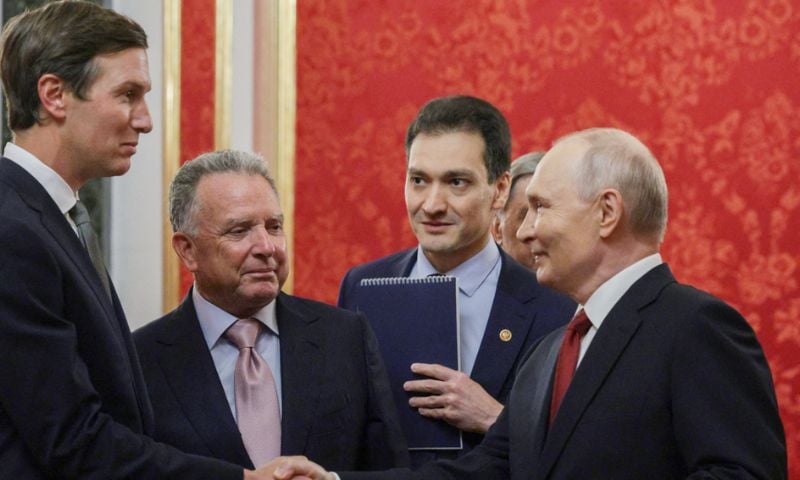
MOSCOW: Russia and the United States held their highest-level diplomatic engagement in months over the Ukraine War, but talks between President Vladimir Putin and US envoys Steve Witkoff and Jared Kushner produced no immediate breakthrough, Kremlin said on Sunday.
The useful talks without a breakthrough underscored the wide gap between Moscow’s war aims and efforts to secure a peace deal.
Putin held more than three hours of talks with the two envoys at the Kremlin on Saturday, with Russian presidential aide Yuri Ushakov describing the discussions as “highly useful”.
American side presented several ideas on possible ways to settle but gave no details of the proposals, he added.
A White House official described the discussions as substantive and said the next steps would be announced in the coming weeks.
Witkoff and Kushner were expected to travel to Kyiv on Sunday for talks with Ukrainian President Volodymyr Zelenskiy, extending Washington’s renewed diplomatic push to both sides of the conflict.
Putin maintains war aims
The Kremlin’s description of the meeting offered little evidence that Moscow had softened its fundamental position.
Ushakov said Putin told the US envoys that Russian forces were making “real progress” on the battlefield and that Moscow remained confident of achieving its objectives.
READ ALSO: Russia, Ukraine Trade Major Drone Strikes As War Escalates
Putin also stressed the need to address what he called the “root causes” of the conflict, a phrase Moscow has repeatedly used to frame its demands for restructuring of Ukraine’s security and political position, according to The Print.
The talks were parallel with Russia and Ukraine continuing to exchange heavy long-range missile and drone strikes, despite largely static front lines.
Russia has intensified attacks on Kyiv in recent weeks, including strikes on Ukrainian security and infrastructure targets.
Meanwhile, Ukraine has increasingly targeted Russian refineries, oil terminals, warehouses and other economic assets in an effort to raise the cost of the war for Moscow.
Putin has also continued to insist on terms that Kyiv rejects. Moscow’s position includes Ukraine giving up territory claimed by Russia and abandoning its ambition to join NATO. The Kremlin has described Putin’s position on these issues as “unshakeable”.
A person close to the Kremlin told Reuters that Putin remained focused on securing the remaining part of Donetsk and believed Russia could achieve that objective by the end of the year.
Western military analysts have questioned that assessment, pointing to Russia’s slow battlefield gains and continued Ukrainian resistance. (The New Voice of Ukraine)
Limited pause creates diplomatic opening
The Moscow meeting was accompanied by a temporary reduction in attacks on the two capitals, but it did not amount to a wider ceasefire.
Putin ordered Russian forces not to strike Kyiv for three days during the US delegation’s diplomatic mission. Ukraine has also hinted that it could refrain from attacking Moscow for the duration of the talks, creating a limited window for negotiations, according to Khaama News.
The pause is significant because it comes after weeks of intensified air warfare. Yet the fighting elsewhere has continued, highlighting the difference between tactical arrangements designed to facilitate diplomacy and a comprehensive ceasefire.
Washington seeks a path to settlement
The meeting followed President Donald Trump’s announcement that Washington had developed a fresh proposal aims at ending the war, although he did not publicly disclose its details.
Putin praised Trump’s efforts, saying the US president was continuing to pursue a settlement despite the difficulties involved.
The US initiative now faces its most difficult test in Kyiv. Ukraine has repeatedly rejected any settlement requiring it to surrender territory it has defended since Russia launched its full-scale invasion in February 2022.
The conflict, now in its fifth year, remains one of the biggest obstacles to European security and has produced no durable political settlement despite repeated diplomatic efforts.
For Washington, the Moscow talks at least keep direct communication with the Kremlin alive.
For Kyiv, however, the continuing gap over territory, NATO and Russia’s wider security demands means that the latest diplomatic push remains an opening for negotiations rather than evidence that peace is close.