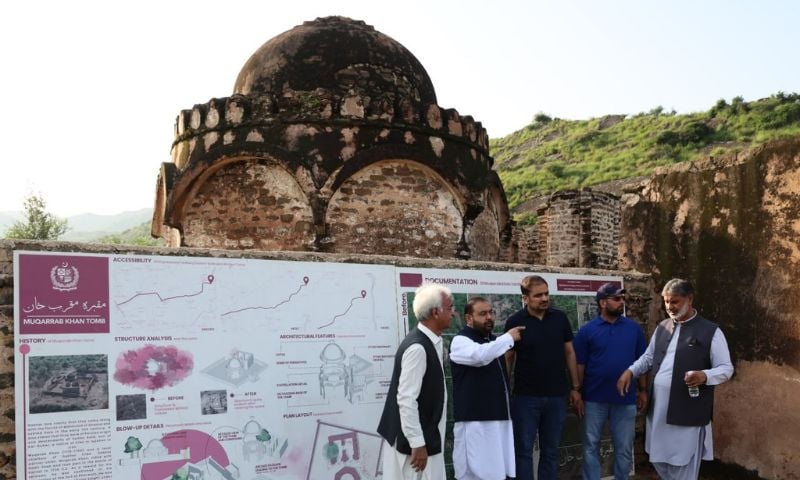
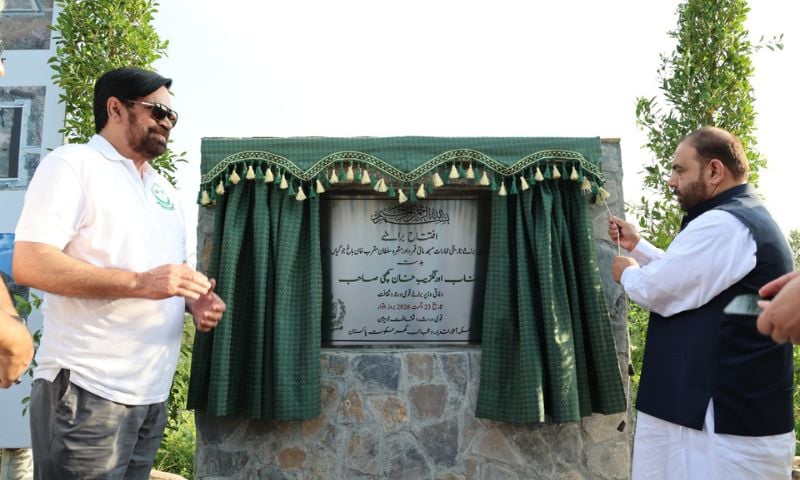
ISLAMABAD: Pakistan has taken a significant step towards showcasing its rich historical legacy to the world, as Federal Minister for National Heritage and Culture Aurangzeb Khan Khichi inaugurated and opened four ancient heritage sites associated with the Gakhar legacy to tourists on the banks of the Swan River in the Islamabad region.
The sites, including the approximately 450-year-old Mai Qamro Mosque, the 350-year-old Tomb of Sultan Muqarrab Khan, the nearly 1,000-year-old Pharwala Tomb, and Rawat Fort, have been placed on the UNESCO World Heritage Tentative List, marking a pivotal moment for their international recognition and preservation.
Rs54 million invested in conservation work
According to the Ministry of National Heritage and Culture, the Department of Archaeology and Museums (DOAM) made exceptional efforts to secure the inclusion of these historic sites on the UNESCO Tentative List.
A PC-I costing approximately Rs54 million was approved and included in the Public Sector Development Programme (PSDP), with conservation work having been ongoing for nearly three years since its commencement in 2022.
The inauguration ceremony marked the culmination of extensive restoration work that has transformed the once-deteriorated sites into welcoming destinations for visitors.
Minister vows to protect Pakistan’s heritage
Speaking at the inauguration, Federal Minister Aurangzeb Khan Khichi reaffirmed the government’s commitment to protecting Pakistan’s historical and cultural heritage, emphasising the promotion of these sites as destinations for domestic and international tourists, researchers, and scholars.
“I was surprised and delighted to learn that such a rich historical and cultural heritage exists within Islamabad and its surrounding region,” the Minister remarked, noting the common perception that development and history in the capital began only after the 1960s.
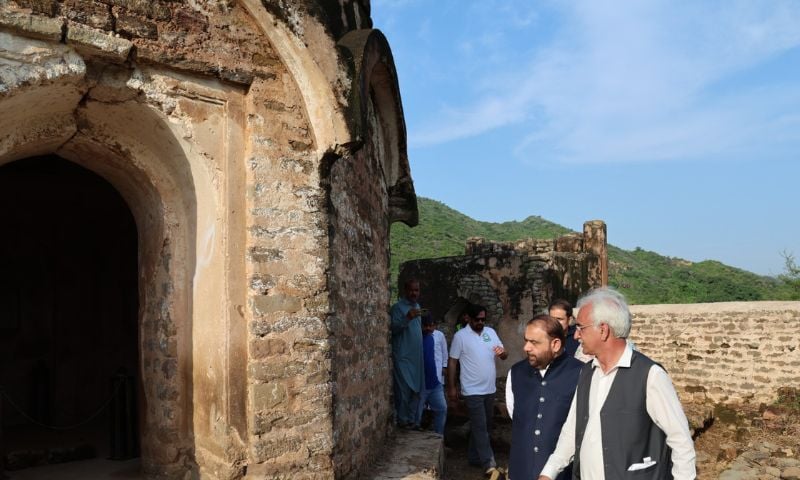
The Minister inspected the facilities and conservation work carried out at the sites, expressing satisfaction with the progress made. He detailed the measures taken to ensure the protection and upkeep of the heritage sites, including the installation of CCTV cameras, hiring of security guards, and deployment of gardeners.
Conservation, repair, preservation, landscaping, and other development works have also been undertaken.
Honourable Federal Minister for National Heritage and Culture Division , Mr. Aurangzeb Khan Khichi, inaugurated the historical Mai Qamro Mosque and the Tomb of Sultan Muqarab Khan at Bagh Jogian Islamabad, enlisted on tentative list of world Heritage Sites UNESCO. pic.twitter.com/u0t70HLRtp
— National Heritage and Culture Division (@DivisionCulture) August 24, 2026
48 kanals of land recovered, restored
The Minister highlighted that when work began, the site was in a highly deteriorated condition, with inadequate access and the area largely covered by bushes. The Department of Archaeology and Museums carried out proper demarcation and successfully recovered approximately 48 kanals of land that had been occupied by various local individuals. The recovered land was subsequently fenced, landscaped, and developed into a garden, with seating and other basic facilities provided for visitors.
One of the historic tombs associated with Mai Qamro was close to collapse, the Minister noted. Through special conservation efforts, the department preserved and restored the tomb while retaining its boundary wall in its original form. Some historic graves associated with the Gakhar tribes have also been restored under the available budget.
Road access to be upgraded for tourists
The Federal Minister identified accessibility as one of the major challenges facing the heritage site. A roughly two-kilometre road is available for local residents and tourists, but the existing route is in poor condition.
“With the site now included on UNESCO’s Tentative List, the road would be upgraded into a proper carpeted road by the authorities concerned upon the Ministry’s request,” Khichi said.
He emphasised that improved road access would enable domestic and international tourists to reach the historic sites conveniently and would contribute significantly to the promotion of cultural tourism in the region.
UNESCO listing a major achievement
The Minister described the inclusion on UNESCO’s World Heritage Tentative List as a major first step by the Government of Pakistan towards internationally highlighting the sacrifices, history, and cultural heritage of the Gakhar people.
He expressed hope that once the remaining UNESCO requirements were fulfilled, the four sites would ultimately achieve full World Heritage status, attracting tourists and scholars from around the world.
The Minister also informed that a PC-II for Pharwala Fort had been prepared and would be approved after the allocation of funds.
Gakhars’ deep historical connection
Khichi noted that the Gakhars of Potohar have a deep connection with the region’s history, culture, and identity.
He said that after being briefed by DOAM about the historic sites of Bagh Jogian and the surrounding area, he had directed the department to complete the repair and renovation work as soon as possible.
The Gakhars of Potohar: Warriors, rulers, and guardians of a rich legacy
The Gakhars of Potohar are among Punjab’s most formidable warrior clans, having dominated the rugged terrain between the Indus and Jhelum rivers for over eight centuries, from roughly the 11th century until 1818.
Believed to have originated from Central Asia or Persia, they rose to prominence as fierce defenders of their homeland, famously resisting Mahmud of Ghazni in 1008 and assassinating Muhammad Ghori in 1206 after their forced conversion to Islam. They established their stronghold at Pharwala Fort in the 13th century and ruled vast swathes of the Potohar Plateau, including parts of present-day Islamabad, Rawalpindi, Attock, Jhelum, and Gujrat, with chieftains known as ‘Rai’ or ‘Malik’.
Read Also: Pakistan Launches Conservation Plan to Protect 3,000-Year-Old Taxila Heritage
During the Mughal era (1526–1857), they proved both formidable adversaries and loyal allies, Emperor Babur captured their chief Hathi Khan at Pharwala in 1519, yet the tribe remained faithful to Humayun during his exile (1540–1555), waging guerrilla warfare against Sher Shah Suri, who built Rohtas Fort between 1541–1548 to contain them.
Their influence peaked in the early 18th century under Sultan Muqarrab Khan (ruled c. 1730–1769), who issued his own coins and controlled territory from Attock to Chenab, but their power was eventually broken by the rising Sikh Empire under Maharaja Ranjit Singh, with Pharwala Fort falling in 1818.
Today, the Gakhars’ enduring legacy lives on through their ancient forts, tombs, and mosques, including the newly inaugurated sites near Islamabad, which stand as proud evidence of their rich history, cultural identity, and deep-rooted connection to the Potohar region.
Read Also: Pakistan Strengthens Global Cultural Standing with Four New Khyber Pakhtunkhwa Sites on UNESCO List
A new era for cultural tourism
The Minister reiterated that the Government of Pakistan would continue its efforts to preserve the country’s historic heritage, complete the remaining UNESCO requirements, and promote the Potohar region as an important destination for history, archaeology, and cultural tourism.
“This is just the beginning,” the Minister affirmed. “Pakistan has a wealth of historical treasures waiting to be discovered, and we are committed to ensuring that they receive the recognition and protection they deserve.”
Read Also: Japanese Monk Calls for Global Buddhist Prayer at Pakistan’s Ancient Stupa to Heal a Divided World
With these sites now open to the public, Pakistan takes a significant step towards establishing itself as a premier destination for cultural tourism, inviting the world to explore the rich tapestry of its ancient civilisations and historical legacies.