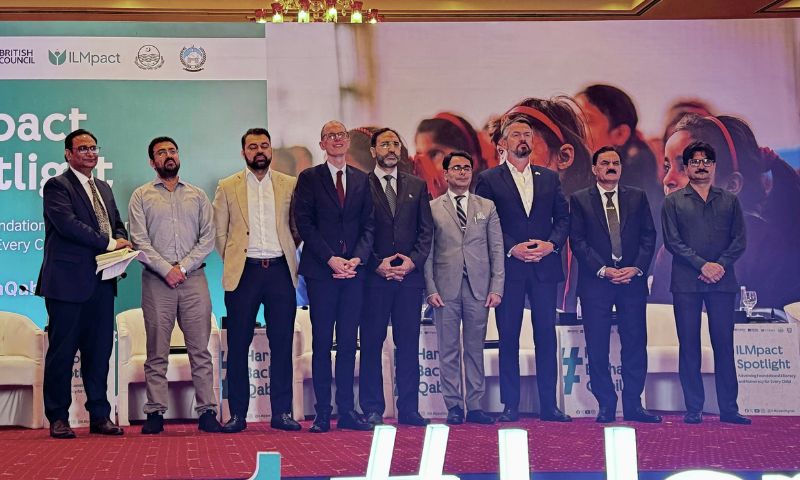
ISLAMABAD: A groundbreaking UK-Pakistan education initiative has helped more than 200,000 children across Punjab and Khyber Pakhtunkhwa improve their reading, numeracy, and life skills, while bringing over 35,000 out-of-school children back into the classroom.
The programme, delivered through collaboration between the British High Commission and provincial governments, has achieved remarkable results in just a short period. In participating schools, Urdu reading proficiency surged from 15 percent to 78 percent, English reading improved from 15 percent to 45 percent, and subtraction skills jumped from 37 percent to 67 percent.
Read Also: Pakistan Delegation Visits UK to Strengthen Educational Ties
Dramatic learning gains across two provinces
The initiative reached more than 500 public schools across both provinces, employing a comprehensive approach that included learning-level assessments, targeted instruction, teacher coaching, and regular progress tracking to help children catch up on missed education.
The data reveals extraordinary improvements: where only one in seven children could read Urdu before the programme, now nearly four in five can do so with confidence. Similarly, English reading skills have tripled, while numeracy has nearly doubled, demonstrating the effectiveness of evidence-based, targeted interventions.
35,000 out-of-school children return to classrooms
Beyond mainstream schooling, the programme provided remedial education to 48,000 learners, strengthened teaching capacity by training over 5,500 educators and 250 Master Trainers, and upgraded facilities in 400 schools, creating a more conducive learning environment for thousands of students.
Perhaps most significantly, the partnership has successfully brought more than 35,000 out-of-school children back into the education system, addressing one of Pakistan’s most persistent challenges in achieving universal access to schooling.
Read Also: UK Launches Programmes to Forge Pakistan’s Next Generation of Global Leaders
British high commissioner hails teachers’ role
British High Commissioner Jane Marriott, praised the dedication of teachers and education officials, stating: “Teachers are at the heart of improving learning outcomes for children, and the most important measure of success is whether they find these approaches valuable enough to continue using them.’’
She maintained that the feedback so far has been extremely encouraging. By bringing together governments, schools and communities, children who previously could not read a simple sentence are now reading independently.”
Punjab officials commend transformative impact
Muhammad Musa Ali Bokhari, CEO of Punjab Education Curriculum Training and Assessment Authority (PECTAA), highlighted the programme’s transformative impact: “Every child in Punjab deserves the chance to read, write and count with confidence before they move beyond primary school. UK support has helped move the conversation on foundational learning from theory to demonstrated practice, here in Punjab.”
Read Also: Pakistan Desires Stronger Bilateral Ties with UK: Defence Minister
KP pledges continued commitment to foundational learning
Masood Ahmed, Special Secretary of Elementary and Secondary Education in Khyber Pakhtunkhwa, reaffirmed the province’s commitment to educational progress: “The achievements of this UK-supported programme show that focused investments in foundational learning can produce meaningful results for children and communities. We remain committed to building on this progress and ensuring that every child has the opportunity to develop the literacy and numeracy skills that are essential for lifelong learning.”
The success of this partnership underscores the importance of international cooperation in addressing Pakistan’s education challenges, particularly in foundational literacy and numeracy, skills that serve as the building blocks for all future learning and economic opportunity.