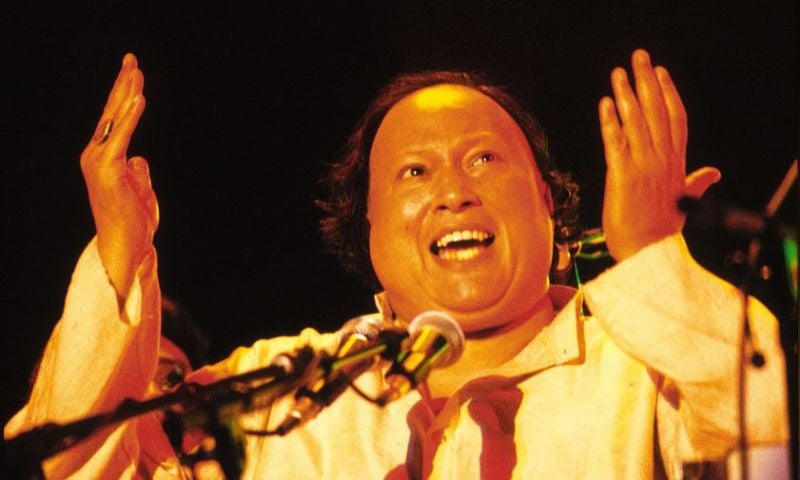
ISLAMABAD: From the dimly lit shrines of South Asia to the grand concert halls of New York, and from Mumbai’s film studios to Washington’s universities, the world united on Sunday to honour Pakistan’s music legend Ustad Nusrat Fateh Ali Khan.
जिनकी आवाज़ से हमेशा इश्क-ए-हक़ और रूहानियत की खुशबू आई।
ऐसे अजीम फनकार ‘शहंशाह-ए-कव्वाली’ नुसरत फतेह अली ख़ान साहब को उनकी पुण्यतिथि पर दिल से दुआ और श्रद्धांजलि। pic.twitter.com/Ld7Xy69mro
— रितेश देशमुख ( 𝙿𝚊𝚛𝚘𝚍𝚢 ) (@Deshmukh_0) August 16, 2026
Twenty-nine years after his passing, the legendary qawwali maestro’s transcendent voice continues to echo across continents in a global outpouring of love, proof that his music knows no borders, no boundaries, and no expiration date.
A global phenomenon: How Nusrat conquered the world
Nusrat Fateh Ali Khan was not merely Pakistan’s greatest musical export, he was a global phenomenon whose influence transcended cultural, linguistic, and religious divides. His music resonated with audiences from all walks of life, from devout Muslims seeking spiritual connection to Western listeners who had never before encountered qawwali.
On his death anniversary, remembering the voice that carried a thousand emotions. Nusrat’s voice remains immortal. pic.twitter.com/Daiq2uMRKz
— Arush Malhotra (@djarushofficial) August 16, 2026
His international breakthrough came with his work on the 1995 Hollywood film ‘Dead Man Walking’, which introduced his transcendent voice to millions of Americans who had never experienced South Asian devotional music. He went on to compose music for Martin Scorsese’s ‘The Last Temptation of Christ’, collaborated with world-renowned musician Peter Gabriel, and performed at prestigious venues including the Brooklyn Academy of Music in New York.
“He took Qawwali out of gatherings and monasteries and brought it to the world stage,” fans and critics alike have noted. “Immersed in love and pain, his voice also had a touch of spirituality that could move even the most hardened hearts.”
His influence extended to academia as well, with the University of Washington inviting him to teach music—a rare honor for a Pakistani artist that demonstrated the depth of his musical scholarship beyond his performing prowess.
On his death anniversary, remembering the voice that carried a thousand emotions. Nusrat’s voice remains immortal. pic.twitter.com/K4r36L4Q8e
— Medusa (@FrozenByGaze) August 15, 2026
Bollywood and the subcontinent remember their maestro
While the West embraced Nusrat Fateh Ali Khan as a world music pioneer, the subcontinent claimed him as its own. Bollywood celebrities, music directors, and playback singers took to social media on Sunday to express their admiration for the maestro whose compositions continue to define Indian cinema’s most memorable moments.
Some voices are heard by the ears, but a voice like Nusrat Fateh Ali Khan is felt by the soul. ❤️🩹✨
A legend whose music turned pain into prayer and emotions into eternity.
NFAK — forever alive in every heart that listens. 🕊️🎶 pic.twitter.com/bwUYGq5PgW— Sohail Akhtar (@mirealsohail) August 16, 2026
His work on Bollywood films including ‘Aur Pyaar Ho Gaya’, ‘Kachche Dhaage’, ‘Kartoos’, and ‘Bandit Queen’ remains legendary, while ‘Dulhe Ka Sehra’ from the film ‘Dhadkan’ continues to be one of the most beloved wedding songs in the history of Indian cinema.
Music directors across the subcontinent acknowledge their debt to Nusrat’s revolutionary fusion of Eastern classical music with modern Western sounds—a style that appealed to a new generation and continues to influence contemporary artists across genres.
A musical dynasty and humble beginnings
Born on October 13, 1948, in Faisalabad to renowned qawwal Fateh Ali Khan, Nusrat was destined for musical greatness from the very beginning. He came from a distinguished family of qawwals that had migrated from Jalandhar in eastern Punjab to Faisalabad at the time of Pakistan’s creation. His father and uncle, Mubarak Ali Khan, were celebrated qawwals of their era.
At the age of 16, Nusrat adopted the Sufi style of qawwali, devoting his life to learning the intricacies of the genre. His extraordinary vocal ability, coupled with his deep understanding of classical ragas and his remarkable improvisational skills, set him apart from every other vocalist of his generation.
Remembering the legendary Nusrat Fateh Ali Khan on his death anniversary. 🎶🤍
A voice that transcended borders, a soul that turned music into devotion, and an artist whose legacy remains eternal. His qawwali still echoes in hearts across the world. pic.twitter.com/ReNzXCZAxy— Takhat Singh Ratnu (@ratnu_takhat) August 16, 2026
A legacy etched in 125 albums and countless hearts
Nusrat Fateh Ali Khan’s body of work remains staggering in its volume and quality. He released an astonishing 125 audio albums as a qawwal, a feat that earned him a place in the Guinness World Records. His repertoire spanned qawwali, ghazal, classical, and semi-classical forms, and he sang with equal mastery in Urdu, Punjabi, and Persian.
Read Also: The King of Qawwali: Ustad Nusrat Fateh Ali Khan
Among his most beloved works are the ecstatic ‘Dum Mast Qalandar Mast Mast’, the soul-stirring ‘Ali Maula Ali’, the hauntingly beautiful ‘Yeh Jo Halka Halka Suroor Hai’, the devotional ‘Allah Hoo Allah Hoo’, and the joyous ‘Mera Piya Ghar Aaya’. His patriotic anthem ‘Mera Paigham Pakistan’ became an enduring symbol of national pride.
Some people belong to their era.
Some people define it.
And a very few become timeless.
Nusrat Fateh Ali Khan was one of them.#NusratFatehAliKhan #NFAKDeathAnniversary pic.twitter.com/u7Op4eRFB2— Nain Tara (@0ut__lander) August 16, 2026
His songs breathed new life into folk poetry and contemporary verse, with tracks like ‘San Charkhe Di Mithhi Mithhi Kook’ and ‘Saanson Ki Mala’ attracting listeners who had previously shown little interest in qawwali, expanding the genre’s audience in unprecedented ways.
Global tributes pour in
On Sunday, social media platforms were flooded with tributes from across the world. Fans from Pakistan, India, Bangladesh, the United States, the United Kingdom, Canada, Australia, and the Middle East shared their favorite Nusrat performances, recounting how his music had touched their lives.
उस्ताद नुसरत फतेह अली खान के जाने के बाद अगस्त 1997 में उनके घराने में एक श्रद्धांजलि सभा हुई और उसमें उनके उत्तराधिकारी के रूप में राहत फतेह अली खान को चुना गया..राहत फतीहबली खान को मुख्य क़व्वाल के तौर पर परफॉर्म करना था..
इस वीडियो के ठीक 61 सेकेंड में देखिए..राहत फतेह अली… pic.twitter.com/tZQ9iDta2E— Deepak Sharma (@sharma_k_deepak) August 16, 2026
Musicians and artists from diverse genres, from classical to pop, from rock to electronic, acknowledged their debt to the qawwali maestro. International music publications featured special articles celebrating his legacy, while radio stations around the world dedicated special programming to his music.
“His music remains the tip of the iceberg of a career that transformed qawwali and carried Pakistani music far beyond the country’s borders,” is the sentiment echoed by admirers worldwide.
یہ زمین جب نہ تھی،یہ جہاں جب نہ تھا چاند سورج نہ تھے آسمان جب نہ تھا
راز حق بھی کسی پر عیاں جب نہ تھا
تھا مگر تُو ہی تُو۔اللہ ہُو اللہ ہُو
Nusrat Fateh Ali Khan teaching Qawalli at University of Washington pic.twitter.com/OmFMKexhEL— Mithu مِٹھو (@90_mithu) August 16, 2026
A national treasure remembered with pride
Nusrat Fateh Ali Khan received numerous national and international awards throughout his career, including the Pride of Performance, one of Pakistan’s highest civilian honors. His work became a source of recognition for Pakistan in countries where the name of the nation was little known, making him not just a musical legend but a cultural diplomat of extraordinary significance.
16 August 1997… ek aisi awaaz khamosh hui, jo aaj bhi dilon mein goonjti hai.
Shahenshah-e-Qawwali Ustad Nusrat Fateh Ali Khan ko khiraj-e-aqeedat. 🙏#NusratFatehAliKhan #Qawwali #Legend pic.twitter.com/6L1vjo7luR
— RAHI KAPOOR (@RahiKapoor2) August 16, 2026
His passing in London on August 16, 1997, left a void in the world of music that has never been filled. Yet, his art lives on, in the qawwals who follow his style, in the millions of fans who play his recordings, in the film soundtracks that use his compositions, and in the hearts of those who find spiritual solace in his voice.
“With his passing, the world of music lost a great voice, but his art still lives on among fans,” is the sentiment shared by millions who continue to celebrate his life and work.
In the Pakistani city of Faisalabad, the shrine of Ustad Nusrat Fateh Ali Khan was illuminated to mark his death anniversary, and a Naat recitation ceremony was also held pic.twitter.com/ry9EijpO2c
— Abrar Habiby Official (@HabibyAbrar) August 16, 2026
A voice that refuses to be silenced
Nearly three decades after his death, Ustad Nusrat Fateh Ali Khan’s voice continues to command a place among the most celebrated sounds in global music. His unique vocal technique, his ability to convey profound spiritual emotion through mere notes, and his unparalleled improvisational skills remain the gold standard for aspiring qawwals and classical singers.
“People associated with music still learn from Nusrat Fateh Ali Khan’s art, tones, and singing style, while his voice holds a unique place in the world of music along with Qawwali,” music critics and enthusiasts agree.
16 August 1997 Black Day Of Music History
Ustad Nusrat Fateh Ali khan 💔#NFAK pic.twitter.com/207nhLUlDl— Ali (@alinawaz02) August 16, 2026
A legacy that transcends time
In a world that often forgets its heroes, the voice of Nusrat Fateh Ali Khan refuses to fade, a timeless reminder that true greatness, once achieved, belongs to eternity.
Read Also: Nusrat Fateh Ali Khan Named Among 200 Greatest Singers
As tributes poured in from every corner of the globe, it became clear that the King of Qawwali may have left this world, but his music will never, ever leave us.