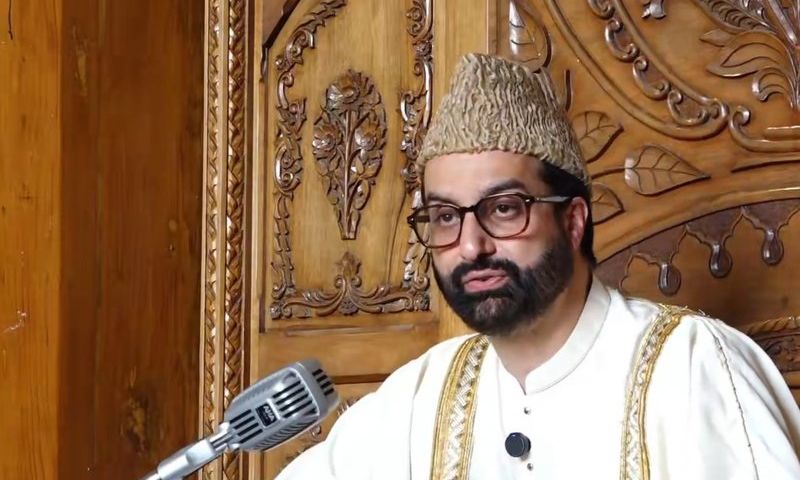
ISLAMABAD: Senior All Parties Hurriyat Conference (APHC) leader Mirwaiz Umar Farooq has rejected the banned Joint Awami Action Committee’s (JAAC) unconstitutional demands, saying no group has the authority to deprive Kashmiris of their constitutional right to vote, particularly refugees from Jammu and Kashmir living in Pakistan.
Mirwaiz said every genuine movement must uphold moral principles and respect constitutional rights. “JAAC cannot deprive Kashmiri people of their right to vote,” the APHC leader maintained.
“We feel that every real movement, when it reaches its logical conclusion, maintains a moral standard within itself,” Mirwaiz said in his address.
He maintained that the constitutional rights of Kashmiri refugees cannot be ignored.
“If we talk about rights, we should not forget that there are some constitutional rights that cannot be ignored.”
The APHC leader stressed that millions of refugees from Jammu and Kashmir are living in different provinces of Pakistan.
Mirwaiz said that a large number of these Kashmiri refugees have approached the Supreme Court to protect their rights.
He said nearly 300,000 Kashmiri refugees are those who have the right to vote and who have a constitutional status. “The constitutional status of such refugees cannot be ignored in any way.”
Mirwaiz Umar Farooq exposed the banned Action Committee’s contradictions, reminding them that every genuine movement must uphold moral principles and cannot ignore the constitutional rights of nearly 300,000 Kashmiri refugees pic.twitter.com/63lithQFjv
— Faisal (@faisalpak1stan) August 1, 2026
In June, the Supreme Court of Azad Jammu and Kashmir (AJK) ruled that the 12 seats reserved for refugees in the Legislative Assembly are constitutionally protected and cannot be altered through administrative measures, political agreements, or public pressure.
The 53-member AJK Legislative Assembly includes 12 seats reserved for Kashmiri refugees who migrated from Indian Illegally Occupied Jammu and Kashmir during the conflicts of 1947 and 1965 and are now settled across Pakistan.
Six seats represent refugees from the Jammu division, estimated at around 434,000 people, while six represent refugees from the Kashmir Valley, whose population is estimated at about 30,000.
In its opinion, the Supreme Court reaffirmed that the refugee seats are guaranteed under Article 22 of the AJK Constitution and are rooted in a long legislative history dating back to electoral arrangements introduced in 1960 and subsequent constitutional reforms in 1964 and 1970.
The court described the seats as a “constitutional expression of a profound historical and juridical truth” arising from the displacement of Kashmiris following the 1947 partition and subsequent conflict. It noted that the arrangement was further strengthened through successive legal instruments before being incorporated into the Constitution through the 13th Amendment.